
Now Reading: China hits 90 launches as Guowang deployment continues, Fengyun-4C heads to GEO
-
01
China hits 90 launches as Guowang deployment continues, Fengyun-4C heads to GEO


HELSINKI — China reached 90 orbital launches in 2025 with consecutive Long March missions deploying Guowang megaconstellation satellites and the advanced Fengyun-4C weather spacecraft.
A Long March 8A lifted off at 6:26 p.m. Eastern (2326 UTC) Dec. 25 from Hainan Commercial Space Launch Center on Hainan Island. The China Aerospace Science and Technology Corporation (CASC) announced the success of the launch, confirming the deployment of a 17th group of satellites for the national Guowang broadband megaconstellation.
Nine satellites were subsequently tracked by U.S. Space Force into roughly 910-kilometer-altitude orbits inclined by 50 degrees. CASC stated that its major spacecraft manufacturing arm, the China Academy of Space Technology (CAST), produced the satellites for the launch.
There are now 136 satellites in orbit for the planned 13,000-satellite Guowang constellation, a year on from the first batch of 10 launched on a Long March 5B rocket. The near-term target for Guowang is to have 400 satellites in orbit by 2027.
The Long March 8A is an upgraded variant of the standard Long March 8 and had its first flight in February this year, carrying the second Guowang constellation batch. It shares the same first stage and side boosters as the standard Long March 8 which debuted in 2020 but includes a newly designed 3.35-meter-diameter hydrogen-oxygen second stage, allowing a wider, 5.2-meter-diameter payload fairing. The 50.5-meter-long rocket can carry around 7,000 kilograms to 700-km Sun-synchronous orbit (SSO).
The Christmas Day mission was the sixth launch of the expendable Long March 8A, the production of which has been geared towards assisting the construction of Guowang, including ramping up production of YF-100 kerosene-liquid oxygen engines.
The launch was also the ninth of the year from the two pads at Hainan Commercial Space Launch Center, with the facilities helping to support China’s growing launch cadence. New Pads 3 and 4 are expected to be operational in the next year, hosting new commercial rockets as well as Long March rockets, allowing a greater number of launches.
Fengyun-4C
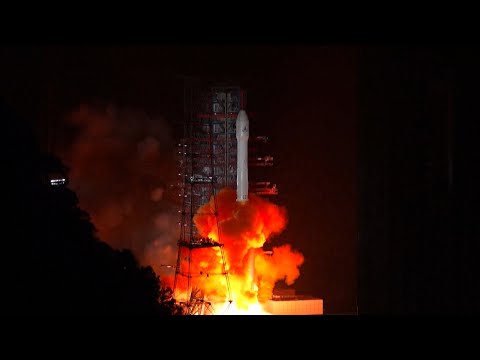
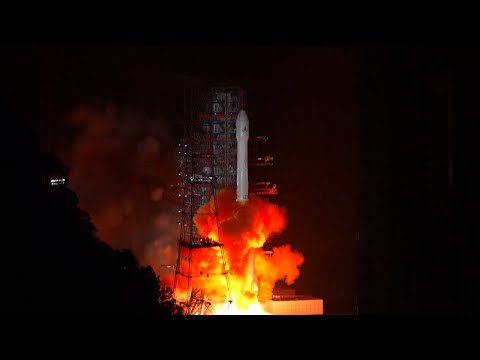
The 17th Guowang launch was followed by a Long March 3B lifting off at 11:07 a.m. Eastern (1607 UTC) Dec. 26 from Xichang Satellite Launch Center in the southwestern province of Sichuan, with the rocket climbing into a night sky above the hill-surrounded spaceport. CASC confirmed a successful launch into geosynchronous transfer orbit.
The 5,300-kilogram satellite is to settle at 133 degrees East in the geostationary belt, joining the earlier-launched new-generation Fengyun-4A and 4B in GEO. It carries a range of payloads and is primarily designed for short-term weather forecasting of typhoons and heavy rainstorms and space weather forecasting. It also features so-called “thruster on a stick” technology, in which an electric thruster module is mounted on a boom for station-keeping. Fengyun-4C is expected to operate into the mid-2030s.
The launches were China’s 89th and 90th of a record-breaking year for Chinese launch, far surpassing 2024’s previous record of 68 orbital launch attempts. Long March 4B and Long March 7A launches are scheduled for Dec. 30 (UTC) from Jiuquan and Wenchang spaceports respectively. Airspace notices for a debut commercial Ceres-2 solid rocket launch were issued for Dec. 27 but later removed.










Related Posts

Stay Informed With the Latest & Most Important News
Previous Post
Next Post

Advertisement
-
 01Two Black Holes Observed Circling Each Other for the First Time
 -
 02From Polymerization-Enabled Folding and Assembly to Chemical Evolution: Key Processes for Emergence of Functional Polymers in the Origin of Life
 -
 03Astronomy 101: From the Sun and Moon to Wormholes and Warp Drive, Key Theories, Discoveries, and Facts about the Universe (The Adams 101 Series)
 -
 04True Anomaly hires former York Space executive as chief operating officer
 -
 05Φsat-2 begins science phase for AI Earth images
 -
 06Hurricane forecasters are losing 3 key satellites ahead of peak storm season − a meteorologist explains why it matters
 -
 07Binary star systems are complex astronomical objects − a new AI approach could pin down their properties quickly