
Now Reading: HyPrSpace looks for applications beyond launch for its hybrid propulsion technology
-
01
HyPrSpace looks for applications beyond launch for its hybrid propulsion technology


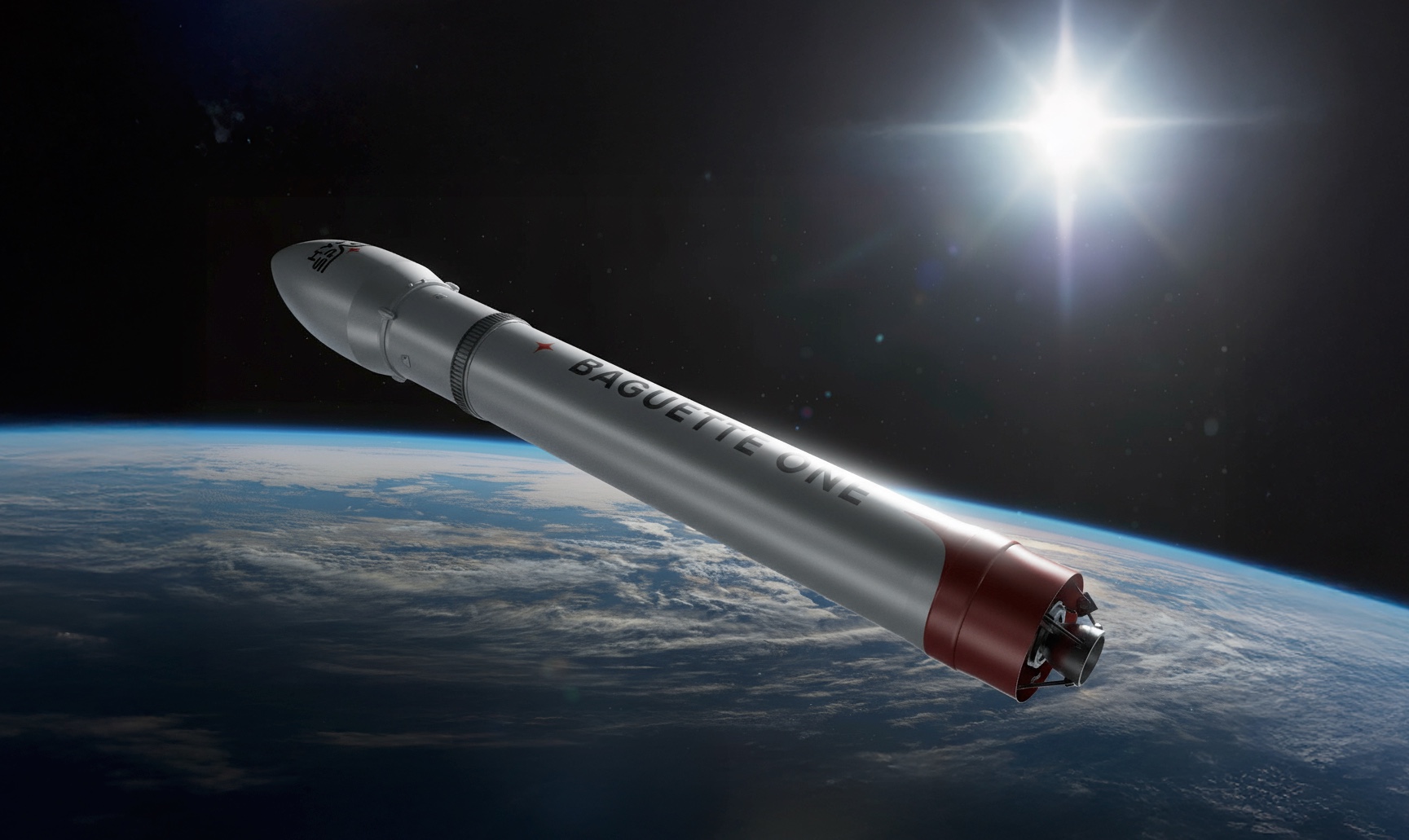

WASHINGTON — A French launch startup that recently closed a funding round is seeking defense applications for its hybrid propulsion technology.
HyPrSpace announced last month it closed a 21 million euro ($24.7 million) Series A funding round. The round, which the company said was oversubscribed, was led by venture capital firm Red River West and the DeepTech 2030 fund managed by the French public-sector investment bank Bpifrance on behalf of the French government.
HyPrSpace is developing a small launch vehicle called Orbital Baguette 1, or OB-1, capable of placing up to 235 kilograms into orbit. The company is also working on a suborbital vehicle, Baguette One, intended as a technology demonstrator for OB-1.
The Series A funding will allow HyPrSpace to complete development of Baguette One for a launch in the first half of 2026, said Sylvain Bataillard, a co-founder of the company, in a recent interview. The launch will take place from a French military base.
The hybrid rocket engine powering Baguette One will also be used on OB-1, he said. Several engines will power the first stage of the orbital rocket, while a single engine with a modified nozzle will be used on the second stage.
HyPrSpace is one of several companies worldwide pursuing hybrid propulsion, which combines a solid fuel with a liquid oxidizer. In theory, hybrid engines combine attributes of both solid- and liquid-propellant rockets, but they have gained little market traction beyond their use in Virgin Galactic’s suborbital spaceplanes. First launch attempts earlier this year by Gilmour Space Technologies’ Eris rocket and Innospace’s Hanbit-Nano, which both use hybrid engines in their first stages, failed shortly after liftoff.
“We are, of course, watching closely what they are doing,” Bataillard said of other companies working on hybrid propulsion. HyPrSpace is taking a different approach, he said, using a patented design that does not require turbopumps for the liquid oxidizer.
The fuel for the company’s engines is a plastic material also used in large water pipes. “It’s extremely simple, extremely cheap. It allows us to have a really infinite supply chain,” he said.
For its orbital vehicle, the company plans to use liquid oxygen as the oxidizer. However, HyPrSpace is also considering defense applications for its hybrid motors that would use other oxidizers.
“We are seeing a new surge in hybrid around the world, not so much for civil but rather mostly for defense applications,” Bataillard said, adding that the company has seen interest from defense agencies for uses beyond orbital launch. “We have a lot of new operational capabilities which could be really interesting.”
He did not elaborate on those opportunities, but said that for defense uses the company would consider oxidizers such as nitrous oxide or hydrogen peroxide, trading lower performance compared to liquid oxygen for storability.
For OB-1, HyPrSpace is planning a first launch attempt in late 2027, with the French space agency CNES as the customer. That schedule, he acknowledged, depends on the outcome of the Baguette One suborbital launch as well as the company’s ability to raise a Series B funding round planned for mid-2027.
The company is pursuing both commercial and government customers for OB-1, positioning the vehicle as an alternative to SpaceX rideshare missions for small satellites. “Every satellite manufacturer told me they are tired of launching with SpaceX,” Bataillard said. “We will never be cheaper than SpaceX when talking about price per kilogram to orbit, of course, but we aim for high-end customer service, which is apparently not the case with SpaceX.”
HyPrSpace is also seeking government launch opportunities with the European Commission and the European Space Agency, although Bataillard described those efforts as “longer and more complicated” than commercial business. He added that the French Space Command is interested in “reactive,” or responsive, launch capabilities that HyPrSpace could provide.
The company submitted a proposal to ESA for the European Launcher Challenge, or ELC, but was not among the five “preselected challengers” the agency announced in July. All five received at least partial funding at the ministerial conference in November.
“We were not really surprised by the results,” Bataillard said, noting that the French government had signaled it would likely support only one company, which turned out to be MaiaSpace, a spinoff of ArianeGroup.
“Our positioning regarding civil and defense use cases means that it’s not a catastrophe for us,” he said of not being selected for the ELC. “We still succeeded in fundraising a few months after not being selected for the ELC. Our investors understood that with our technology, we are something different than the classic liquid-propulsion launcher company. I think we would never have been able to fundraise if we had a standard technical solution.”










Related Posts

Stay Informed With the Latest & Most Important News
Previous Post
Next Post




Advertisement
-
 01Two Black Holes Observed Circling Each Other for the First Time
 -
 02From Polymerization-Enabled Folding and Assembly to Chemical Evolution: Key Processes for Emergence of Functional Polymers in the Origin of Life
 -
 03Astronomy 101: From the Sun and Moon to Wormholes and Warp Drive, Key Theories, Discoveries, and Facts about the Universe (The Adams 101 Series)
 -
 04True Anomaly hires former York Space executive as chief operating officer
 -
 05Φsat-2 begins science phase for AI Earth images
 -
 06Hurricane forecasters are losing 3 key satellites ahead of peak storm season − a meteorologist explains why it matters
 -
 07Binary star systems are complex astronomical objects − a new AI approach could pin down their properties quickly