
Now Reading: China caps record year for orbital launches with Tianhui-7 and Shijian-29 technology test missions
-
01
China caps record year for orbital launches with Tianhui-7 and Shijian-29 technology test missions

China caps record year for orbital launches with Tianhui-7 and Shijian-29 technology test missions

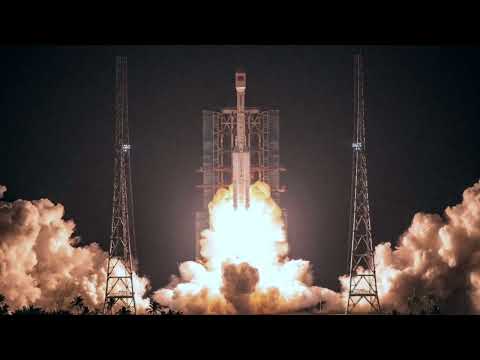
HELSINKI — China reached 92 orbital launches in 2025 with back-to-back missions this week, capping a record year for both the country and the global space sector.
The launches see global orbital launch attempts reach more than 320, not including an incident involving a Kuaizhou rocket on the pad at Jiuquan, far surpassing the 259 launch attempts in 2024. This means a new global record has been set for the fifth consecutive year, far eclipsing the records set by the peak launch rates of the Cold War era.
Final launches of China’s year began late Dec. 29, with a Long March 4B—an older, hypergolic rocket—lifting off at 11:12 p.m. Eastern (0412 UTC, Dec. 30) from the Jiuquan Satellite Launch Center in the Gobi Desert. The China Aerospace Science and Technology Corporation (CASC) revealed the payload to be the Tianhui-7 remote sensing satellite in a post-launch statement.
Tianhui, roughly translating to “sky drawing,” is a remote sensing and mapping satellite series for likely both civilian and military applications. There are few details regarding the sensors and payloads for Tianhui-7, with CASC describing it as mainly for tasks such as geographic information mapping, land resource surveys and scientific experimental research.
The satellite’s manufacturer, CASC’s China Academy of Space Technology (CAST), stated post-launch that Tianhui-7’s core payload is designed to “achieve world-class resolution and precision.” Payload heat dissipation was identified as a mission-critical design driver, linked directly to high-resolution imaging, while also revealing that the CAST team rejected a mature, lower-risk solution in favor of a new, unproven technical architecture because it offered better imaging performance.
The satellite was tracked in a roughly circular 485-kilometer-altitude sun synchronous orbit.
Shijian-29 A and B
Tianhui-7 was followed less than a day later by China’s final launch of the year. A Long March 7A lifted off at 5:40 p.m. Eastern (2240 UTC) Dec. 30 from the coastal Wenchang Satellite Launch Center on the southern island province of Hainan.
CASC revealed the launch to carry the Shijian-29 A and B satellites when announcing launch success. The pair are described as being used mainly to “conduct verification tests of new technologies for space target detection.” This broad definition could refer to space situational awareness (SSA) purposes. Shiyan-12 (01) and (02), launched on a Long March 7A in 2021, are thought to be both technology pathfinders and geostationary SSA assets.
Little is known about the satellites, as is typical for the Shijian series, which includes a diverse array of spacecraft used variously to conduct experiments, test new technologies and verify operational practices on orbit. Two satellites in the series this year conducted pioneering refueling tests around the geostationary belt.
CASC stated that Shijian-29 A was built by the corporation’s Shanghai Academy of Spaceflight Technology (SAST), while Microsat under the Chinese Academy of Sciences (CAS) stated it provided satellite B.
The pair are likely headed for geostationary transfer orbit, given the launch vehicle and airspace closure notices, though this was not confirmed by orbital tracking at time of launch. The Long March 7A has, exceptionally, also sent satellites into medium Earth orbits with the Yaogan-45 and Yaogan-46 missions.
China’s 2025 launch record
The launches were China’s 91st and 92nd orbital launch attempts of 2025, far surpassing its previous record of 68, set in 2024. There were just two failures, seeing the loss of a Zhuque-2E methalox rocket (Landspace) and a Ceres-1 solid rocket (Galactic Energy).
A big driver for China’s growing launch cadence was the country’s two megaconstellations, Guowang and Qianfan/Thousand Sails. There were 16 launches for the former alone, as China seeks to construct its own commercial and strategic response to Starlink and other systems. Also helping to facilitate the growth in launches was the new Hainan commercial spaceport—also expected to see pads 3 and 4 come online in 2026—and the expansion of a commercial zone at Jiuquan spaceport.
Jiuquan hosted 33 launches, up from 21 last year, while Wenchang and Hainan accelerated from nine launches to 21, eclipsing the 19 launches from Xichang in southwest China. There was also a relative drop in reliance on older, hypergolic Long March 2, 3 and 4 series rockets, with newer kerosene rockets including the Long March 5, 6, 7 and 8 series being used more regularly and with much greater payloads in terms of mass.
CASC claimed overall responsibility for 73 of the launches, with the rest performed by state-spinoffs Expace and CAS Space, and commercial launch service providers Galactic Energy, Landspace, iSpace and Orienspace. Three new rockets had debut launches in 2025, namely the Long March 8A—which has now flown five times—Landspace’s Zhuque-3 and the Long March 12A.
The latter two notably marked China’s first two attempts at recovering an orbital booster. While recovery attempts failed, both second stages (without payloads) successfully reached orbit. Landspace has indicated that it is targeting April 2026 for a second launch.
Several other rockets were potentially set for 2025 debuts, but a number of these have slipped into early 2026. These include the Kinetica-2 (CAS Space), Pallas-1 (Galactic Energy), Tianlong-3 (Space Pioneer), Hyperbola-3 (iSpace) and Nebula-1 (Deep Blue Aerospace).
One of the areas of major progress for China in 2025 was hardware tests for its crewed lunar ambitions, with further milestones expected imminently. The Long March 10A rocket is expected to debut in 2026.











Related Posts
Stay Informed With the Latest & Most Important News
Previous Post
Next Post


Advertisement
-
 01Two Black Holes Observed Circling Each Other for the First Time
 -
 02From Polymerization-Enabled Folding and Assembly to Chemical Evolution: Key Processes for Emergence of Functional Polymers in the Origin of Life
 -
 03Astronomy 101: From the Sun and Moon to Wormholes and Warp Drive, Key Theories, Discoveries, and Facts about the Universe (The Adams 101 Series)
 -
 04True Anomaly hires former York Space executive as chief operating officer
 -
 05Φsat-2 begins science phase for AI Earth images
 -
 06Hurricane forecasters are losing 3 key satellites ahead of peak storm season − a meteorologist explains why it matters
 -
 07Binary star systems are complex astronomical objects − a new AI approach could pin down their properties quickly