
Now Reading: Recent Production Rates Of Cosmogenic Nuclides In The Igneous Rocks of Jezero Crater Floor, Mars
-
01
Recent Production Rates Of Cosmogenic Nuclides In The Igneous Rocks of Jezero Crater Floor, Mars

Recent Production Rates Of Cosmogenic Nuclides In The Igneous Rocks of Jezero Crater Floor, Mars

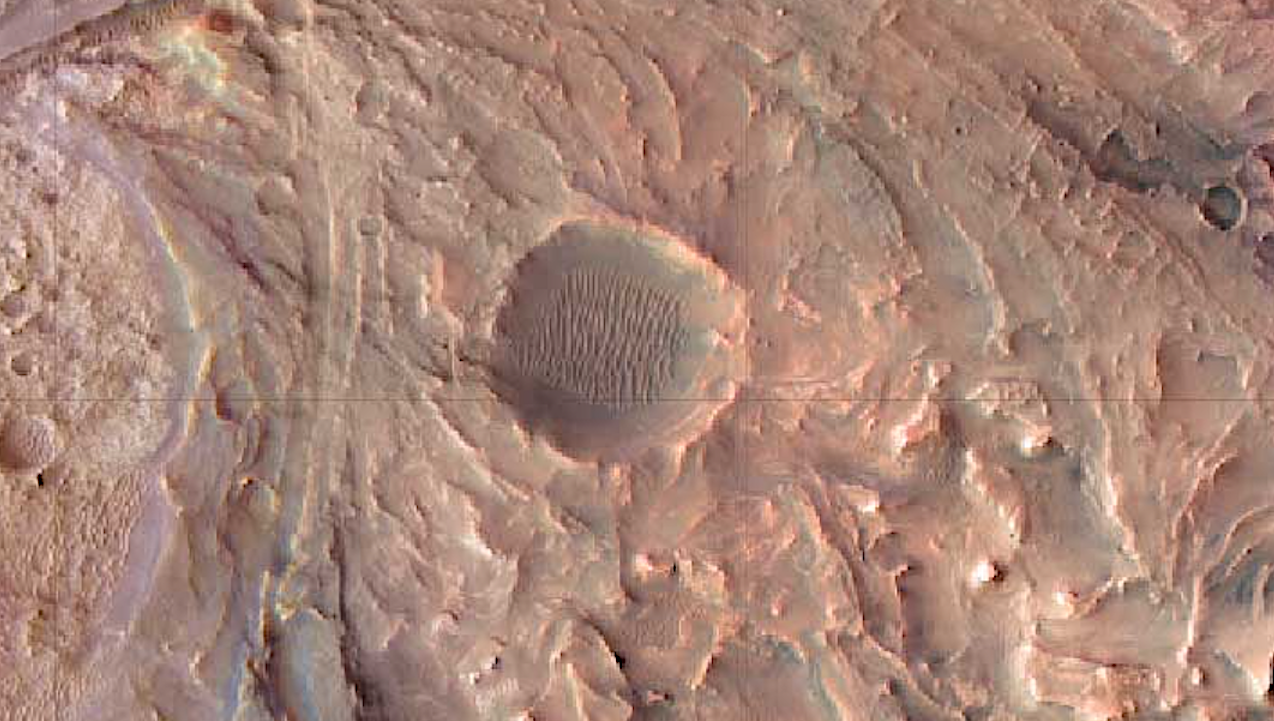
The Perseverance rover has collected rock samples from the floor of Jezero crater, Mars, set to be returned to Earth through the Mars Sample Return (MSR) mission. These surface rocks are continuously bombarded by cosmic rays, resulting in the formation of cosmogenic nuclides.
To accurately date these rocks and understand past geological events, precise estimates of nuclide production rates are essential.
Here, we simulate neutron-induced cosmogenic nuclide production in the igneous rocks of Jezero crater using neutron flux data from the radiation assessment detector (RAD) and rock compositions from the planetary instrument for X-ray lithochemistry (PIXL).
Our calculations focus on stable and long-lived isotopes up to Z = 27 (Co) over an exposure period of 100,000 years (0.1 Ma). The highest yields are observed for 1H and 4He, followed by 12C, 13C, 15N, 23Na, 27Al and 36Cl.
We show that the predicted cumulative production over 0.1 Ma of long-lived radionuclides such as 10Be (T1/2 = 1.39 Ma), 26Al) (0.72 Ma), 36Cl (0.301 Ma), and 41Ca (0.104 Ma) reaches ~ 108–109 nuclei per gram, a concentration well within the detection limits of current accelerator mass spectrometry (AMS) techniques.
We project the impact of extended cosmic radiation exposure (1.4 billion years) on isotopic ratios, showing significant shifts in δ13C and δ15N values, whose correct interpretation is critical for astrobiology.
These calculations can help define the instrumentation requirements for the future analysis of the Martian samples on Earth, ensuring accurate interpretation and helping to distinguish radiation effects from other planetary and biological cycles.
Astrobiology, Astrochemistry,











Related Posts
Stay Informed With the Latest & Most Important News



Advertisement
-
 01Two Black Holes Observed Circling Each Other for the First Time
 -
 02From Polymerization-Enabled Folding and Assembly to Chemical Evolution: Key Processes for Emergence of Functional Polymers in the Origin of Life
 -
 03Astronomy 101: From the Sun and Moon to Wormholes and Warp Drive, Key Theories, Discoveries, and Facts about the Universe (The Adams 101 Series)
 -
 04True Anomaly hires former York Space executive as chief operating officer
 -
 05Φsat-2 begins science phase for AI Earth images
 -
 06Hurricane forecasters are losing 3 key satellites ahead of peak storm season − a meteorologist explains why it matters
 -
 07Binary star systems are complex astronomical objects − a new AI approach could pin down their properties quickly