
Now Reading: Lava Tubes On Earth, the Moon, And Mars: Detection, Evolution, And Exploration Potential
-
01
Lava Tubes On Earth, the Moon, And Mars: Detection, Evolution, And Exploration Potential

Lava Tubes On Earth, the Moon, And Mars: Detection, Evolution, And Exploration Potential

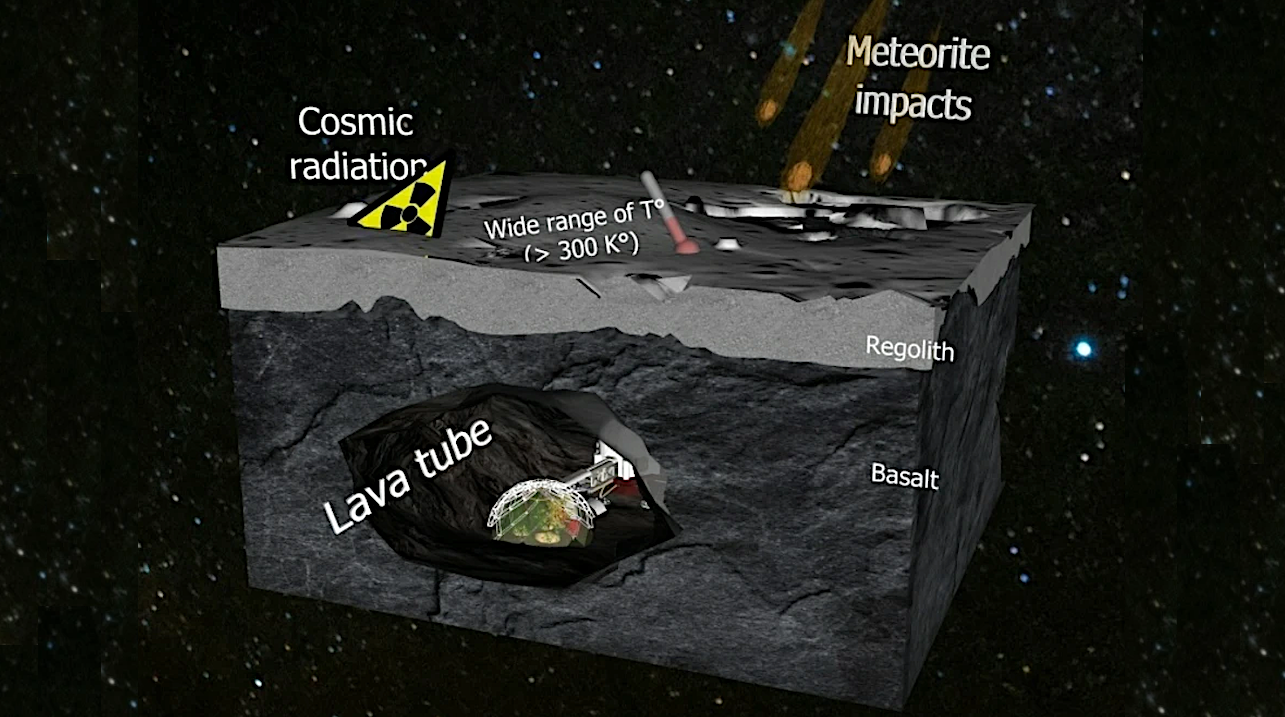
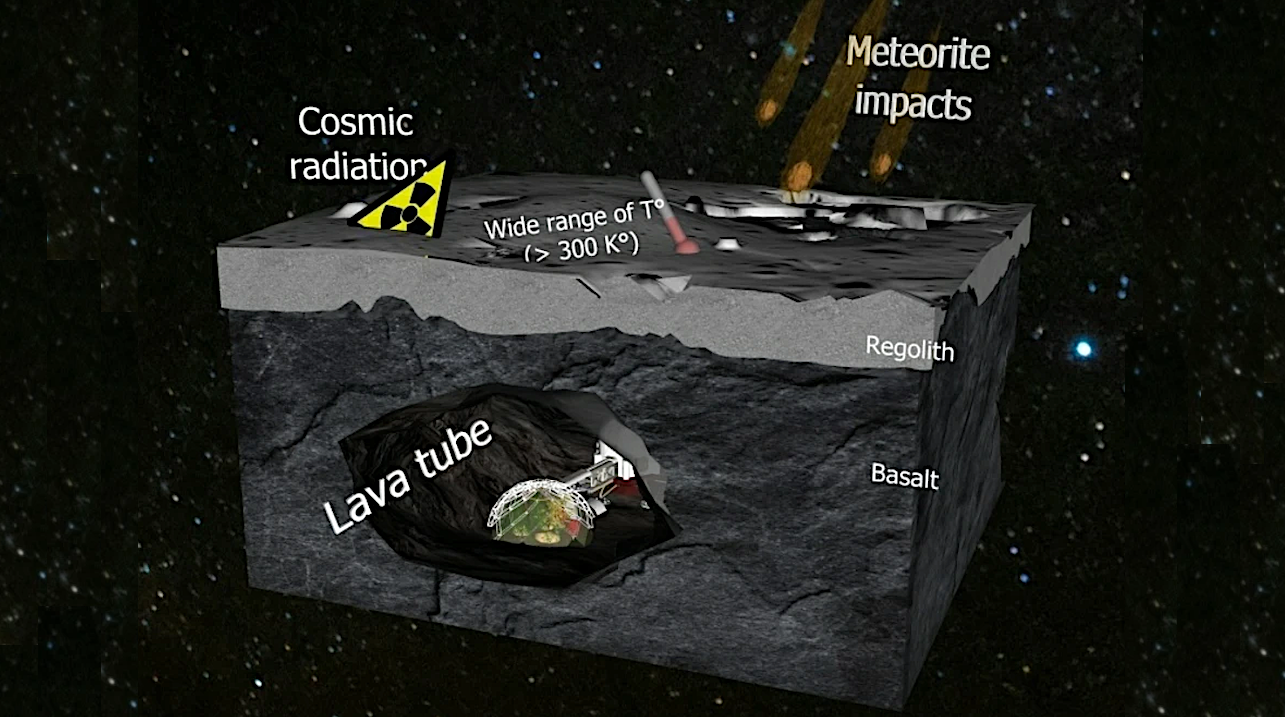
Conceptual illustration of a potential human base inside a lunar lava tube, located within the basaltic crust. The lava tube offers natural protection from major surface hazards such as cosmic radiation, extreme temperature fluctuations, and meteorite impact. — Space Science Reviews
Lava tubes, or subsurface conduits formed by volcanic activity, have emerged as critical geological features for understanding planetary evolution and for supporting future human space exploration.
This paper provides an integrated review of the formation, morphology, and preservation of lava tubes on Earth, the Moon, and Mars, emphasizing their geological significance and habitability potential.
We discuss the processes responsible for their genesis, including overcrusting, shallow inflation, and deep inflation and thermal/mechanical erosion, as well as their cross-sectional and network-scale morphologies. Our synthesis suggests that deep inflation and thermal/mechanical erosion along weak horizons is the most plausible mechanism for kilometer-scale tubes on the Moon and Mars, while any of these mechanisms may operate at smaller scales.
This review also highlights how differences in gravity, tectonic activity, and erosional forces across planetary bodies affect lava tube dimensions and preservation. While terrestrial lava tubes have been extensively mapped and modeled using geophysical methods, the detection of lunar and Martian analogs relies on remote sensing, gravity data, and image-based analysis.
The structural integrity and environmental stability of these tubes make them prime candidates for safe, long-term extraterrestrial habitats, offering natural protection from cosmic radiation, temperature extremes, and surface hazards. Additionally, lava tubes preserve stratigraphic, geochemical, and possibly biological records, making them valuable targets for planetary science, astrobiology, and future robotic or human missions.
- Lava Tubes on Earth, the Moon, and Mars: Detection, Evolution, and Exploration Potential, Space Science Reviews via x-mol.net
- Lava Tubes on Earth, the Moon, and Mars: Detection, Evolution, and Exploration Potential, Space Science Reviews
Astrobiology, Astrogeology,










Related Posts
Stay Informed With the Latest & Most Important News


Advertisement
-
 01Two Black Holes Observed Circling Each Other for the First Time
 -
 02From Polymerization-Enabled Folding and Assembly to Chemical Evolution: Key Processes for Emergence of Functional Polymers in the Origin of Life
 -
 03Astronomy 101: From the Sun and Moon to Wormholes and Warp Drive, Key Theories, Discoveries, and Facts about the Universe (The Adams 101 Series)
 -
 04True Anomaly hires former York Space executive as chief operating officer
 -
 05Φsat-2 begins science phase for AI Earth images
 -
 06Hurricane forecasters are losing 3 key satellites ahead of peak storm season − a meteorologist explains why it matters
 -
 07Binary star systems are complex astronomical objects − a new AI approach could pin down their properties quickly