
Now Reading: Dearth of Photosynthetically Active Radiation Suggests No Complex Life on Late M-Star Exoplanets
-
01
Dearth of Photosynthetically Active Radiation Suggests No Complex Life on Late M-Star Exoplanets

Dearth of Photosynthetically Active Radiation Suggests No Complex Life on Late M-Star Exoplanets

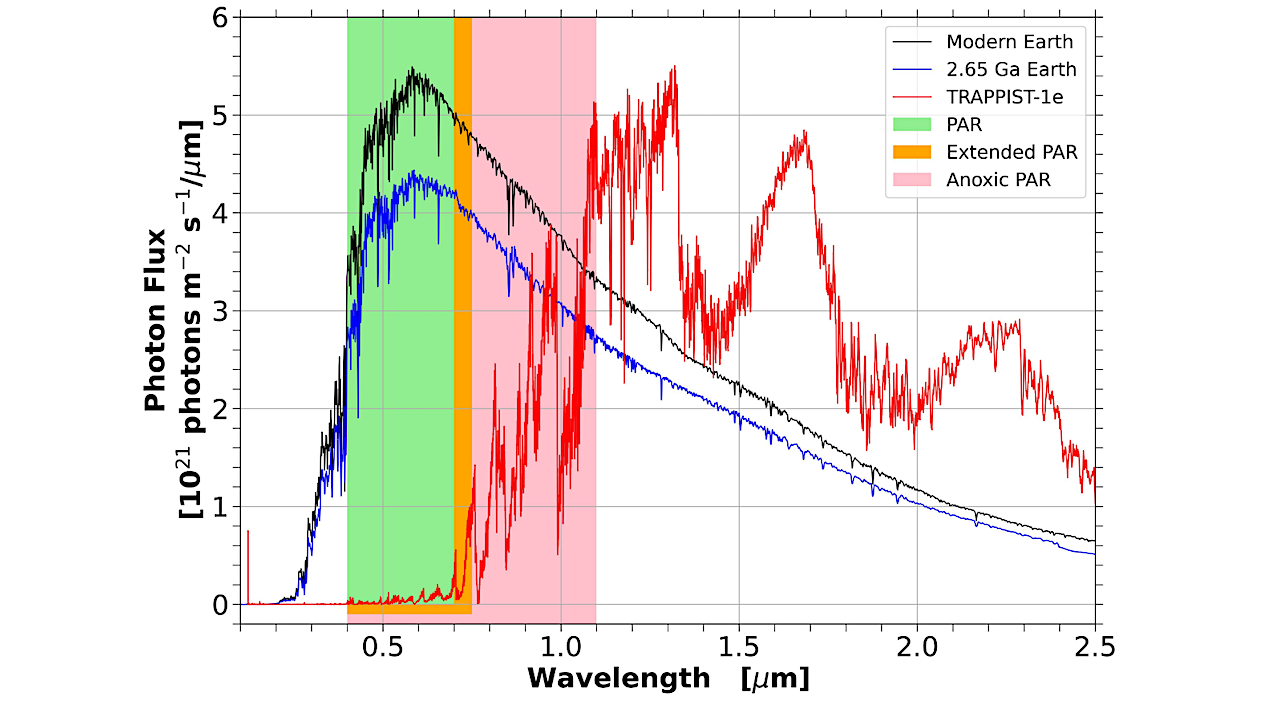
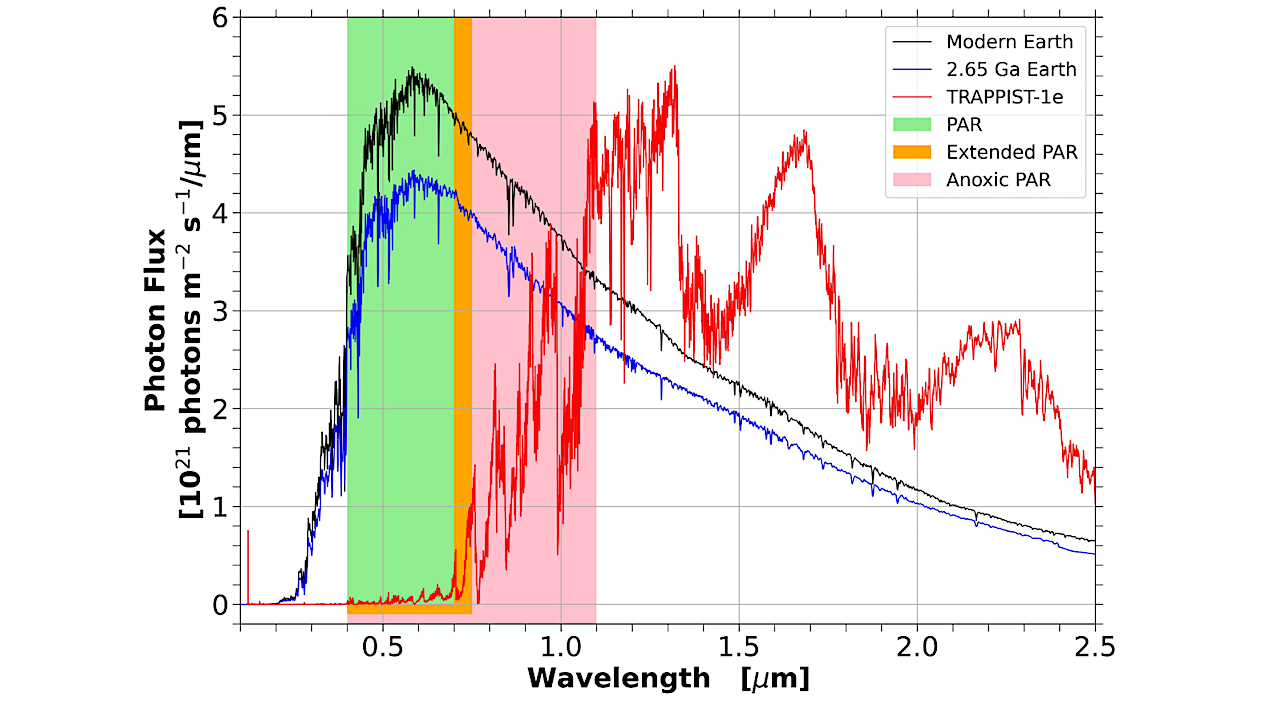
The incident photon flux density for the modern-day Earth (black), Archean Earth at 2.65 Ga (blue), and TRAPPIST-1e (red). The spectral resolution has been reduced for clarity. The shaded regions represents three relevant bandpasses for photosynthesis: standard PAR (0.40-0.70 µm), extended PAR (0.40-0.75 µm), and anoxic PAR (0.40-1.1 µm). — astro-ph.EP
The rise of oxygen in the Earth’s atmosphere during the Great Oxidation Event (GOE) occurred about 2.3 billion years ago. There is considerably greater uncertainty for the origin of oxygenic photosynthesis, but it likely occurred significantly earlier, perhaps by 700 million years.
Assuming this time lag is proportional to the rate of oxygen generation, we can estimate how long it would take for a GOE-like event to occur on a hypothetical Earth-analog planet orbiting the star TRAPPIST-1 (a late M star with Teff 2560 K). Although in the habitable zone, an Earth-analog planet located in TRAPPIST-1e’s orbit would receive only 0.9% of the Photosynthetically Active Radiation (PAR) that the Earth gets from the Sun.
This is because most of the star’s light is emitted at wavelengths longer than the 400-700 nm PAR range. Thus it would take 63 Gyrs for a GOE to occur. But the linear assumption is problematic; as light levels increase, photosynthesis saturates then declines, an effect known as photoinhibition.
Photoinhibition varies from species to species and depends on a host of environmental factors. There is also sensitivity to the upper wavelength limit of the PAR: extending just 50 nm increases the number of photons by a factor of 2.5. Including these and other factors greatly reduces the timescale to roughly 1-5 Gyrs for a GOE. However, non-oxygenic photosynthetic bacteria can thrive in low-light environments and can use near-IR light out to 1100 nm, providing 22 times as many photons.
With this huge light advantage, and because they evolved earlier, anoxygenic photosynthesizers would likely dominate the ecosystem. On a late M-star Earth-analog planet, oxygen may never reach significant levels in the atmosphere and a GOE may never occur, let alone a Cambrian Explosion. Thus complex animal life is unlikely.
Joseph J. Soliz, William F. Welsh
Comments: 38 pages, 3 figures, 2 tables
Subjects: Earth and Planetary Astrophysics (astro-ph.EP)
Cite as: arXiv:2601.02548 [astro-ph.EP](or arXiv:2601.02548v1 [astro-ph.EP] for this version)
https://doi.org/10.48550/arXiv.2601.02548
Focus to learn more
Submission history
From: William Welsh
[v1] Mon, 5 Jan 2026 20:49:01 UTC (1,870 KB)
https://arxiv.org/abs/2601.02548
Astrobiology











Related Posts

Stay Informed With the Latest & Most Important News
Previous Post
Next Post


Advertisement
-
 01Two Black Holes Observed Circling Each Other for the First Time
 -
 02From Polymerization-Enabled Folding and Assembly to Chemical Evolution: Key Processes for Emergence of Functional Polymers in the Origin of Life
 -
 03Astronomy 101: From the Sun and Moon to Wormholes and Warp Drive, Key Theories, Discoveries, and Facts about the Universe (The Adams 101 Series)
 -
 04True Anomaly hires former York Space executive as chief operating officer
 -
 05Φsat-2 begins science phase for AI Earth images
 -
 06Hurricane forecasters are losing 3 key satellites ahead of peak storm season − a meteorologist explains why it matters
 -
 07Binary star systems are complex astronomical objects − a new AI approach could pin down their properties quickly