
Now Reading: Interplanetary science needs a commercial backbone
-
01
Interplanetary science needs a commercial backbone


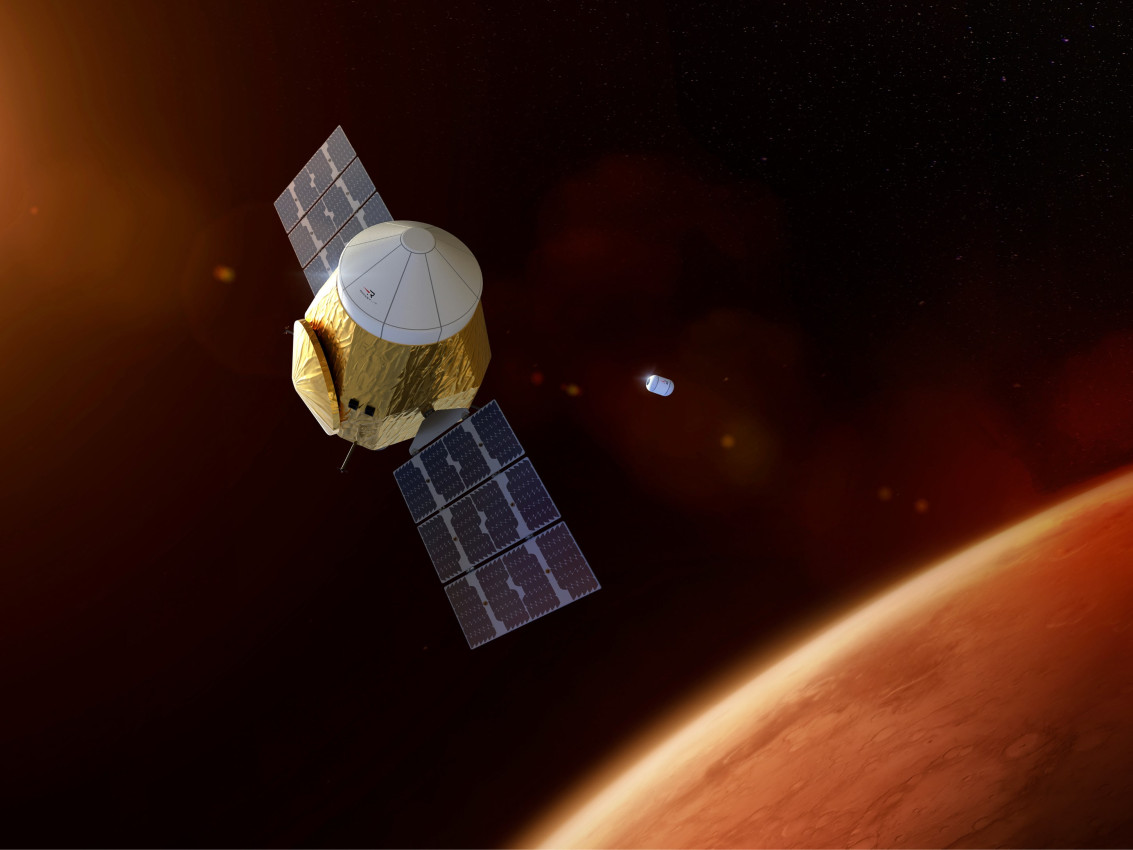

We are in an era where planetary science no longer depends on government missions. Commercial capabilities are mature and ready to deliver a higher cadence of planetary exploration that fits within proposed budgets. What’s missing is an operational model that matches ambition.
The old way — one in which bespoke, government-run missions with decade-long development cycles and billion-dollar budgets that don’t scale — does not serve U.S. geopolitical needs, and it will not lay the groundwork for human missions to Mars. Industry is prepared to deploy commercial spacecraft beyond Earth orbit to achieve decadal science on timelines that would have been unthinkable a decade ago.
If it takes 10 years and more than $1 billion to launch a single planetary flagship mission, we will never build the dynamic, responsive exploration programs the future requires. Science slows and the next generation of space professionals lose their chance to build and fly missions.
It’s time for a new operational model that leverages industry’s capabilities. Imagine 10 missions at $100 million each, launched in half the time, producing more science at lower cost, with a new generation of scientists and engineers shaping discoveries. The result is more science, strengthened U.S. global leadership and faster progress toward human exploration.
From flagships to regular flights
Missions like NASA’s Escape and Plasma Acceleration and Dynamics Explorers (ESCAPADE) dual spacecraft mission proved that lean researcher-led teams can deliver decadal-class science on ambitious schedules. Rocket Lab delivered ESCAPADE from concept to launch in less than three and a half years. That speed and discipline should become the norm.
ESCAPADE succeeded because NASA set clear budget expectations, used a firm fixed-price spacecraft contract, procured a commercial launch and delegated decision authority and risk management to the teams doing the work. The university–industry partnership functioned as a single team that made decisions quickly with efficient concurrence from NASA. The lesson is simple: build to budget, deliver on schedule, fly every window.
Build, deliver, fly, scale
Planetary exploration shouldn’t be limited to missions that cost billions and take decades. It should be routine, affordable, ambitious and scalable in the face of budget pressure.
We can hit every planetary launch window and address broad science targets while moving missions from contract to launch in 24 to 30 months. That expectation requires a shift away from cost-plus development and toward fixed-price, risk-tolerant missions that rely on mature commercial capabilities.
The programs to do this already exist. NASA’s Small Innovative Missions for Planetary Exploration (SIMPLEx) program and the broader Explorers programs were built for high-cadence science, yet their pace has slowed as budgets have not kept up with demand or today’s capabilities. ESCAPADE was the last SIMPLEx mission selected and there has not been a new call since.
Leading sustained planetary exploration depends on regular funding and frequent calls for these programs. The commercial ecosystem is ready, but it needs a green light not just from policy leaders but also from procurement organizations.
Infrastructure is a mandatory next step
There’s a lot of energy right now around taking big leaps with deep-space missions, as sustained lunar activity and Mars exploration gain momentum. Commercial players are leading, but major leaps forward require infrastructure that does not yet exist.
High-bandwidth, low-latency communications are a baseline requirement, not a nice-to-have. It’s essential not only for future human missions, but for near-term priorities like enabling the return of NASA’s curated Martian samples ahead of China. Mars Sample Return shows exactly why the old approach doesn’t work: $11 billion and two decades was never going to fly. A commercial path can deliver the same outcome by 2031 for $4 billion under a firm-fixed priced contract. It’s hard, yes, but industry is ready, and if we want U.S. leadership in space, this is how we show it.
These are hard problems — but solving hard problems is exactly what commercial space was built for. If the U.S. wants to lead the next era of exploration, it’s time to let industry lead.
For example, deep-space exploration needs modern communication and support architecture that is reliable, affordable and high bandwidth. Human missions to Mars start with communications. A commercial Mars Telecommunications Orbiter (MTO) could deliver that capability quickly and affordably while also enabling a near-term priority: helping to return NASA’s curated Mars samples before China returns its own.
What can be done now
NASA doesn’t need to reinvent the wheel for planetary exploration. It just needs it rolling more smoothly. Here’s how:
- Fund small planetary missions like the SIMPLEx and Explorer programs on a regular cadence.
- Broadly adopt firm fixed price contracting approaches across science.
- Streamline decision making and empower industry and university teams to execute quickly.
- Update risk classifications to reflect the maturity of today’s commercial systems.
- Invest in enabling infrastructure that supports both science and humans to Mars.
- Let industry lead a time-critical, cost-constrained program to return Mars samples before China.
Looking ahead: what 2026 can and should deliver
By the end of 2026, the question should not be whether commercial space can accelerate planetary science. The evidence should be visible in missions headed for the moon, Mars and beyond.
Let’s make 2026 the year we turn commercial momentum into standard operating practice. That means regular calls for SIMPLEx and Explorer-class planetary missions, wide adoption of fixed-price contracts for science, ambitious timelines and full development of infrastructure like a Mars Telecommunications Orbiter.
Most of all, 2026 should mark a shift in mindset: if we want the U.S. to lead the next era of space exploration, not just participate, commercial teams must be given the chance to compete and to lead.
The operating model exists. The proof is already in space. NASA’s commercial partners are ready to execute more. Now is the time to align budgets and policy to match ambition. The country can move further, faster and more affordably with a commercial foundation built for scale.
The roadmap is clear. 2026 is the year to follow it.
Sir Peter Beck is the founder, President and Chief Executive Officer of Rocket Lab Corporation
This article first appeared in the January 2026 issue of SpaceNews Magazine.
SpaceNews is committed to publishing our community’s diverse perspectives. Whether you’re an academic, executive, engineer or even just a concerned citizen of the cosmos, send your arguments and viewpoints to opinion (at) spacenews.com to be considered for publication online or in our next magazine. If you have something to submit, read some of our recent opinion articles and our submission guidelines to get a sense of what we’re looking for. The perspectives shared in these opinion articles are solely those of the authors and do not necessarily represent their employers or professional affiliations.










Related Posts
Stay Informed With the Latest & Most Important News
Previous Post
Next Post





Advertisement
-
 01Two Black Holes Observed Circling Each Other for the First Time
 -
 02From Polymerization-Enabled Folding and Assembly to Chemical Evolution: Key Processes for Emergence of Functional Polymers in the Origin of Life
 -
 03Astronomy 101: From the Sun and Moon to Wormholes and Warp Drive, Key Theories, Discoveries, and Facts about the Universe (The Adams 101 Series)
 -
 04True Anomaly hires former York Space executive as chief operating officer
 -
 05Φsat-2 begins science phase for AI Earth images
 -
 06Hurricane forecasters are losing 3 key satellites ahead of peak storm season − a meteorologist explains why it matters
 -
 07Binary star systems are complex astronomical objects − a new AI approach could pin down their properties quickly