
Now Reading: The Persistent Thermal Anomalies In Rocky Worlds
-
01
The Persistent Thermal Anomalies In Rocky Worlds


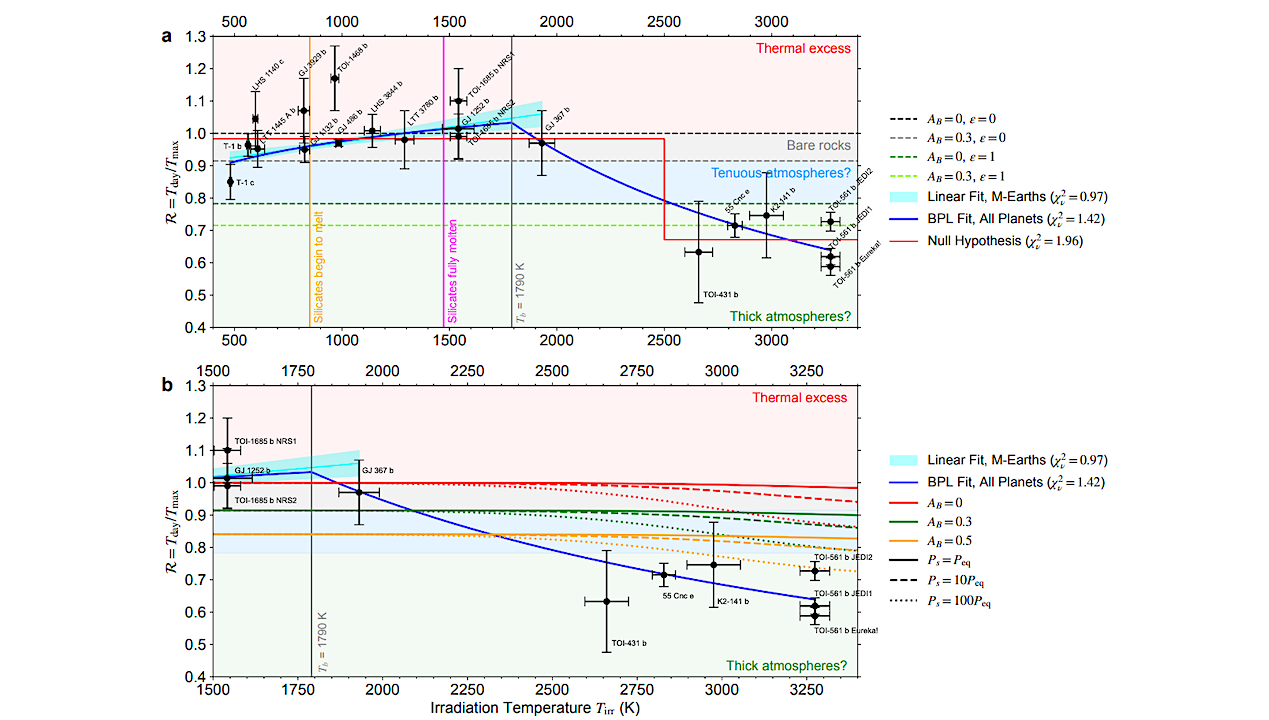
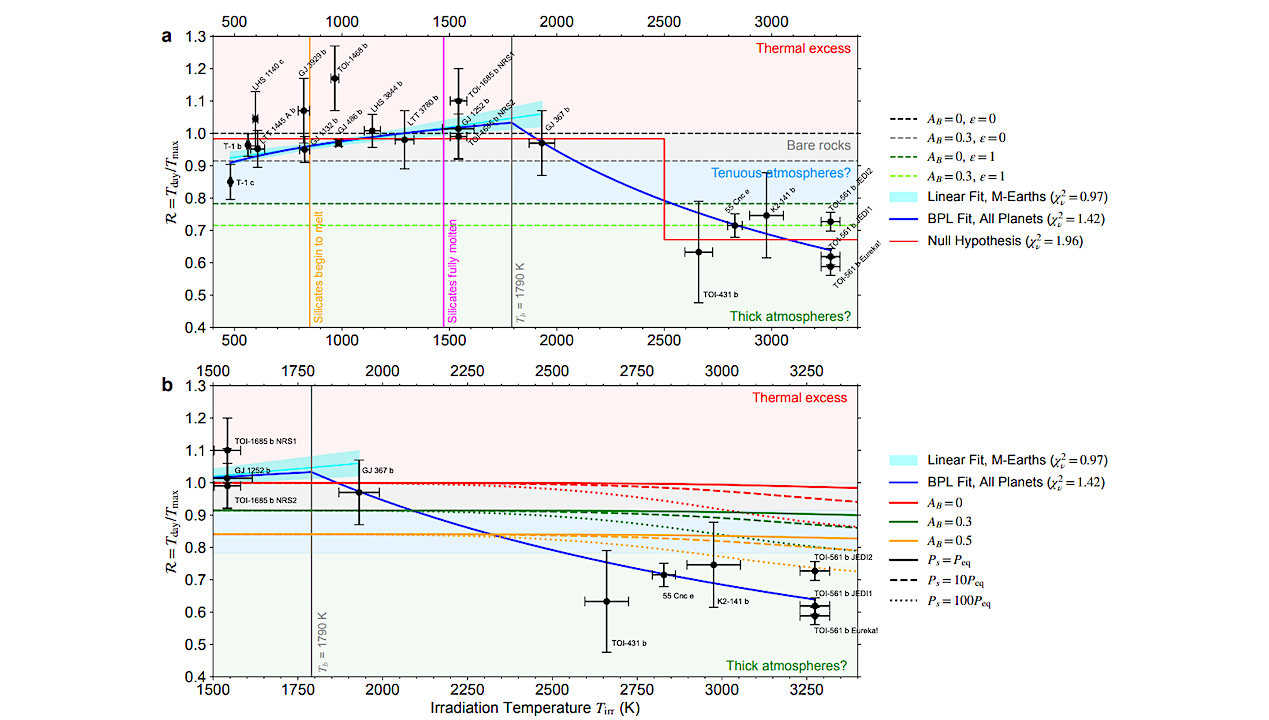
Dayside temperature scaling factor, R = Tday/Tday,max, as a function of irradiation temperature, Tirr, for (a) all observed rocky exoplanets and (b) planets with Tirr > 1500 K, which may have rock vapor atmospheres. Observed exoplanets (Table 1), excluding LHS 1478 b, are shown as black error bars. Two fits are shown: (cyan) linear fit for M-Earths shows a positive trend, while (blue) BPL fit shows a positive trend for M-Earths with Tirr Tb = 1790 K and a negative trend for five extremely hot planets with Tirr > Tb. Both fits are better than the null hypothesis (red line in panel a), suggesting an underlying physical mechanism that produces both thermal emission excess and deficit. In (a), the melting temperatures of silicates (orange and magenta vertical lines) are annotated. In (b), R of exoplanets with rock vapor atmospheres derived from a scaling relation (D. D. B. Koll 2022) are shown in red, green, and orange for surface Bond albedo of 0, 0.3, and 0.5, respectively. Thick atmospheres with Ps much greater than the equilibrium pressure Peq are required to explain the observed thermal deficit. — astro-ph.EP
Observing the dayside thermal emissions of rocky exoplanets provides essential insights into their compositions and the presence of atmospheres.
Even though no conclusive evidence has been found for atmospheres on small rocky exoplanets orbiting M dwarfs, recent JWST observations identified puzzling thermal emission excesses: some rocky exoplanets orbiting M dwarfs have dayside emission temperatures higher than the theoretical maximum.
Theoretical maximum temperatures assume stellar irradiation as the sole energy source, implying that these planets may have internal heat sources. In this work, we simulate three possible planetary internal processes that may generate excessive heat in addition to stellar irradiation: residual heating from formation, tidal heating, and induction heating due to interactions with the stellar magnetic field.
We found that these mechanisms, even when combined, cannot explain the observed thermal emission excesses, nor can they explain a tentative positive trend in the brightness temperature scaling factor as a function of irradiation temperature.
Our results imply that planetary internal processes are unlikely to generate remotely detectable heat, so the observed thermal excesses, if astrophysical, are likely caused by stellar contamination, surface processes, or other internal processes not considered in this study. The ongoing JWST-HST Rocky Worlds Director’s Discretionary Time Program and the upcoming Nancy Grace Roman Space Telescope will provide more insights into the thermal emission of rocky exoplanets.
Zifan Lin, Tansu Daylan
Comments: 19 pages, 11 figures, 1 table, submitted to the AAS journals
Subjects: Earth and Planetary Astrophysics (astro-ph.EP)
Cite as: arXiv:2601.00412 [astro-ph.EP] (or arXiv:2601.00412v1 [astro-ph.EP] for this version)
https://doi.org/10.48550/arXiv.2601.00412
Focus to learn more
Submission history
From: Zifan Lin
[v1] Thu, 1 Jan 2026 17:59:01 UTC (2,259 KB)
https://arxiv.org/abs/2601.00412
Astrobiology, Astrogeology, exoplanet,











Related Posts
Stay Informed With the Latest & Most Important News
Previous Post
Next Post


Advertisement
-
 01Two Black Holes Observed Circling Each Other for the First Time
 -
 02From Polymerization-Enabled Folding and Assembly to Chemical Evolution: Key Processes for Emergence of Functional Polymers in the Origin of Life
 -
 03Astronomy 101: From the Sun and Moon to Wormholes and Warp Drive, Key Theories, Discoveries, and Facts about the Universe (The Adams 101 Series)
 -
 04True Anomaly hires former York Space executive as chief operating officer
 -
 05Φsat-2 begins science phase for AI Earth images
 -
 06Hurricane forecasters are losing 3 key satellites ahead of peak storm season − a meteorologist explains why it matters
 -
 07Binary star systems are complex astronomical objects − a new AI approach could pin down their properties quickly