
Now Reading: Debate Erupts Over Roswell Incident and Project Mogul Implications
-
01
Debate Erupts Over Roswell Incident and Project Mogul Implications


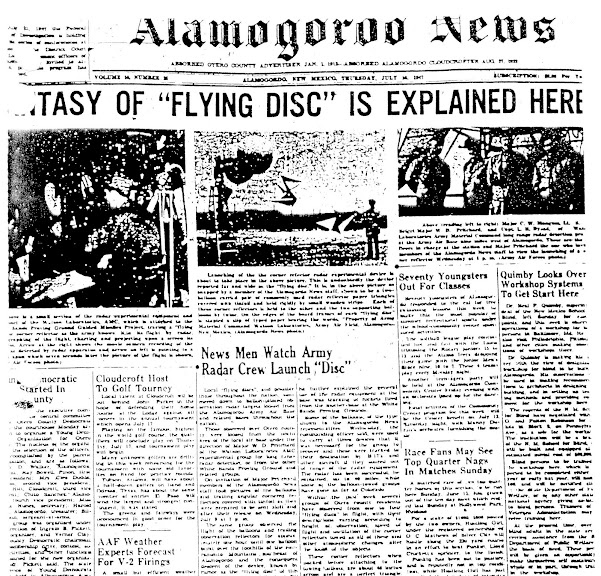

In the complex tapestry of the Roswell incident, one cannot overlook the substantial ramifications of Project Mogul, particularly when discussing the narratives presented by Gilles and Bamm Bamm Bahama. Their conclusions invoke a fervent debate that extends beyond mere speculation, plunging into the heart of the nature of classified information and its implications on historical accounts.
First, let us consider the essence of classified materials and the alleged top-secret nature of Mogul flights. Gilles rightly points out that top-secret operations typically do not commence with publicized images in newspapers. The dissemination of materials related to the New York University balloon project, which was part of the Mogul initiative, raises critical questions. If the photographs circulated widely, as they did shortly after the events of July 1947, one must question the actual classification of the experiments being conducted in New Mexico.
Understanding the dynamics of secrecy requires a deep dive into the classification protocols of the 1940s. Documentation from that era, or lack thereof, often provides the clearest insight into what remained obscured from the public eye. As Gilles asserts, the absence of classification markings on the existing documents implies a lack of secrecy surrounding the balloon flights. When reviewing military protocol, one sees that unclassified projects do not warrant stringent documentation practices that would typically accompany highly classified missions.
Moreover, the intricate details shared by Gilles regarding Albert Crary’s diary offer an important perspective on operational methods at the time. The extraordinary measures noted for scrap recovery from the alleged crash sites suggest not only a deviation from standard procedures but also an absence of classified urgency. In typical operations, particularly ones deemed sensitive, measures taken to preserve evidence or recover materials generally reflect classified intentions, which seems absent here.
On the other hand, Bamm Bamm Bahama poses an intriguing challenge to Gilles’ narrative by questioning the motivations behind the photographic documentation of the debris. While it is true that the photographs may have served a dual purpose—both public relations and documentation—the suggestion that they were staged indicates a deeper level of deception possibly at play. However, Bamm Bamm Bahama seems to downplay the multifaceted objectives of the balloon project itself. The nuances of how Project Mogul aimed not merely at espionage but also at scientific advancement must be emphasized.
When discussing the real purpose behind Mogul’s balloon flights, there are historical precedents to consider. During World War II, Japan deployed balloon bombs, which were a form of aerial weapon that demonstrated how a constant-level balloon could possess various military applications. This historical context enriches the understanding of why such projects may have been pursued under the guise of scientific inquiry while having potential military implications.
Nevertheless, both Gilles and Bamm Bamm Bahama grapple with one pivotal point in their analyses: the existence of Flight #4. The critical evaluation of whether or not this flight ever launched is paramount; if it indeed did not occur, it raises the specter of alternative explanations for the debris discovered on the Foster ranch.
Witness testimonies about the recovery of materials provide a further layer of complexity. Bill Brazel’s account of a distinct gouge at the debris field and reports of multiple sites, corroborated by figures such as Brigadier General Arthur Exon, suggest a narrative that transcends the Mogul explanation. The suggestion of two sites complicates the assertion that a solitary balloon array could account for the debris found. This mosaic of witness accounts serves as a compelling backdrop for the possibility that the events surrounding Roswell were not simply an isolated incident involving Project Mogul.
As we dissect the assertions made by Gilles and Bamm Bamm Bahama, one is left with profound questions about the nature of evidence, witness reliability, and the implications of secrecy. The challenge lies in synthesizing these narratives, particularly in the context of historical classification practices and the repercussions of purported extraterrestrial encounters. To quote Sherlock Holmes, “When you have eliminated the impossible, whatever remains, however improbable, must be the truth.” In the case of Roswell, the truth may lie suspended in the delicate interplay of witness accounts, classified intentions, and historical context, urging us to remain open-minded as we seek understanding amidst the enigma.










Related Posts


Stay Informed With the Latest & Most Important News
Previous Post
Next Post


Advertisement
-
 01Two Black Holes Observed Circling Each Other for the First Time
 -
 02From Polymerization-Enabled Folding and Assembly to Chemical Evolution: Key Processes for Emergence of Functional Polymers in the Origin of Life
 -
 03Astronomy 101: From the Sun and Moon to Wormholes and Warp Drive, Key Theories, Discoveries, and Facts about the Universe (The Adams 101 Series)
 -
 04True Anomaly hires former York Space executive as chief operating officer
 -
 05Φsat-2 begins science phase for AI Earth images
 -
 06Hurricane forecasters are losing 3 key satellites ahead of peak storm season − a meteorologist explains why it matters
 -
 07Binary star systems are complex astronomical objects − a new AI approach could pin down their properties quickly