
Now Reading: Sub-Neptune Memories I: Implications of Inefficient Mantle Cooling and Silicate Rain
-
01
Sub-Neptune Memories I: Implications of Inefficient Mantle Cooling and Silicate Rain

Sub-Neptune Memories I: Implications of Inefficient Mantle Cooling and Silicate Rain

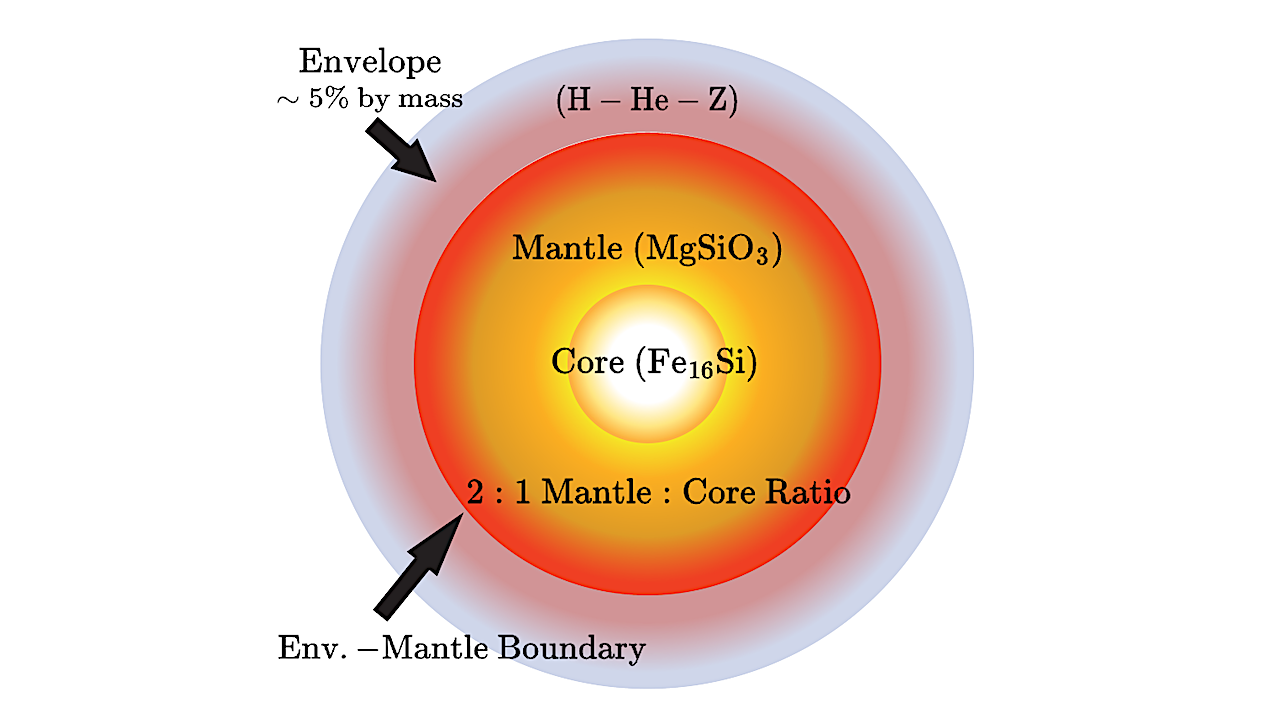
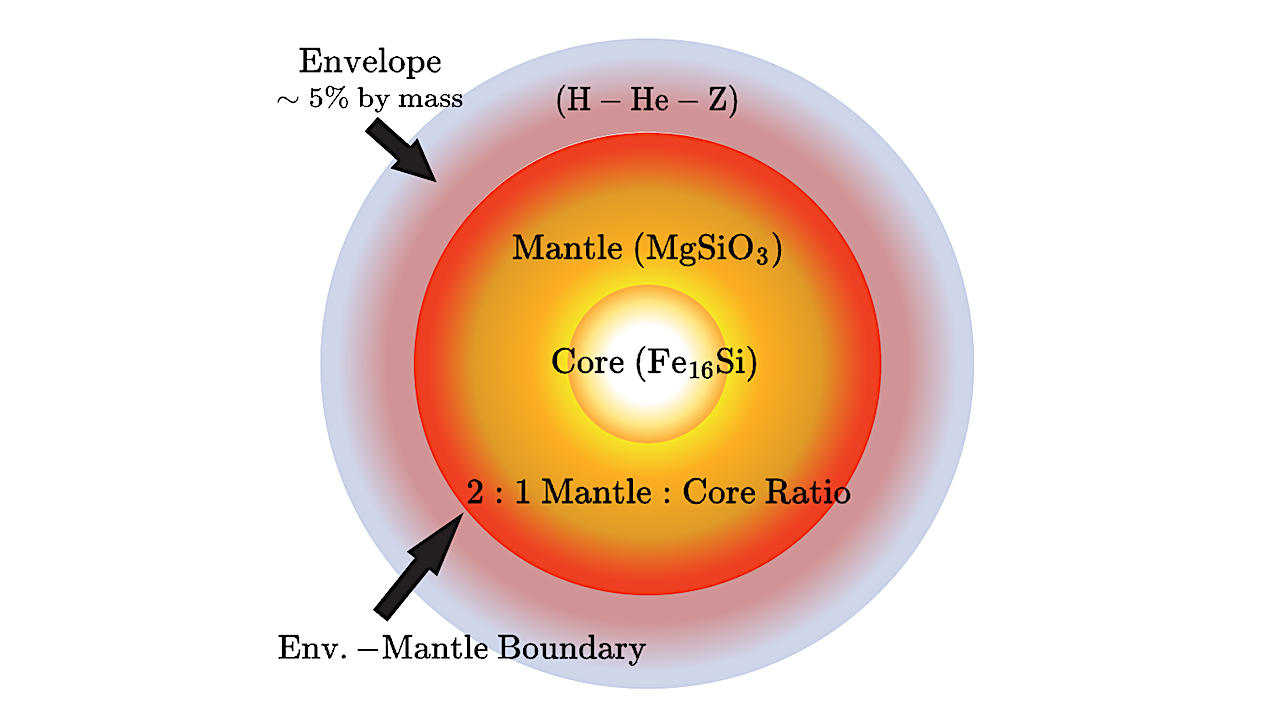
Interior structure schematic for the interior composition of sub-Neptune models presented in this work. Color is an approximate indicator of temperature (specific values depend on the model). The envelope (∼5% by mass) is a mixture of hydrogen, helium, and heavy elements (Z) represented by either water (Section 3.1) or silicates (Sections 3.2, 3.3). The mantle composition is MgSiO3, and the core composition is Fe16Si. We maintain a 2:1 mass ratio between the core and the mantle. For this work, the EMB represents a steep compositional gradient and thus controls mantle cooling by transferring heat to the envelope via conduction. Since conductive flux alone is insufficient to transport the entire interior heat to the envelope, a steep temperature gradient forms at the EMB, as seen in all models in this work. — astro-ph.EP
We explore the evolution of sub-Neptune (radii between ∼1.5 and 4 R⊕) exoplanet interior structures using our upgraded planetary evolution code, APPLE, which self-consistently couples the thermal and compositional evolution of the whole structure.
We incorporate stably stratified regions with convective mixing and, for the first time, ab initio results on the phase separation of silicate-hydrogen mixtures to model silicate rain in sub-Neptune envelopes. We demonstrate that inefficient mantle cooling can retain sufficient heat to Gyr ages: inefficient heat transport from mantle to envelope alone keeps radii ∼10% larger than predicted by adiabatic models at late times. Silicate rain can contribute an additional ∼5% to the radius, depending on envelope mass and initial metal abundance.
The silicate-hydrogen immiscibility region may lie in the middle or even upper envelope, far above the envelope-mantle boundary layer, and bifurcates the envelope into two an upper, hydrogen-rich region and a lower, metal-rich region above the mantle. If silicate rain occurs, atmospheres should appear depleted of silicates while radii remain inflated at late ages.
To demonstrate this, we present interior evolution models for GJ 1214 b, K2-18 b, TOI-270 d, and TOI-1801 b, showing that hot, liquid silicate mantles with thin envelopes reproduce their radii and mean densities, providing an alternative to water-world interpretations. These results imply that bulk compositions inferred from mean density must account for mantle thermal state and envelope mixing/phase separation history; such thermal “memories” may constrain formation entropies and temperatures when metallicities are better measured.
Roberto Tejada Arevalo, Akash Gupta, Adam Burrows, Donghao Zheng, Yao Tang, Jie Deng
Comments: 27 pages, 13 figures, 1 table, submitted to ApJ
Subjects: Earth and Planetary Astrophysics (astro-ph.EP)
Cite as: arXiv:2601.00059 [astro-ph.EP] (or arXiv:2601.00059v1 [astro-ph.EP] for this version)
https://doi.org/10.48550/arXiv.2601.00059
Focus to learn more
Submission history
From: Roberto Tejada Arevalo
[v1] Wed, 31 Dec 2025 19:00:01 UTC (7,791 KB)
https://arxiv.org/abs/2601.00059
Astrobiology, Astrogeology, exoplanet,










Related Posts
Stay Informed With the Latest & Most Important News




Advertisement
-
 01Two Black Holes Observed Circling Each Other for the First Time
 -
 02From Polymerization-Enabled Folding and Assembly to Chemical Evolution: Key Processes for Emergence of Functional Polymers in the Origin of Life
 -
 03Astronomy 101: From the Sun and Moon to Wormholes and Warp Drive, Key Theories, Discoveries, and Facts about the Universe (The Adams 101 Series)
 -
 04True Anomaly hires former York Space executive as chief operating officer
 -
 05Φsat-2 begins science phase for AI Earth images
 -
 06Hurricane forecasters are losing 3 key satellites ahead of peak storm season − a meteorologist explains why it matters
 -
 07Binary star systems are complex astronomical objects − a new AI approach could pin down their properties quickly