
Now Reading: A Comprehensive Study Of The Relations Between The Properties Of Planetary Systems And The Chemical Compositions Of Their Host Stars
-
01
A Comprehensive Study Of The Relations Between The Properties Of Planetary Systems And The Chemical Compositions Of Their Host Stars

A Comprehensive Study Of The Relations Between The Properties Of Planetary Systems And The Chemical Compositions Of Their Host Stars

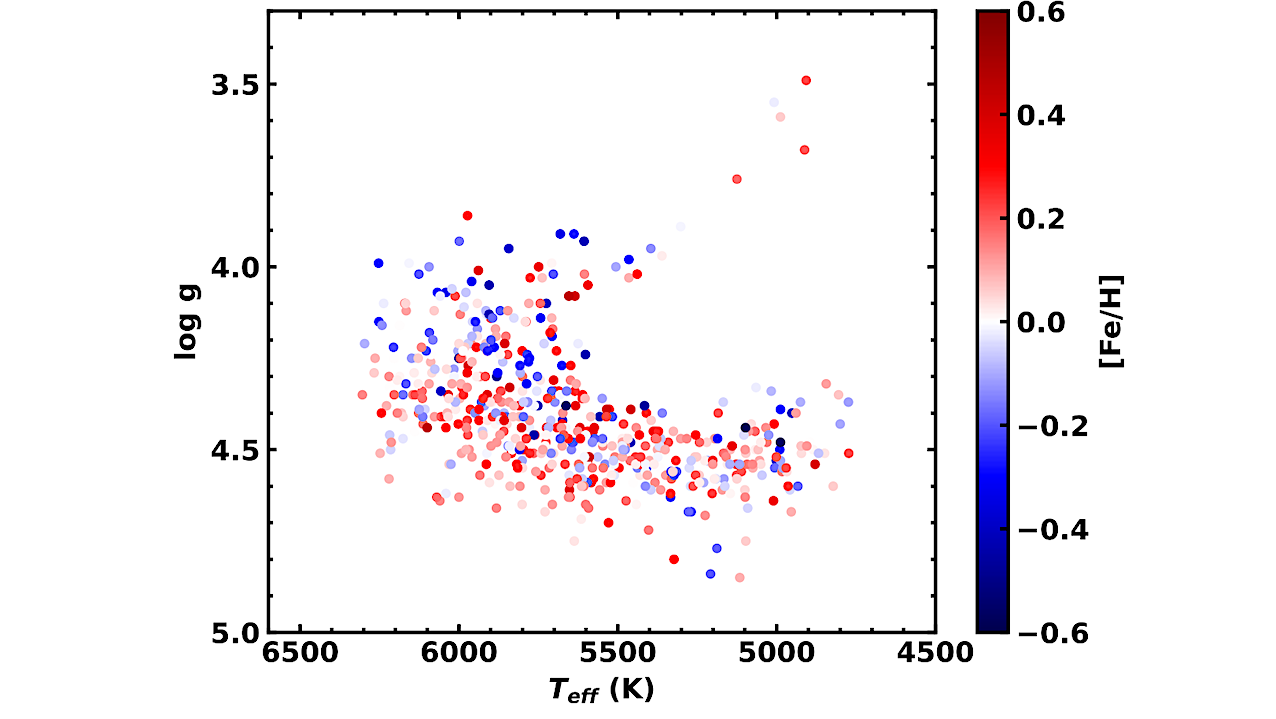
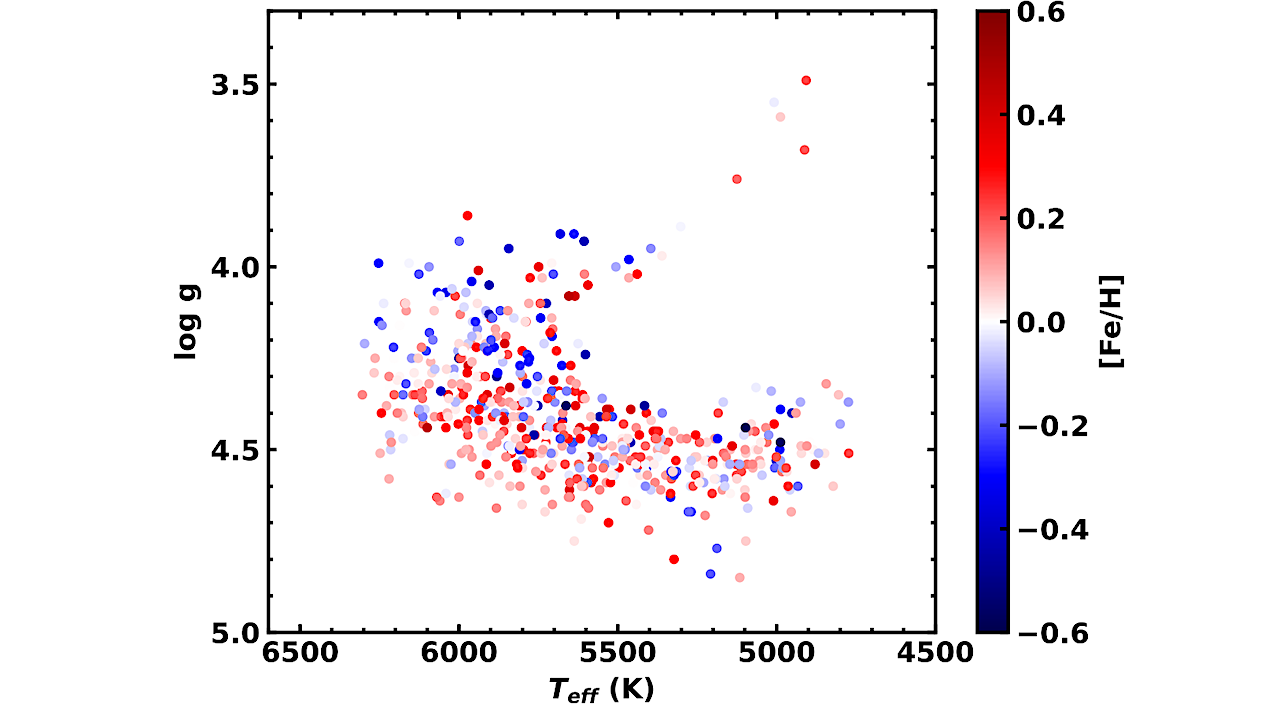
Kiel diagram for our sample of 561 stars. The stellar metallicities are represented by the color bar. — astro-ph.EP
The giant planet-metallicity correlation revealed that planetary formation depends on the stellar properties. There is growing evidence that it is also valid for smaller hot planets, but it is not clear whether elements other than iron also influence the properties of planetary systems.
To investigate this, we determined the abundances of 13 chemical elements (Na, Mg, Al, Si, Ca, Sc, Ti, V, Cr, Mn, Co, Ni and Cu) for a sample of 561 Kepler exoplanet-hosting stars using high-resolution Keck/HIRES spectra. We find that stars in systems having only large or hot planets are enriched in some elements relative to those having only small or warm planets, respectively, with this signature being related to the underlying stellar metallicity.
This Kepler sample is composed of stars belonging to the Galactic low- and high-α sequences, corresponding to the chemical thin and thick disks. Our results reveal that stars enhanced in α-elements may facilitate the formation of large planets in metal-poor environments although the iron abundance is still a limiting factor. We also investigated chemical abundances as a function of elemental condensation temperatures and found that there is a diversity of slopes of regardless of the exoplanetary systems hosted by the star.
We confirmed that the Sun is depleted in refractory elements relative to the solar twins in our sample, all of which host a diversity of exoplanets, suggesting that this depletion is caused by processes not related to planet formation.
Luan Ghezzi (1 and 2), Ellen Costa-Almeida (2), Verónica Loaiza-Tacuri (3), Katia Cunha (2 and 4) ((1) Universidade Federal do Rio de Janeiro – Observatório do Valongo, (2) Observatório Nacional, (3) Departamento de Física – Universidade Federal de Sergipe, (4) Steward Observatory)
Comments: Accepted for publication in ApJ
Subjects: Earth and Planetary Astrophysics (astro-ph.EP); Solar and Stellar Astrophysics (astro-ph.SR)
Cite as: arXiv:2601.00962 [astro-ph.EP](or arXiv:2601.00962v1 [astro-ph.EP] for this version)
https://doi.org/10.48550/arXiv.2601.00962
Focus to learn more
Submission history
From: Luan Ghezzi
[v1] Fri, 2 Jan 2026 19:20:07 UTC (675 KB)
https://arxiv.org/abs/2601.00962
Astrobiology, Astrochemistry,










Related Posts
Stay Informed With the Latest & Most Important News
Previous Post
Next Post
Previous Post

Next Post



Advertisement
-
 01Two Black Holes Observed Circling Each Other for the First Time
 -
 02From Polymerization-Enabled Folding and Assembly to Chemical Evolution: Key Processes for Emergence of Functional Polymers in the Origin of Life
 -
 03Astronomy 101: From the Sun and Moon to Wormholes and Warp Drive, Key Theories, Discoveries, and Facts about the Universe (The Adams 101 Series)
 -
 04True Anomaly hires former York Space executive as chief operating officer
 -
 05Φsat-2 begins science phase for AI Earth images
 -
 06Hurricane forecasters are losing 3 key satellites ahead of peak storm season − a meteorologist explains why it matters
 -
 07Binary star systems are complex astronomical objects − a new AI approach could pin down their properties quickly