
Now Reading: New research says icy lakes on Mars lasted for decades
-
01
New research says icy lakes on Mars lasted for decades


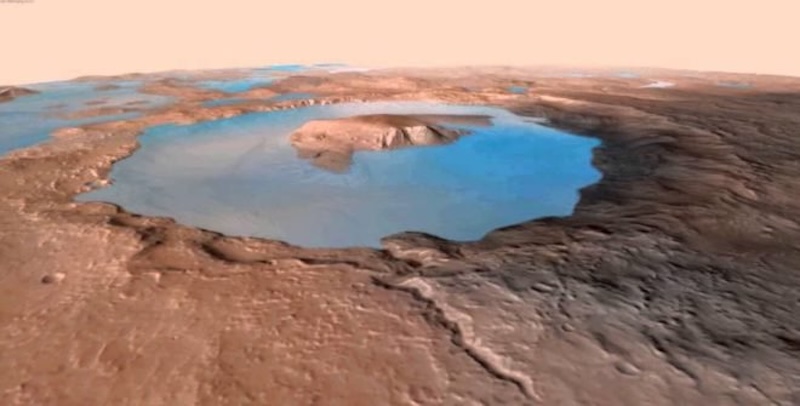

- Evidence shows Mars once had lakes and other bodies of water on its surface a few billion years ago. Yet some climate models say it was too cold for water. So how can that perplexing contradiction be solved?
- Small lakes on ancient Mars had a seasonal thin layer of ice on top, new research suggests. The ice would have been enough to keep the lakes liquid below the surface.
- The lakes would have been stable enough to persist for decades, and perhaps much longer.
EarthSky’s 2026 lunar calendar is available now. Get yours today! Makes a great gift.
Icy lakes on Mars
We know Mars once had lakes on its surface long ago. But scientists are still debating just how that was possible, when some climate models suggest Mars was always too cold. On January 5, 2026, researchers at Rice University in Houston, Texas, said some small lakes covered by a thin, seasonal layer of ice could have lasted for decades … and perhaps much longer. This could include the ancient lake in Gale crater, near the equator, where NASA’s Curiosity rover is still exploring.
The findings might help resolve the long-standing debate about early Mars. Was it warm and wet or cold and wet? If it was cold but still had liquid water on its surface, the study results would help explain how that happened.
The researchers published the peer-reviewed details in AGU Advances on December 29, 2025.
Seasonal layers of thin ice
The researchers noted there’s a lack of evidence for ancient lakes with thick layers of ice on top that could have kept the water liquid below. Without that, the lakes might not have lasted for long. But the new study showed that thin layers of ice could have been sufficient. As lead author Eleanor Moreland, a graduate student at Rice University, said:
Seeing ancient lake basins on Mars without clear evidence of thick, long-lasting ice made me question whether those lakes could have held water for more than a single season in a cold climate. When our new model began showing lakes that could last for decades with only a thin, seasonally disappearing ice layer, it was exciting that we might finally have a physical mechanism that fits what we see on Mars today.
Climate modeling suggests that small lakes on ancient Mars could have remained liquid for decades beneath thin seasonal ice, even with average air temperatures well below freezing. doi.org/hbht9m
— Science X / Phys.org (@sciencex.bsky.social) 2026-01-05T16:57:53-05:00
An insulating lid
The ice, even if just a seasonal thin layer, would act as an insulating lid. In the simulations, some of the lakes completely froze in the coldest parts of the Martian year. Others, however, remained liquid below the top ice layer. The ice insulated the water, reducing water loss. Plus, the ice was thin enough for sunlight to pass through. This helped to warm the lakes a bit more.
The simulations also showed the lakes barely changed in depth for at least decades. This means they remained stable despite the freezing conditions outside of them. Co-author Kirsten Siebach at Rice University explained:
This seasonal ice cover behaves like a natural blanket for the lake.
The findings could also explain why Curiosity or other rovers haven’t found evidence of thicker ice or glaciers in the former lakes. (Jezero crater, the landing site of NASA’s Perseverance rover, was also once a lake). Siebach said:
Because the ice is thin and temporary, it would leave little evidence behind, which could explain why rovers have not found clear signs of perennial ice or glaciers on Mars.

Using earthly climate models for Mars
So, how did the researchers come to these conclusions about ancient Mars? They used a climate model called Proxy System Modeling. Scientists use it on Earth to figure out what past climates were like on our own planet.
But the researchers had to adapt it to use on Mars. They called this updated model Lake Modeling on Mars with Atmospheric Reconstructions and Simulations (LakeM2ARS). The model was based on data from Gale crater and the Curiosity rover.
On Earth, scientists can use trees or other natural markers to evaluate past climates. But since Mars doesn’t have those, they had to improvise by using rock and mineral records and other data from the Mars rovers. Ultimately, the model represented Mars about 3.6 billion years ago.
Altogether, the researchers tested 64 different simulations. All of them simulated the lake that once existed in Gale crater, lasting for 30 Martian years (about 56 Earth years). Co-author Sylvia Dee at Rice University said:
It was fun to work through the thought experiment of how a lake model designed for Earth could be adapted for another planet, though this process came with a hefty amount of debugging when we had to change, say, gravity. We were surprised and encouraged by how sensitively the model responded to parameters like atmospheric pressure and temperature seasonality. It shows that with some creativity and experimentation, Earth-origin models can yield realistic climate scenarios for Mars.
A habitable environment?
If the Martian lakes were able to last for long periods of time – even under thin ice – they could have been a home for microbes. As Moreland noted:
If similar patterns emerge across the planet, the results would support the idea that even a quite cold early Mars could sustain year-round liquid water, a key ingredient for environments to be suitable for life.
The researchers now want to look for evidence of other ice-covered lakes on ancient Mars. They will also examine how changes in atmospheric composition or groundwater circulation might have affected the stability of lake ice over time.

Ice-free lakes with ripples?
The results might seem to contradict those of another study from last year. That one found that at least some lakes were likely ice-free and had wind-blown ripples on their surfaces. Like this new study, that one was also based on data from Gale crater.
Can the two studies be reconciled? Perhaps, since the new study makes the case that the ice coverings were likely seasonal, not year-round. So when there was no ice, ripples could have formed on the lake surface. We just don’t know for sure yet.
Bottom line: The ancient lake in Gale crater – and other icy lakes on Mars – could have been liquid below the surface for decades thanks to seasonal surface ice.
Source: Seasonal Ice Cover Could Allow Liquid Lakes to Persist in a Cold Mars Paleoclimate
Read more: Lakes on Mars had ripples! They must have been ice-free
Read more: Did a lost moon of Mars create tides in an ancient lake?
The post New research says icy lakes on Mars lasted for decades first appeared on EarthSky.










Related Posts
Stay Informed With the Latest & Most Important News
Previous Post
Next Post





Advertisement
-
 01Two Black Holes Observed Circling Each Other for the First Time
 -
 02From Polymerization-Enabled Folding and Assembly to Chemical Evolution: Key Processes for Emergence of Functional Polymers in the Origin of Life
 -
 03Astronomy 101: From the Sun and Moon to Wormholes and Warp Drive, Key Theories, Discoveries, and Facts about the Universe (The Adams 101 Series)
 -
 04True Anomaly hires former York Space executive as chief operating officer
 -
 05Φsat-2 begins science phase for AI Earth images
 -
 06Hurricane forecasters are losing 3 key satellites ahead of peak storm season − a meteorologist explains why it matters
 -
 07Binary star systems are complex astronomical objects − a new AI approach could pin down their properties quickly