
Now Reading: Investigating the High-energy Radiation Environment of Planets in Sun-like Binary Systems
-
01
Investigating the High-energy Radiation Environment of Planets in Sun-like Binary Systems

Investigating the High-energy Radiation Environment of Planets in Sun-like Binary Systems

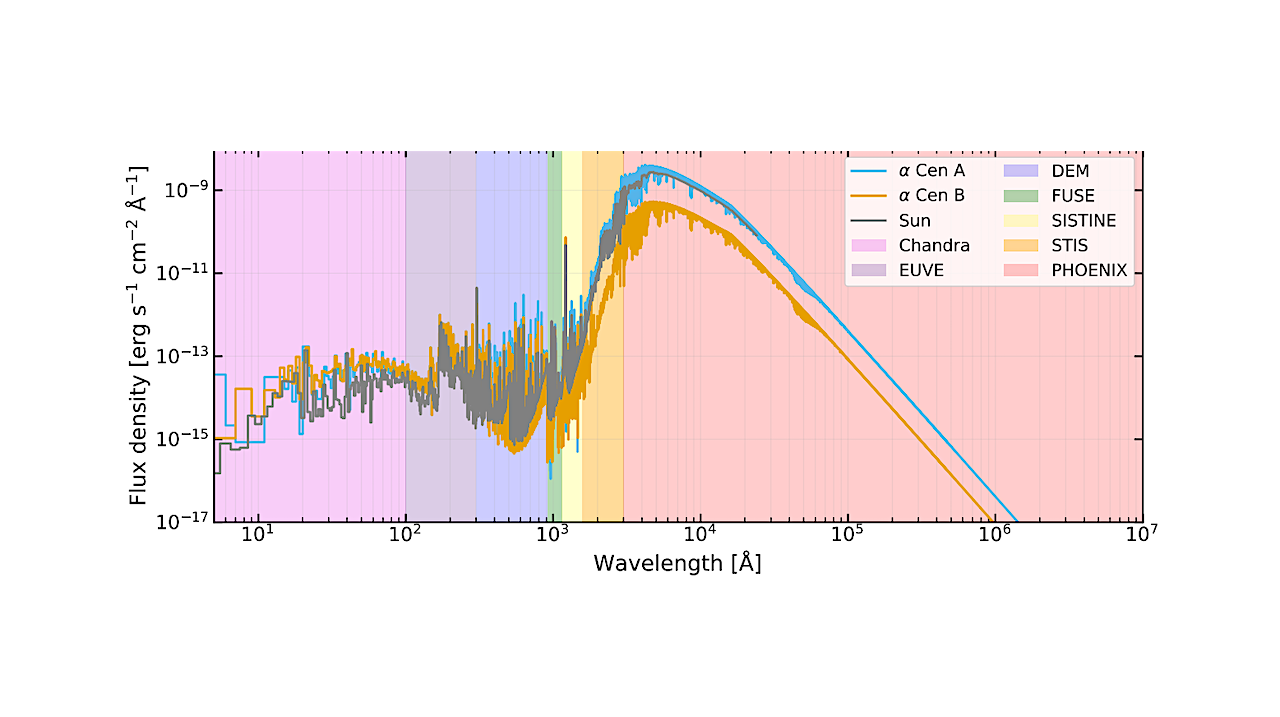

Stellar SEDs for α Cen A (blue) and B (orange) binned to 1 ˚A. The SED of the Sun, scaled to a distance of 1.33 pc, from Woods et al. (2009) is shown in gray for comparison. Colored background regions show the various regions described in §5.2. The regions containing the reconstructed Lyα (1214–1217 ˚A, §5.2.4) and SISTINE detector gap (1270–1300 ˚A, §5.2.3) are not colored for clarity. The PHOENIX model extends to 107 ˚A but we have restricted the Y axis to 10−17 erg s−1 cm−2 ˚A −1 , again to aid visual clarity of features within the main spectra. — astro-ph.EP
Far-ultraviolet (FUV) radiation is a driving source of photochemistry in planetary atmospheres. Proper interpretation of atmospheric observations requires a full understanding of the radiation environment that a planet is exposed to.
Using the Suborbital Imaging Spectrograph for Transition-region Irradiance from Nearby Exoplanet host stars (SISTINE) rocket-borne spectrograph, we observed the Sun-like binary system α Centauri AB and captured the FUV spectrum of both stars simultaneously.
Our spectra cover 980–1570 Å, providing the broadest FUV wavelength coverage taken in a single exposure and spanning several key stellar emission features which are important photochemical drivers. Combining the SISTINE spectrum with archival observations, model spectra, and a novel stellar activity model, we have created spectral energy distributions (SEDs) spanning 5 Å–1 mm for both α Centauri A and B.
We use the SEDs to estimate the total high-energy flux (X-ray–UV) incident on a hypothetical exoplanet orbiting α Centauri A. Because the incident flux varies over time due to the orbit of the stellar companion and the activity level of each star, we use the VULCAN photochemical kinetics code to estimate atmospheric chemical abundances in the case of minimum and maximum flux exposure.
Our results indicate that enhanced atmospheric mass loss due to stellar binarity will likely not be an issue for future exoplanet-hunting missions such as the Habitable Worlds Observatory when searching for Earth-like planets around Sun-like stars.
Patrick R. Behr, Kevin France, Nicholas Kruczek, Nicholas Nell, Brian Fleming, Stefan Ulrich, Girish M. Duvvuri, Amy Louca, Yamila Miguel
Comments: Accepted for publication in AJ
Subjects: Earth and Planetary Astrophysics (astro-ph.EP); Instrumentation and Methods for Astrophysics (astro-ph.IM); Solar and Stellar Astrophysics (astro-ph.SR)
Cite as: arXiv:2601.04593 [astro-ph.EP] (or arXiv:2601.04593v1 [astro-ph.EP] for this version)
https://doi.org/10.48550/arXiv.2601.04593
Focus to learn more
Submission history
From: Patrick Behr
[v1] Thu, 8 Jan 2026 04:44:15 UTC (1,841 KB)
https://arxiv.org/abs/2601.04593
Astrobiology,











Related Posts


Stay Informed With the Latest & Most Important News



Advertisement
-
 01Two Black Holes Observed Circling Each Other for the First Time
 -
 02From Polymerization-Enabled Folding and Assembly to Chemical Evolution: Key Processes for Emergence of Functional Polymers in the Origin of Life
 -
 03Astronomy 101: From the Sun and Moon to Wormholes and Warp Drive, Key Theories, Discoveries, and Facts about the Universe (The Adams 101 Series)
 -
 04True Anomaly hires former York Space executive as chief operating officer
 -
 05Φsat-2 begins science phase for AI Earth images
 -
 06Hurricane forecasters are losing 3 key satellites ahead of peak storm season − a meteorologist explains why it matters
 -
 07Binary star systems are complex astronomical objects − a new AI approach could pin down their properties quickly