
Now Reading: JWST Captures Growth of Aromatic Hydrocarbon Dust Particles in the Extremely Metal-poor Galaxy Sextans A
-
01
JWST Captures Growth of Aromatic Hydrocarbon Dust Particles in the Extremely Metal-poor Galaxy Sextans A

JWST Captures Growth of Aromatic Hydrocarbon Dust Particles in the Extremely Metal-poor Galaxy Sextans A

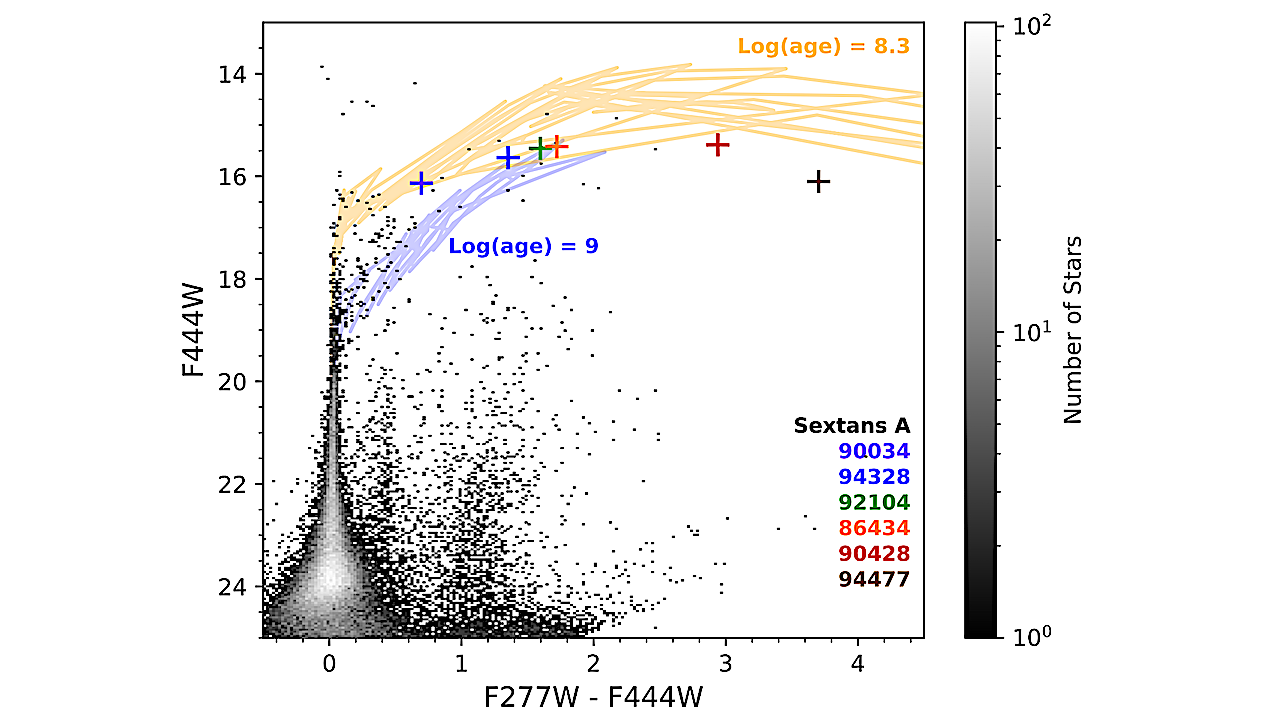
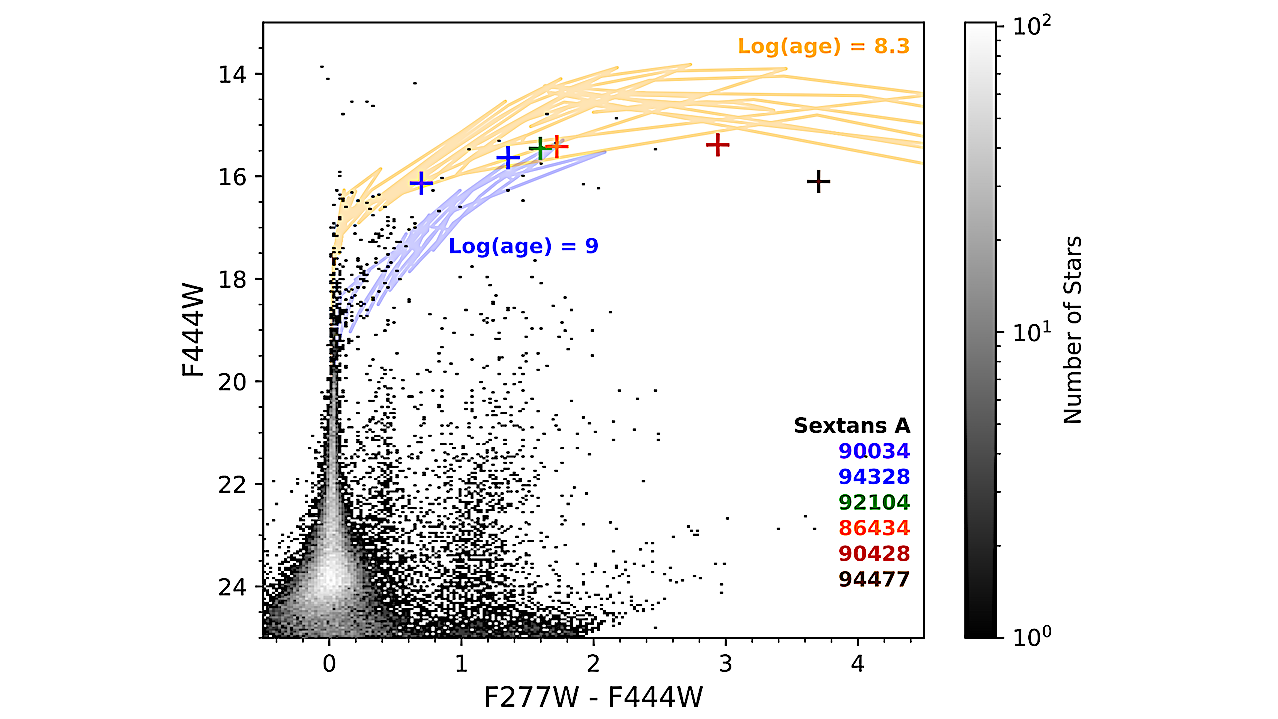
A color–magnitude Hess diagram of Sextans A with JWST/ NIRCam photometry at 2.7 and 4.4 μm with the positions of the JWST/LRS targets overplotted. COLIBRI isochrones with [M/H] = −1.7 are plotted for log(age) = 8.3 in orange and log(age) = 9 in blue (P. Marigo et al. 2013), both showing prominent branches of thermally pulsing AGB stars at red colors (F277W − F444W > 0 mag). The population of faint red objects is dominated by unresolved background galaxies and young stellar objects (J. T. Warfield et al. 2023; L. Lenkić et al. 2024). — astro-ph.GA
The mid-infrared spectrum of star-forming, high metallicity galaxies is dominated by emission features from aromatic and aliphatic bonds in small carbonaceous dust grains, often referred to as polycyclic aromatic hydrocarbons (PAHs).
In metal-poor galaxies, the abundance of PAHs relative to the total dust sharply declines, but the origin of this deficit is unknown. We present JWST observations that detect and resolve emission from PAHs in the 7% Solar metallicity galaxy Sextans A, representing the lowest metallicity detection of PAH emission to date.
In contrast to higher metallicity galaxies, the clumps of PAH emission are compact (0.5-1.5” or 3-10 pc), which explains why PAH emission evaded detection by lower resolution instruments like Spitzer. Ratios between the 3.3, 7.7, and 11.3 μm PAH features indicate that the PAH grains in Sextans A are small and neutral, with no evidence of significant processing from the hard radiation fields within the galaxy.
These results favor inhibited grain growth over enhanced destruction as the origin of the low PAH abundance in Sextans A. The compact clumps of PAH emission are likely active sites of in-situ PAH growth within a dense, well-shielded phase of the interstellar medium. Our results show that PAHs can form and survive in extremely metal-poor environments common early in the evolution of the Universe.
Elizabeth J. Tarantino, Julia Roman-Duval, Karin M. Sandstrom, J.-D. T. Smith, Cory M. Whitcomb, Bruce T. Draine, Martha L. Boyer, Jérémy Chastenet, Ryan Chown, Christopher J. R. Clark, Karl D. Gordon, Brandon S. Hensley, Thomas S.-Y. Lai, Christina W. Lindberg, Kristen B. W. McQuinn, Max J. B. Newman, O. Grace Telford, Dries Van De Putte, Benjamin F. Williams
Comments: Under review
Subjects: Astrophysics of Galaxies (astro-ph.GA)
Cite as: arXiv:2512.04060 [astro-ph.GA] (or arXiv:2512.04060v1 [astro-ph.GA] for this version)
https://doi.org/10.48550/arXiv.2512.04060
Focus to learn more
Submission history
From: Elizabeth Tarantino
[v1] Wed, 3 Dec 2025 18:46:04 UTC (15,564 KB)
https://arxiv.org/abs/2512.04060
Astrobiology, Astrochemistry,










Related Posts
Stay Informed With the Latest & Most Important News
Previous Post
Next Post



Advertisement
-
 01Two Black Holes Observed Circling Each Other for the First Time
 -
 02From Polymerization-Enabled Folding and Assembly to Chemical Evolution: Key Processes for Emergence of Functional Polymers in the Origin of Life
 -
 03Astronomy 101: From the Sun and Moon to Wormholes and Warp Drive, Key Theories, Discoveries, and Facts about the Universe (The Adams 101 Series)
 -
 04True Anomaly hires former York Space executive as chief operating officer
 -
 05Φsat-2 begins science phase for AI Earth images
 -
 06Hurricane forecasters are losing 3 key satellites ahead of peak storm season − a meteorologist explains why it matters
 -
 07Binary star systems are complex astronomical objects − a new AI approach could pin down their properties quickly