
Now Reading: China’s first launches of 2026 send Yaogan spacecraft into unusual orbit, loft Guowang satellites
-
01
China’s first launches of 2026 send Yaogan spacecraft into unusual orbit, loft Guowang satellites

China’s first launches of 2026 send Yaogan spacecraft into unusual orbit, loft Guowang satellites

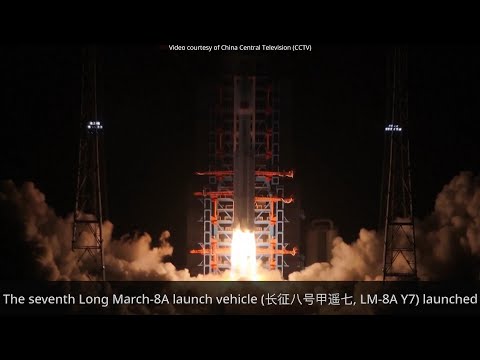
HELSINKI — China conducted a pair of Long March rocket launches Tuesday, kicking off what is likely to be a record-breaking year of launches for the country.
A Long March 6A rocket lifted off at 9:16 a.m. Eastern (1416 UTC) Jan. 13 from Taiyuan Satellite Launch Center, with its solid side boosters illuminating the night sky above the spaceport in northern China. The China Aerospace Science and Technology Corporation (CASC) announced launch success, revealing the payload to be Yaogan-50 (01) satellite.
Airspace closure notices indicated that the launch vehicle would, exceptionally, head westwards instead of eastwards, as is typical for an orbital launch to low Earth orbit. The spacecraft was later catalogued by the U.S. Space Force in a 701 by 944-kilometer-altitude orbit with an inclination of 142 degrees—a highly retrograde orbit, or opposite to the Earth’s rotation.
CASC states Yaogan-50 (01) will primarily be used for national land surveys, crop yield estimation, and disaster prevention and mitigation, a typical and generic description for a Yaogan satellite. Yaogan is thought to be a series of remote sensing satellites with military applications, including spacecraft with synthetic aperture radar, optical and signals intelligence payloads.
The precise intentions for placing a Yaogan satellite into a highly retrograde orbit were not immediately clear. Such orbits trade launch efficiency for higher relative ground-track velocity and repeated coverage of mid-latitude regions, suggesting mission requirements that differ from traditional sun-synchronous imaging. Israel often uses highly retrograde orbits, launching over the Mediterranean Sea. Unlike Israel, which is geographically constrained from launching eastward, China faces no such limitation, making the choice of a highly retrograde orbit notable.
The designation of (01) means further Yaogan-50 satellites may be sent into similar highly retrograde orbits in the future. Such launches incur a penalty in terms of fuel and payload capacity, as the launch vehicle needs to achieve orbital velocity without the aid of the rotational speed of the Earth.
More broadly, the mission follows a recent trend of Yaogan satellites—previously only sent into low Earth and Sun-synchronous orbits—being sent into more diverse orbits, including geostationary and medium Earth orbits.
Guowang batch 18
Just over an hour later, a Long March 8A rocket launched from the coastal Hainan Commercial Space Launch Site near Wenchang spaceport, lifting off at 10:25 a.m. Eastern (1525 UTC). CASC announced a successful launch, with nine satellites for the Guowang low Earth orbit megaconstellation expected to have been inserted into 50 degree inclination orbits.
The launch is the 18th for Guowang, a state-led effort to build a communications constellation of nearly 13,000 satellites. There are now 145 operational Guowang satellites in orbit, with its operator planning to have 400 satellites in orbit by 2027.
The project is part of China’s response to Starlink, both commercially and strategically. Little is known about the satellites, though they are estimated to have a relatively high mass, suggesting payloads for applications beyond communications, such as navigation, remote sensing and space situational awareness for more strategic uses.
The country is also already planning next-generation megaconstellations, with China recently filing paperwork with the ITU for constellations totaling more than 200,000 satellites.
The expendable Long March 8A debuted in early 2025 and completed six launches successfully across the year. CASC noted the launch took place 18 days after the previous Long March 8A launch, and the corporation plans to further optimize the launch and testing process and accelerate its cadence in 2026, in particular to support the construction of Guowang.
China’s 2026 launch plans
The launches were China’s first and second orbital launch attempts of 2026. CASC has not yet issued a clear plan for its launches this year, though there are indications it looks to accelerate from 73 launches it conducted in 2025 to more than 100 in 2026. China launched 92 times overall in 2025 with commercial launches included.
Commercial launches will further swell China’s overall launch activities, including launches of new potentially reusable launchers such as Zhuque-3 from Landspace, Tianlong-3 from Space Pioneer, iSpace’s Hyperbola-3, Nebula-1 from Deep Blue Aerospace, Pallas-1 from Galactic Energy and Orienspace’s Gravity-2.
Major missions will include a first flight of the Long March 10A and the Mengzhou crew spacecraft, Shenzhou-23 and 24—with the latter potentially carrying an international astronaut to the Tiangong space station for the first time—and the Chang’e-7 robotic lander to the lunar south pole.











Related Posts

Stay Informed With the Latest & Most Important News
Previous Post
Next Post





Advertisement
-
 01Two Black Holes Observed Circling Each Other for the First Time
 -
 02From Polymerization-Enabled Folding and Assembly to Chemical Evolution: Key Processes for Emergence of Functional Polymers in the Origin of Life
 -
 03Astronomy 101: From the Sun and Moon to Wormholes and Warp Drive, Key Theories, Discoveries, and Facts about the Universe (The Adams 101 Series)
 -
 04True Anomaly hires former York Space executive as chief operating officer
 -
 05Φsat-2 begins science phase for AI Earth images
 -
 06Hurricane forecasters are losing 3 key satellites ahead of peak storm season − a meteorologist explains why it matters
 -
 07Binary star systems are complex astronomical objects − a new AI approach could pin down their properties quickly