
Now Reading: Modeling The Effect Of C/O Ratio On Complex Carbon Chemistry In Cold Molecular Clouds
-
01
Modeling The Effect Of C/O Ratio On Complex Carbon Chemistry In Cold Molecular Clouds

Modeling The Effect Of C/O Ratio On Complex Carbon Chemistry In Cold Molecular Clouds

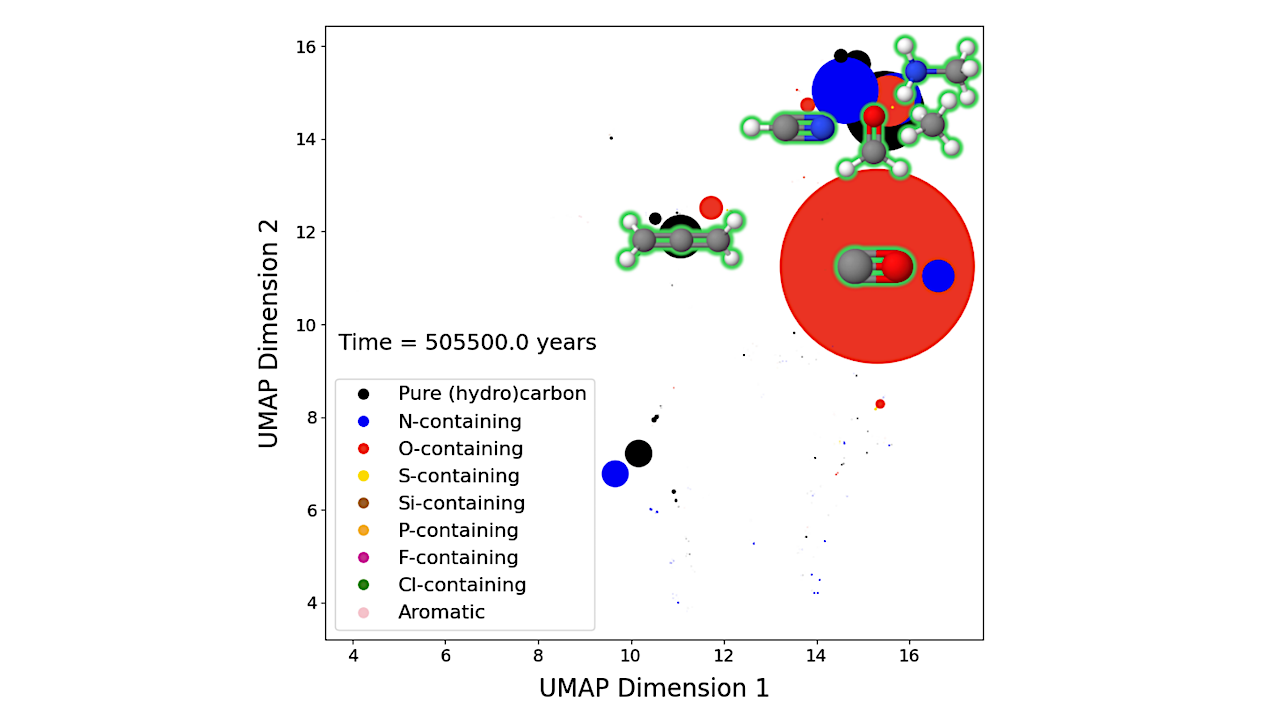

Modeled time-dependent carbon fractions of every carbon-containing species in the network with a C/O ratio of 0.5. Each dot represents a species that contains carbon plotted according to its UMAP vectors. The color corresponds to the elemental composition, while the size is the fraction of carbon multiplied by a scaling factor. Molecular structures are shown for species comprising at least 2% of the total carbon. Some of structures are slightly offset from their corresponding dots for visual clarity. Structures for ice-phase (grain surface or mantle) species are highlighted in green. — astro-ph.GA
Elemental abundances, which are often depleted with respect to the solar values, are important input parameters for kinetic models of interstellar chemistry. In particular, the amount of carbon relative to oxygen is known to have a strong effect on modeled abundances of many species.
While previous studies have focused on comparison of modeled and observed abundances to constrain the C/O ratio, the effects of this parameter on the underlying chemistry have not been well-studied. We investigated the role of the C/O ratio on dark cloud chemistry using the NAUTILUS code and machine learning techniques for molecular representation.
We find that modeled abundances are quite sensitive to the C/O ratio, especially for carbon-rich species such as carbon chains and polycyclic aromatic hydrocarbons (PAHs). CO and simple ice-phase species are found to be major carbon reservoirs under both oxygen-poor and oxygen-rich conditions. T
he appearance of C3H4 isomers as significant carbon reservoirs, even under oxygen-rich conditions, indicates the efficiency of gas-phase C3 formation followed by adsorption and grain-surface hydrogenation. Our model is not able to reproduce the observed, gas-phase C/H ratio of TMC-1 CP at the time of best fit with any C/O ratio between 0.1 and 3, suggesting that the modeled freeze-out of carbon-bearing molecules may be too rapid.
Future investigations are needed to understand the reactivity of major carbon reservoirs and their conversion to complex organic molecules.
Alex N. Byrne, Christopher N. Shingledecker, Edwin A. Bergin, Martin S. Holdren, Gabi Wenzel, Ci Xue, Troy Van Voorhis, Brett A. McGuire
Comments: 17 pages and 10 figures. Accepted for publication in The Astrophysical Journal. MP4 files for Figures 4, 5, and 6 are included as ancillary files
Subjects: Astrophysics of Galaxies (astro-ph.GA)
Cite as: arXiv:2601.04103 [astro-ph.GA] (or arXiv:2601.04103v1 [astro-ph.GA] for this version)
https://doi.org/10.48550/arXiv.2601.04103
Focus to learn more
Submission history
From: Alex Byrne
[v1] Wed, 7 Jan 2026 17:08:38 UTC (3,551 KB)
https://arxiv.org/abs/2601.04103
Astrobiology, Astrochemistry,










Related Posts



Stay Informed With the Latest & Most Important News
Previous Post
Next Post





Advertisement
-
 01Two Black Holes Observed Circling Each Other for the First Time
 -
 02From Polymerization-Enabled Folding and Assembly to Chemical Evolution: Key Processes for Emergence of Functional Polymers in the Origin of Life
 -
 03Astronomy 101: From the Sun and Moon to Wormholes and Warp Drive, Key Theories, Discoveries, and Facts about the Universe (The Adams 101 Series)
 -
 04True Anomaly hires former York Space executive as chief operating officer
 -
 05Φsat-2 begins science phase for AI Earth images
 -
 06Hurricane forecasters are losing 3 key satellites ahead of peak storm season − a meteorologist explains why it matters
 -
 07Binary star systems are complex astronomical objects − a new AI approach could pin down their properties quickly