
Now Reading: Broadband Spectroscopy Of Astrophysical Ice Analogues: IV. Optical Constants Of N2 Ice In The Terahertz And Mid-infrared Ranges
-
01
Broadband Spectroscopy Of Astrophysical Ice Analogues: IV. Optical Constants Of N2 Ice In The Terahertz And Mid-infrared Ranges

Broadband Spectroscopy Of Astrophysical Ice Analogues: IV. Optical Constants Of N2 Ice In The Terahertz And Mid-infrared Ranges

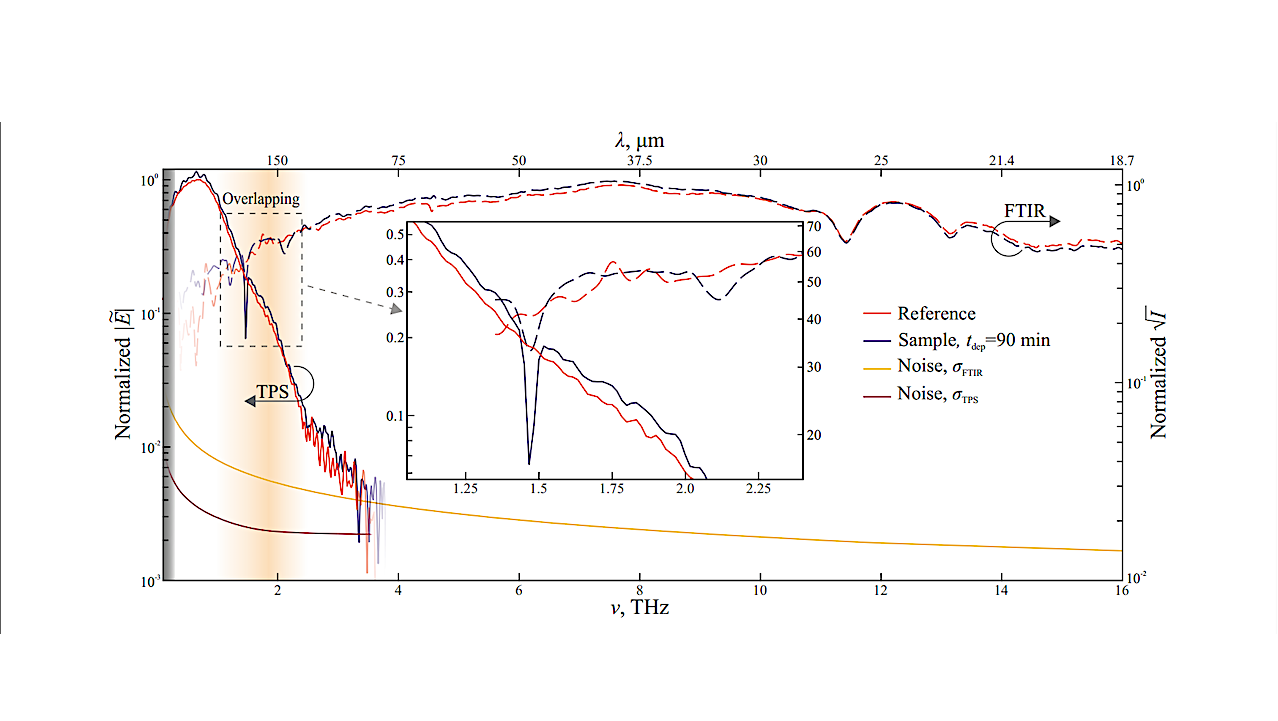

Reference and sample spectra of N2 ice, measured by the TPS (solid lines) and FTIR (dashed lines) spectrometers at specified deposition steps, tdep, and normalized by the maximum of the corresponding reference spectrum (for convenience). The low-frequency gray-shaded area shows the spectral range where distortions are expected owing to the THz beam diffraction at the sample aperture (Giuliano et al. 2019). The orange-shaded area near ≃ 2.0 THz (enlarged in the inset for clarity) indicates where the TPS and FTIR data overlaps. Sensitivity of the TPS and FTIR measurements is characterized by the standard deviation of the corresponding instrumental noise, σTPS and σFTIR as described by Gavdush et al. (2022). — astro-ph.EP
Context. Understanding the optical properties of astrophysical ices is crucial for modeling dust continuum emission and radiative transfer in cold, dense interstellar environments. Molecular nitrogen (N2), a major nitrogen reservoir in protoplanetary disks, plays a key role in nitrogen chemistry, yet the lack of direct terahertz (THz)–infrared (IR) optical constants for N2 ice introduces uncertainties in radiative transfer models, snowline locations, and disk mass estimates.
Aims. We present direct measurements of the optical properties of N2 ice over a broad THz–IR spectral range using terahertz pulsed spectroscopy (TPS) and Fourier-transform infrared spectroscopy (FTIR), supported by density functional theory (DFT) calculations and comparison with literature data.
Methods. N2 ice was grown at cryogenic temperatures by gas-phase deposition onto a cold silicon window. The THz complex refractive index was directly reconstructed from TPS data, while the IR response was derived from FTIR measurements using Kramers–Kronig relations. The optical response was parameterized with a Lorentz dielectric model and validated by DFT calculations.
Results. The complex refractive index of N2 ice is quantified from ν=0.3–16~THz (λ=1~mm–18.75 μm). Resonant absorption peaks at νL=1.47 and 2.13~THz with damping constants γL=0.03 and 0.22~THz are attributed to optically active phonons of the α-N2 crystal.
Conclusions. We provide a complete set of the THz–IR optical constants for N2 ice by combining TPS and FTIR spectroscopy. Our results have implications for future observational and modeling studies of protoplanetary disk evolution and planet formation.
F. Kruczkiewicz, A.A. Gavdush, F. Ribeiro, D. Campisi, A. Vyjidak, B.M. Giuliano, G.A. Komandin, S.V. Garnov, T. Grassi, P. Theulé, K.I. Zaytsev. A.V. Ivlev, Paola Caselli
Comments: Accepted for publication in A&A, 9 pages, 3 figures
Subjects: Earth and Planetary Astrophysics (astro-ph.EP); Astrophysics of Galaxies (astro-ph.GA); Instrumentation and Methods for Astrophysics (astro-ph.IM)
Cite as: arXiv:2601.03951 [astro-ph.EP] (or arXiv:2601.03951v1 [astro-ph.EP] for this version)
https://doi.org/10.48550/arXiv.2601.03951
Focus to learn more
Submission history
From: Franciele Kruczkiewicz
[v1] Wed, 7 Jan 2026 14:05:48 UTC (4,710 KB)
https://arxiv.org/abs/2601.03951
Astrobiology, Astrochemistry,










Related Posts

Stay Informed With the Latest & Most Important News
Previous Post
Next Post




Advertisement
-
 01Two Black Holes Observed Circling Each Other for the First Time
 -
 02From Polymerization-Enabled Folding and Assembly to Chemical Evolution: Key Processes for Emergence of Functional Polymers in the Origin of Life
 -
 03Astronomy 101: From the Sun and Moon to Wormholes and Warp Drive, Key Theories, Discoveries, and Facts about the Universe (The Adams 101 Series)
 -
 04True Anomaly hires former York Space executive as chief operating officer
 -
 05Φsat-2 begins science phase for AI Earth images
 -
 06Hurricane forecasters are losing 3 key satellites ahead of peak storm season − a meteorologist explains why it matters
 -
 07Binary star systems are complex astronomical objects − a new AI approach could pin down their properties quickly