
Now Reading: Formation Of Multi-planetary Systems Via Pebble Accretion In Externally Photoevaporating Discs In Stellar Clusters
-
01
Formation Of Multi-planetary Systems Via Pebble Accretion In Externally Photoevaporating Discs In Stellar Clusters

Formation Of Multi-planetary Systems Via Pebble Accretion In Externally Photoevaporating Discs In Stellar Clusters

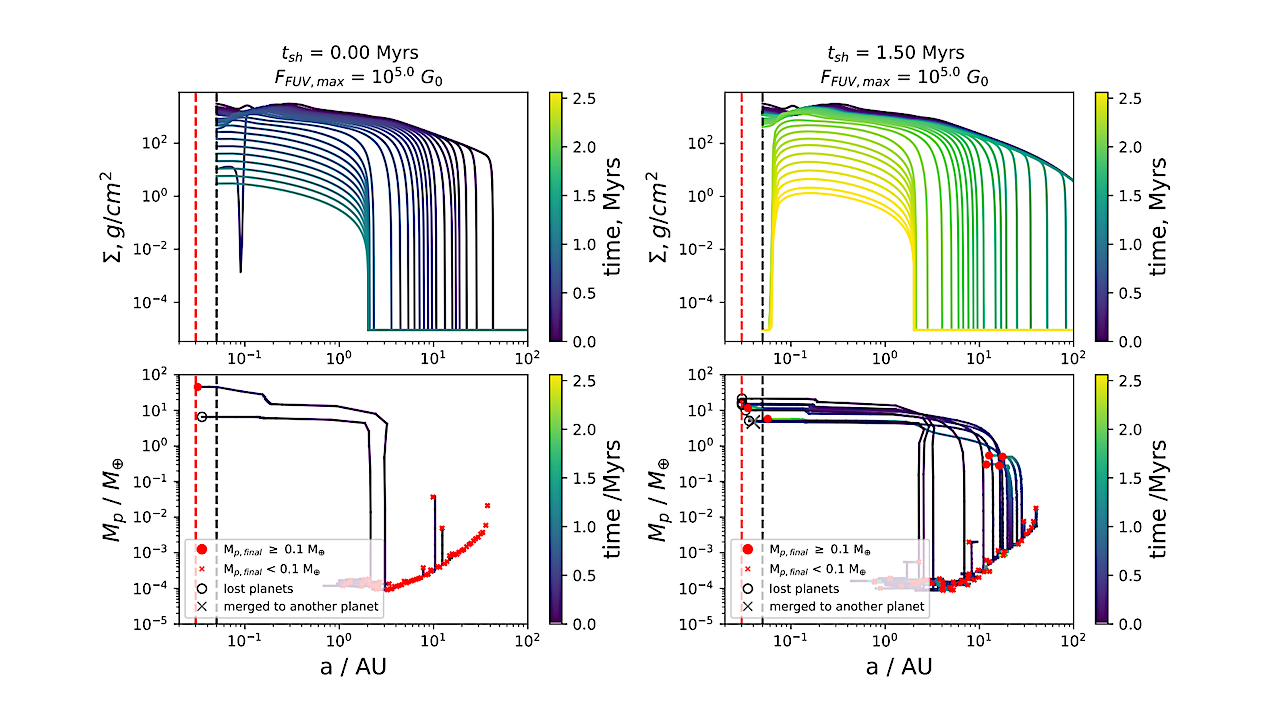

Top panels: evolution of surface density (with lines plotted every 50000 years) for discs with initial mass 𝑀𝑑 = 0.1 M⊕ which are subject to an external FUV radiation field strength of FFUV,max = 105 𝐺0. The left panel shows the disc that is not shielding and the right panel shows the disc that is shielding for 1.5 Myr. The bottom panels show the evolution of mass 𝑀𝑝 and semi-major axis of all the planetary embryos in the disc. The colour indicates the simulation time, and only the first 2.5 million years of the evolution is plotted, as the rapid disc depletion by the strong FUV field makes the gas disc evolution cease after only 1.3 Myr for the left hand non-shielded disc, and only 2.56 Myr for the right hand disc with 𝑡sh = 1.5 Myr. The red dashed line indicates the inner grid domain edge, and grey dashed line indicates the inner disc edge. On the bottom panels, the red solid circle and black empty circle indicate bodies that grew to a final mass ≥ 0.1 M⊕. The red solid circle indicates the final mass and semi-major axis of the ones which survived in the disc by the end of the simulation, the black empty circle indicates the final mass and semi-major axis of the ones that were lost during the simulation due to planet-planet interactions. The small red cross indicates the final mass and semi-major axis the bodies with final mass 0.1 𝑀⊕, and the big grey cross indicates the bodies that merged with another body via collision. — astro-ph.EP
In this paper, we investigate how external photo-evaporation influences the formation, dynamical evolution and the resultant planetary architecture of multi-planet systems born in stellar clusters.
We use a model of N-body simulations of multiple planet formation via pebble accretion coupled with a 1-D viscous disc subject to external photo-evaporation. We found that external photo-evaporation reduces the planet growth by reducing the pebble mass reservoir in discs containing multiple planetary embryos across a wide range of disc masses, and is particularly effective in suppressing planet growth in less initially massive discs (< 0.1 M⊙).
However, in more initially massive (≥ 0.1 M⊕) discs planets lost due to planet-planet interactions dominate the outcome for final resultant total planet mass, masking the effects of external photo-evaporation in curbing the planet mass growth. In terms of the final resulting planetary architectures, the signature of external photo-evaporation is visible in less massive (< 0.1 M⊙) discs, with fewer numbers and lower masses of planets surviving in discs irradiated with stronger external FUV radiation.
External photo-evaporation also leaves a signature for the wide orbit (> 10 au) terrestrial planets (0.1 – 1 M⊕), with fewer planets populating this region for stronger FUV field. Finally, the 1st-order resonant pairs fraction decreases with stronger FUV radiation, although the resonant pairs occur rarely regardless of the FUV radiation environment, due to the small number of planets that survive gravitational encounters.
Lin Qiao, Gavin A. L. Coleman, Thomas J. Haworth
Comments: Accepted by MNRAS
Subjects: Earth and Planetary Astrophysics (astro-ph.EP)
Cite as: arXiv:2601.03963 [astro-ph.EP] (or arXiv:2601.03963v1 [astro-ph.EP] for this version)
https://doi.org/10.48550/arXiv.2601.03963
Focus to learn more
Submission history
From: Lin Qiao
[v1] Wed, 7 Jan 2026 14:24:46 UTC (6,629 KB)
https://arxiv.org/abs/2601.03963
Astrobiology, Astrochemistry,











Related Posts

Stay Informed With the Latest & Most Important News




Advertisement
-
 01Two Black Holes Observed Circling Each Other for the First Time
 -
 02From Polymerization-Enabled Folding and Assembly to Chemical Evolution: Key Processes for Emergence of Functional Polymers in the Origin of Life
 -
 03Astronomy 101: From the Sun and Moon to Wormholes and Warp Drive, Key Theories, Discoveries, and Facts about the Universe (The Adams 101 Series)
 -
 04True Anomaly hires former York Space executive as chief operating officer
 -
 05Φsat-2 begins science phase for AI Earth images
 -
 06Hurricane forecasters are losing 3 key satellites ahead of peak storm season − a meteorologist explains why it matters
 -
 07Binary star systems are complex astronomical objects − a new AI approach could pin down their properties quickly