
Now Reading: HST Observations of HD 166620 and Tau Ceti: First UV Spectra of a Magnetic Grand Minimum Star and the Extent of Tau Ceti’s Astrosphere
-
01
HST Observations of HD 166620 and Tau Ceti: First UV Spectra of a Magnetic Grand Minimum Star and the Extent of Tau Ceti’s Astrosphere

HST Observations of HD 166620 and Tau Ceti: First UV Spectra of a Magnetic Grand Minimum Star and the Extent of Tau Ceti’s Astrosphere

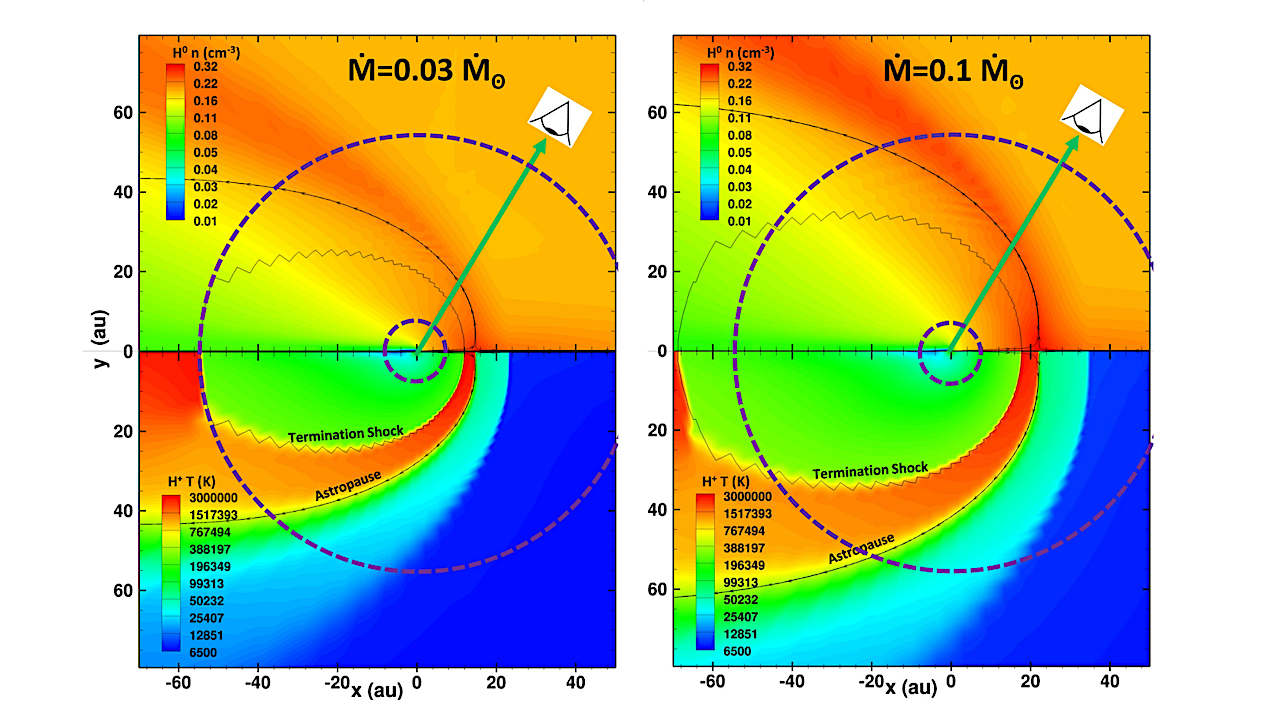
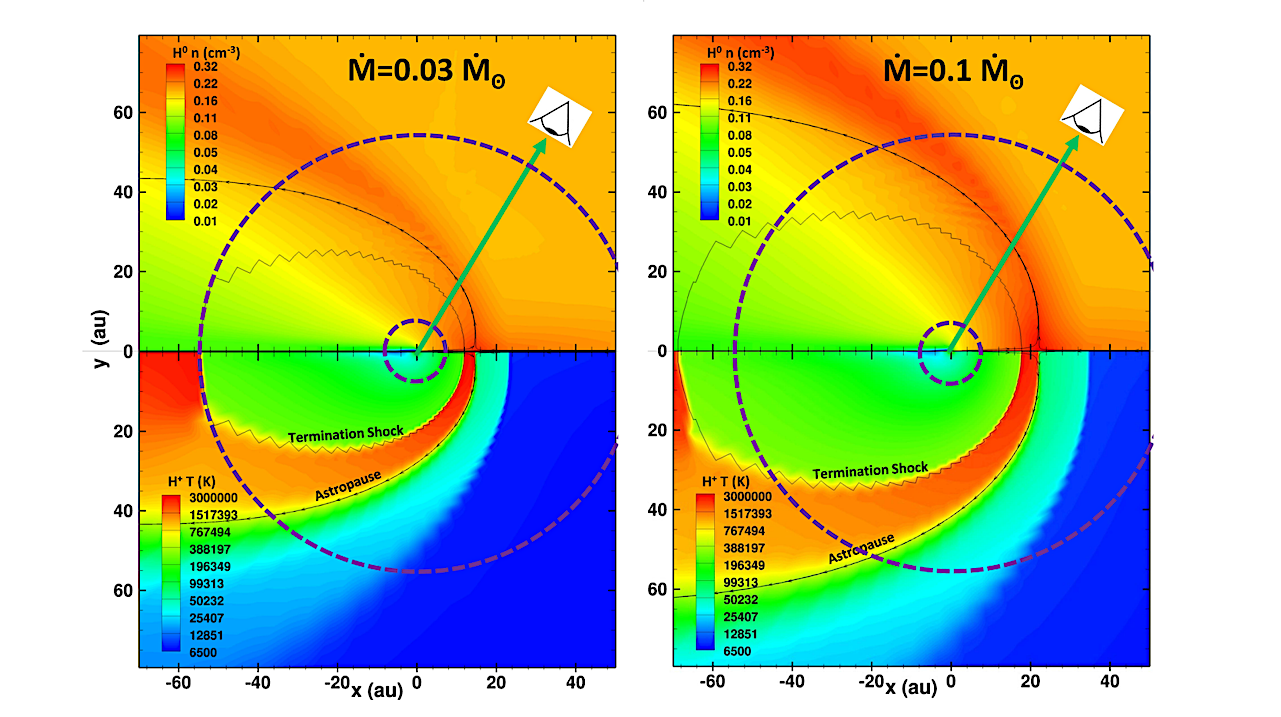
Hydrodynamic models of the τ Ceti astrosphere, assuming stellar mass loss rates of M˙= 0.03 M˙⊙ (left) and M˙= 0.1 M˙⊙ (right). The top panels show neutral H density and the bottom panels show proton temperature. The termination shock and astropause boundaries are labeled in the plasma temperature panel. The LOS to the star is indicated, at 59◦ from the upwind direction of the ISM flow. Dashed circles schematically indicate the spatial extent of τ Ceti’s debris disk, demonstrating that the disk will be at least partly exposed to the ISM outside the astropause, regardless of how the disk is actually oriented relative to the astrospheric structure. — astro-ph.SR
We present new Hubble Space Telescope (HST) UV spectra of the K2 V star HD 166620, the first star clearly recognized to be in a “magnetic grand minimum” state analogous to the Sun’s “Maunder Minimum” in the late 1600’s.
The stellar H I Lyman-alpha surface fluxes are extremely low, about a factor of two below fluxes observed during solar minimum, and also significantly lower than those of Tau Ceti (G8 V) and HD 191408 (K2.5 V), two stars more similar to HD 166620 in spectral type and age (~10 Gyr) than the Sun.
The Tau Ceti data that are compared with HD 166620 include both old archival data and a new HST observation as well. The Lyman alpha data are used to confirm a nondetection of astrospheric Lyman-alpha absorption for this star, suggesting a very weak wind with Mdot<0.1 Mdot_sun.
The very compact astrosphere inferred for Tau Ceti indicates that the star’s debris disk is at least partly exposed to the ISM, and we discuss possible consequences.
Brian E. Wood, Hans-Reinhard Mueller, Dean Hartshorn, Seth Redfield, Travis S. Metcalfe
Comments: 26 pages, 9 figures, to appear in The Astrophysical Journal
Subjects: Solar and Stellar Astrophysics (astro-ph.SR)
Cite as: arXiv:2601.10579 [astro-ph.SR] (or arXiv:2601.10579v1 [astro-ph.SR] for this version)
https://doi.org/10.48550/arXiv.2601.10579
Focus to learn more
Submission history
From: Brian E. Wood
[v1] Thu, 15 Jan 2026 16:52:09 UTC (35,269 KB)
https://arxiv.org/abs/2601.10579
Astrobiology











Related Posts
Stay Informed With the Latest & Most Important News
Previous Post
Next Post


Advertisement
-
 01Two Black Holes Observed Circling Each Other for the First Time
 -
 02From Polymerization-Enabled Folding and Assembly to Chemical Evolution: Key Processes for Emergence of Functional Polymers in the Origin of Life
 -
 03Astronomy 101: From the Sun and Moon to Wormholes and Warp Drive, Key Theories, Discoveries, and Facts about the Universe (The Adams 101 Series)
 -
 04True Anomaly hires former York Space executive as chief operating officer
 -
 05Φsat-2 begins science phase for AI Earth images
 -
 06Hurricane forecasters are losing 3 key satellites ahead of peak storm season − a meteorologist explains why it matters
 -
 07Binary star systems are complex astronomical objects − a new AI approach could pin down their properties quickly