
Now Reading: China conducts static fire test of new reusable Long March 12B rocket
-
01
China conducts static fire test of new reusable Long March 12B rocket


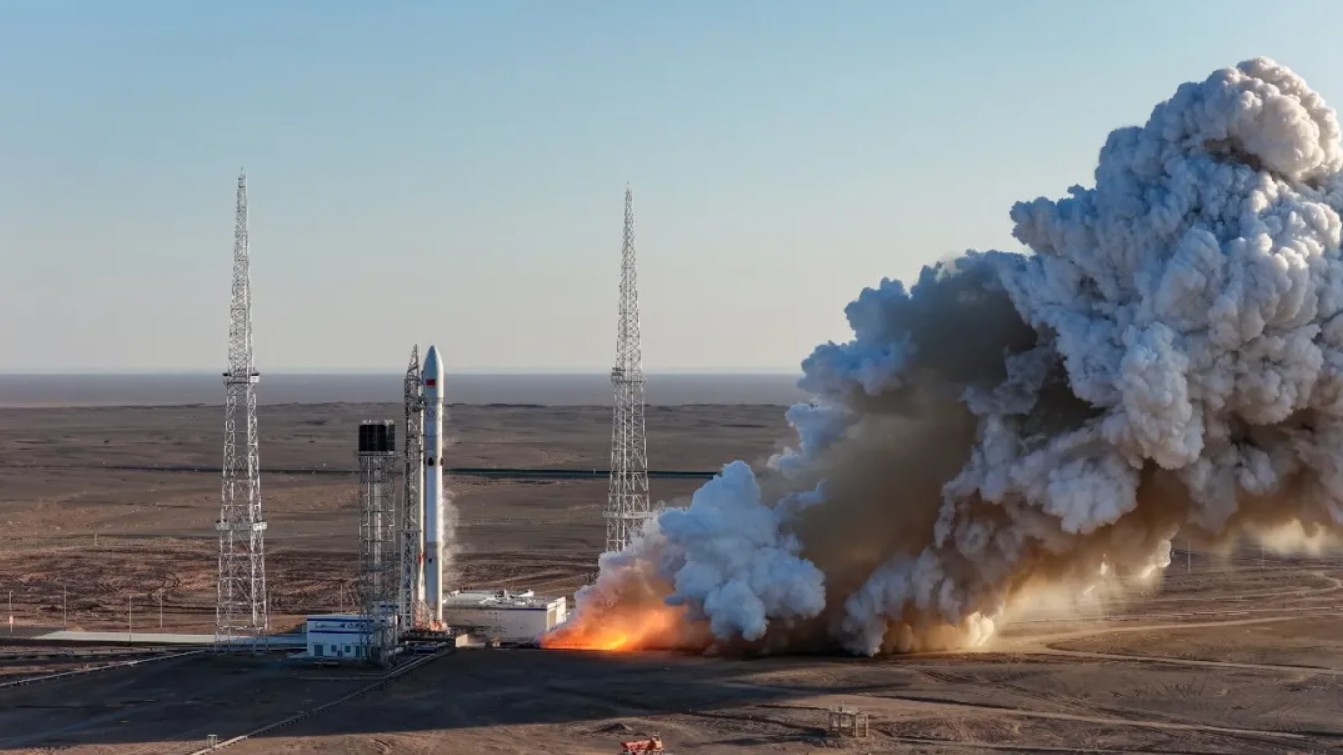

HELSINKI — China’s main space contractor performed a static fire test of a new reusable Long March rocket Friday, paving the way for a test flight.
The Long March 12B rocket successfully completed a static fire test Jan. 16 at facilities at the Dongfeng Commercial Space Innovation Test Zone within the Jiuquan Satellite Launch Center, northwest China.
The China Aerospace Science and Technology Corporation Commercial Rocket Co., Ltd. (CACL), operating under the state-owned China Aerospace Science and Technology Corporation (CASC), announced the successful test. Little further information was disclosed, omitting details such as the duration of the test firing, basic technical information of the rocket and a timeline for future activities.
“This test fully simulated the actual pre-launch process, conducting system verification in key stages such as fueling, ignition, and timing control,” CACL stated. CACL appears to function as a commercial joint venture acting as a development, test, and operations interface, rather than the traditional Long March prime contractor.
The successful test could, however, potentially lead to a test flight of the two-stage Long March 12B in the near future. CASC carried out a first flight of the related Long March 12A in December—developed somewhat in parallel to the Long March 12B—also from the Dongfeng Commercial Space Innovation Test Zone. That flight saw the rocket’s second stage reach orbit without a payload, but the recovery attempt of the reusable first stage failed during descent.
The Long March 12A is a 3.8-meter-diameter rocket powered by methane-liquid oxygen engines, often cited as capable of delivering around 9,000 kilograms to low Earth orbit (LEO), or around 6,000 kg when the first stage is recovered. The newly unveiled Long March 12B is described as a 4-meter-diameter class rocket but uses kerosene and liquid oxygen propellant mix. CACL vaguely describes the Long March 12B as having a “20-ton-class low Earth orbit carrying capacity,” without specifying actual figures for expendable and recoverable modes. Images released by CACL suggest features consistent with a reusable first stage, though recovery hardware for propulsive descent and landing such as landing legs is not clearly visible.
The pair of reusable rockets are also nominally bound up with the expendable Long March 12, which had a debut flight in November 2024 and has completed a total of four flights to date.
Concerted push for reusable launch
The static fire test is the latest development in what is an intensive, concerted effort by Chinese state-owned and commercial companies to acquire reusable launch capabilities. The Long March 12A orbital launch and recovery test followed that of the commercial Zhuque-3 earlier in December 2025, which marked China’s first orbital booster recovery attempt. CASC is also preparing for launch of the reusable Long March 10A and 10B rockets this year, with the former rocket for crew, and the latter for cargo missions. Commercial companies are preparing for the test flights of potentially reusable Pallas-1, Kinetica-2, Tianlong-3 and Nebula-1 in early 2026.
The push for reusability is tied to China’s need to boost its launch capabilities and launch cadence in order to construct its megaconstellation projects, notably the state-led Guowang and Shanghai-backed Qianfan constellations, as well as matching developments in the United States. Xinhua described the Long March 12B explicitly as a new-generation reusable rocket designed to support the deployment of commercial LEO satellite constellations.
While medium-lift reusable launch vehicles appear within reach for China, the country’s space sector is already looking beyond this. State-owned and commercial companies are working on full-flow staged-combustion-cycle methane engines to power larger rockets. China also filed paperwork with the ITU late December for constellations totaling more than 200,000 satellites; an endeavor that would require extremely rapid reusable launch capabilities.










Related Posts

Stay Informed With the Latest & Most Important News
Previous Post
Next Post


Advertisement
-
 01Two Black Holes Observed Circling Each Other for the First Time
 -
 02From Polymerization-Enabled Folding and Assembly to Chemical Evolution: Key Processes for Emergence of Functional Polymers in the Origin of Life
 -
 03Astronomy 101: From the Sun and Moon to Wormholes and Warp Drive, Key Theories, Discoveries, and Facts about the Universe (The Adams 101 Series)
 -
 04True Anomaly hires former York Space executive as chief operating officer
 -
 05Φsat-2 begins science phase for AI Earth images
 -
 06Hurricane forecasters are losing 3 key satellites ahead of peak storm season − a meteorologist explains why it matters
 -
 07Binary star systems are complex astronomical objects − a new AI approach could pin down their properties quickly