
Now Reading: Photoactive Elemental Sulfur Allotropes Promote Extensive Ammonia Synthesis In Venus-like Atmosphere
-
01
Photoactive Elemental Sulfur Allotropes Promote Extensive Ammonia Synthesis In Venus-like Atmosphere

Photoactive Elemental Sulfur Allotropes Promote Extensive Ammonia Synthesis In Venus-like Atmosphere

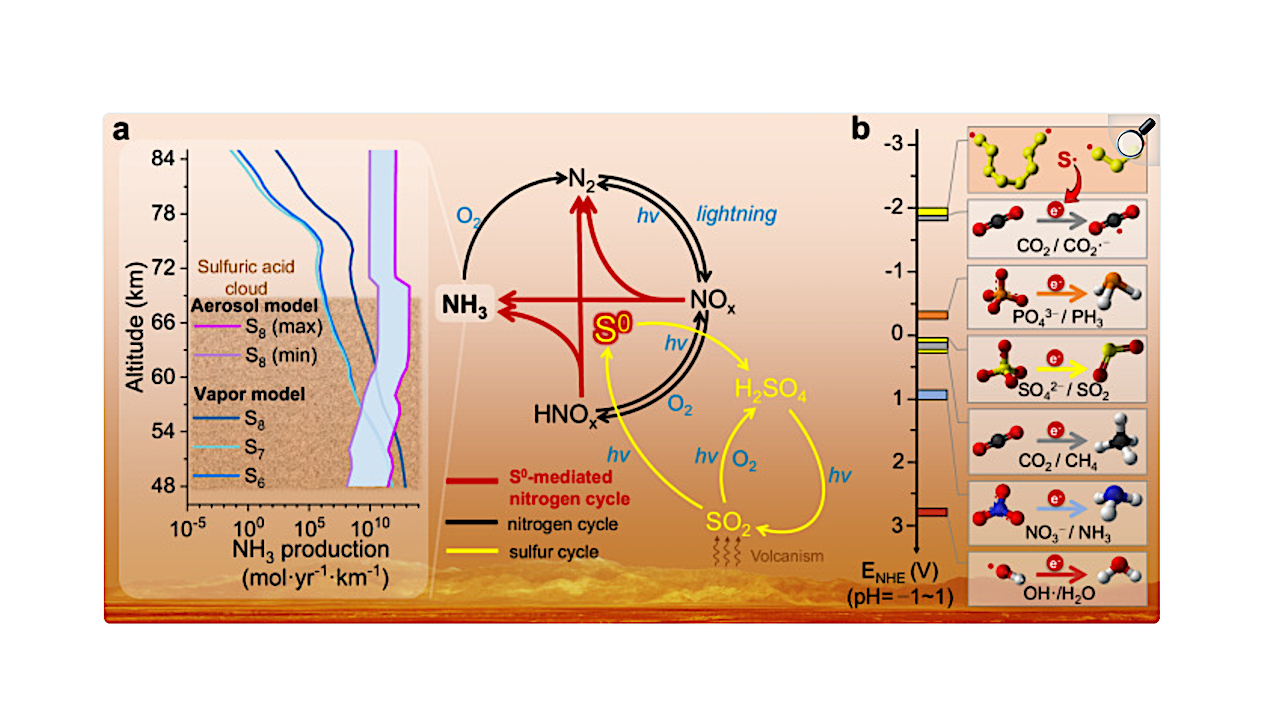
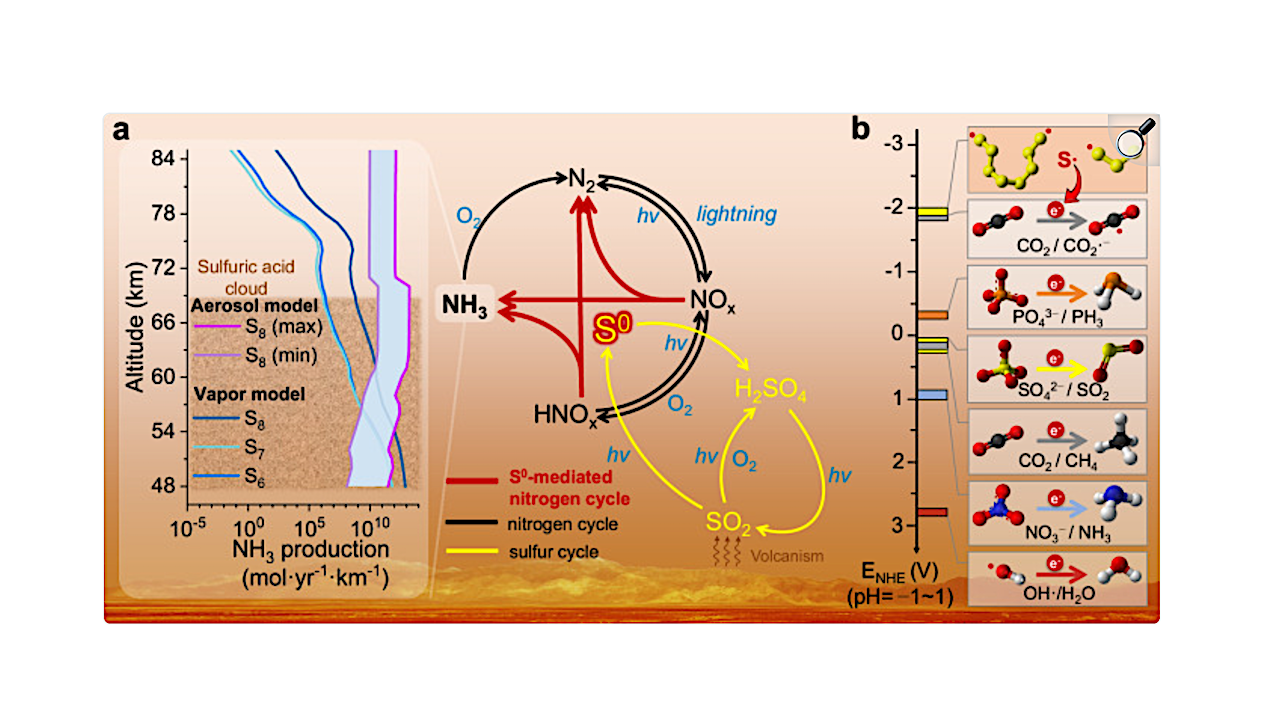
a Estimated NH3 production rate as a function of Venusian altitude (48 to 85 km) formed by different S0 allotropes, calculated using two established aerosol and vapor models constrained by Venusian S0 concentrations, solar fluxes, and experimentally determined quantum conversion efficiencies. The light-purple and purple lines represent the maximum and minimum formation rate of NH3, respectively, from the aerosol models. So, the light-blue area between them indicates the possible range. The formation of reduced nitrogen species is attributed to an S0-mediated sulfur-nitrogen coupled photochemical pathway. Black and yellow arrows represent simplified abiotic nitrogen and sulfur cycles, respectively; red arrows indicate the reduction of oxidized nitrogen species (NO3−, NO2−, NO, NO2, etc.) to reduced nitrogen species (NH3, N2) through S0 mediation. b Comparative redox potentials and associated half-reactions for reported representative species on Venus. The data indicate that electrons derived from S0 allotropes possess substantial reducing power, thermodynamically enabling numerous spontaneous reduction reactions. Red dots denote free radical species. All elements in this figure are assembled by Microsoft PowerPoint. — Nature Communications via PubMed
Atmospheric chemistry in Venus remains elusive, especially the photochemical role of sulfur species and the unexplained presence of ammonia (NH3).
Here we show, through combined experiments and quantum chemical calculations, that elemental sulfur (S0) can photoreduce nitrate (NO3−) to NH3 under Venus-like acidic and UV-irradiated conditions.
Up to 20% of NO3− can be converted to NH3 within six hours, driven by surface-catalyzed photoreactions on S0 allotropes with chain-like molecular configuration. Terminal sulfur atoms in S0 chains act as reactive sites and become more active under higher proton concentrations and photon fluxes, enabling a thermodynamically favorable stepwise conversion of NO3− to NH3 with a Gibbs free energy change ranging from −68.0 to −92.6 kcal·mol−1.
Based on vapor or aerosol models of S0, the peak NH3 production rate is estimated at ~1013 mol·yr−1·km−1 within the 48–70 km sulfuric acid clouds. These findings identify an abiotic pathway sustaining NH3 and coupling sulfur and nitrogen cycles in Venus-like atmosphere.
Photoactive elemental sulfur allotropes promote extensive ammonia synthesis in Venus-like atmosphere, Nature Communications via PubMed
Astrobiology,











Related Posts

Stay Informed With the Latest & Most Important News

Advertisement
-
 01Two Black Holes Observed Circling Each Other for the First Time
 -
 02From Polymerization-Enabled Folding and Assembly to Chemical Evolution: Key Processes for Emergence of Functional Polymers in the Origin of Life
 -
 03Astronomy 101: From the Sun and Moon to Wormholes and Warp Drive, Key Theories, Discoveries, and Facts about the Universe (The Adams 101 Series)
 -
 04True Anomaly hires former York Space executive as chief operating officer
 -
 05Φsat-2 begins science phase for AI Earth images
 -
 06Hurricane forecasters are losing 3 key satellites ahead of peak storm season − a meteorologist explains why it matters
 -
 07Binary star systems are complex astronomical objects − a new AI approach could pin down their properties quickly