
Now Reading: A Young Progenitor For The Most Common Planetary Systems In The Galaxy
-
01
A Young Progenitor For The Most Common Planetary Systems In The Galaxy


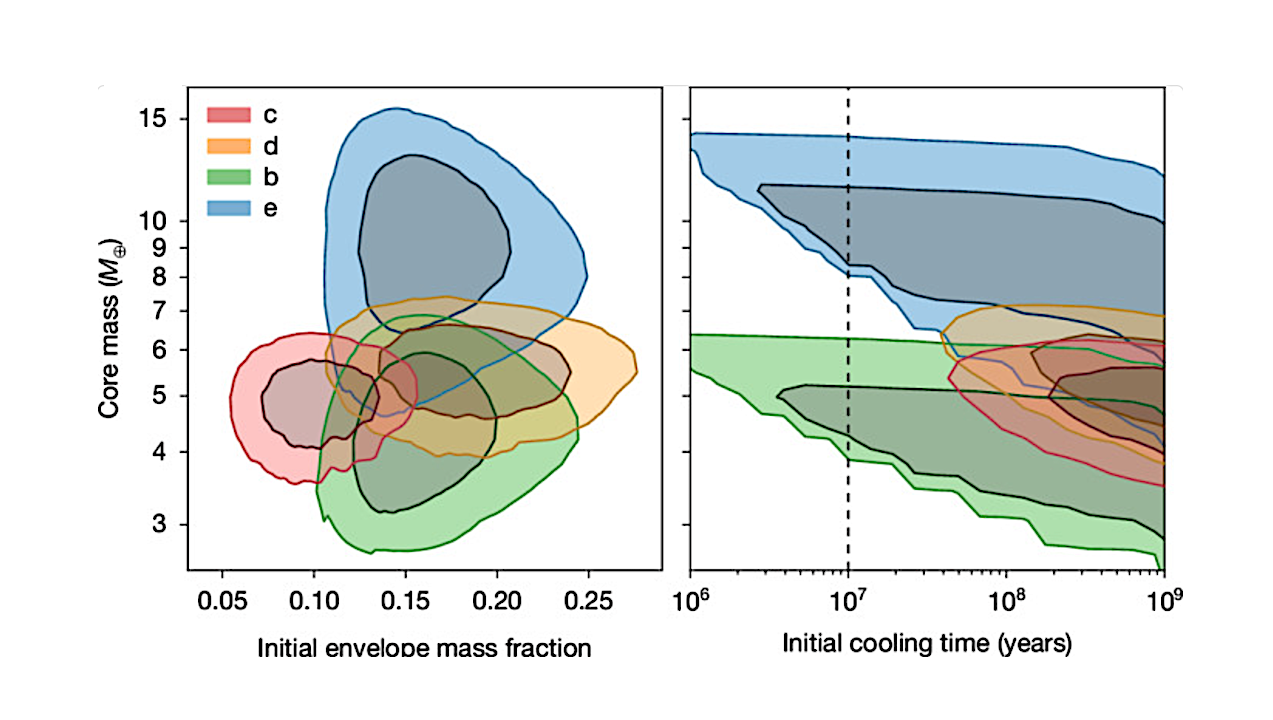
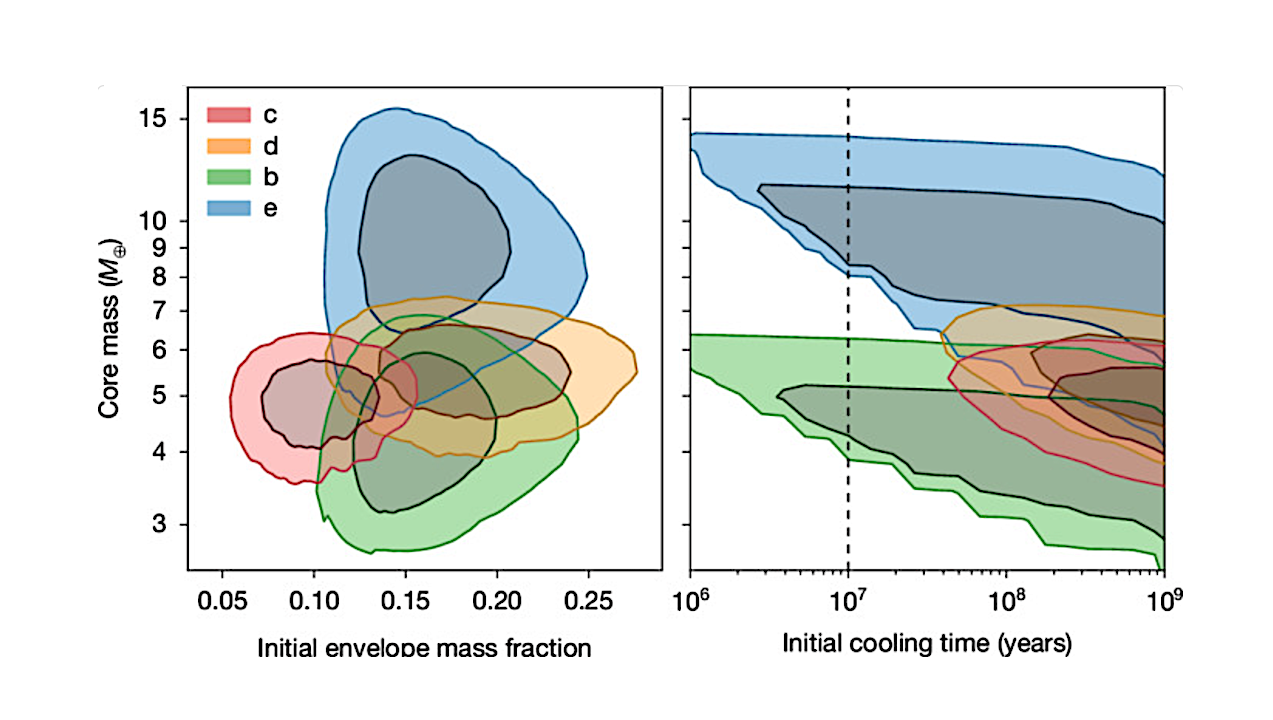
The posteriors were derived by applying the planetary evolution and mass loss framework of ref. 32 to our measured masses and radii for planets c (red), d (orange), b (green) and e (blue). Left, initial envelope mass fraction versus core mass. Right, initial Kelvin–Helmholtz cooling timescale versus core mass. Contours show the 1σ and 2σ credible regions. (Note that the jagged appearance of some contours is a numerical artefact of the discrete core mass grid used in our analysis; see Methods for more details). The vertical dotted line in the right panel at 10 Myr marks the approximate upper limit for standard high-entropy formation models. These models are strongly disfavoured for the inner planets c and d, whereas for the less-irradiated outer planets b and e, the method lacks the statistical power to distinguish between high- and low-entropy scenarios. — Nature
The Galaxy’s most common known planetary systems have several Earth-to-Neptune-size planets in compact orbits. At small orbital separations, larger planets are less common than their smaller counterparts by an order of magnitude. The young star V1298 Tau hosts one such compact planetary system, albeit with four planets that are uncommonly large (5 to 10 Earth radii).
The planets form a chain of near-resonances that result in transit-timing variations of several hours. Here we present a multi-year campaign to characterize this system with transit-timing variations, a method insensitive to the intense magnetic activity of the star. Through targeted observations, we first resolved the previously unknown orbital period of the outermost planet.
The full 9-year baseline from these and archival data then enabled robust determination of the masses and orbital parameters for all four planets. We find the planets have low, sub-Neptune masses and nearly circular orbits, implying a dynamically tranquil history. Their low masses and large radii indicate that the inner planets underwent a period of rapid cooling immediately after dispersal of the protoplanetary disk.
Still, they are much less dense than mature planets of comparable size. We predict the planets will contract to 1.5–4.0 Earth radii and join the population of super-Earths and sub-Neptunes that nature produces in abundance.
A young progenitor for the most common planetary systems in the Galaxy, Nature via PubMed (open access)
Astrobiology,











Related Posts
Stay Informed With the Latest & Most Important News
Previous Post
Next Post

Advertisement
-
 01Two Black Holes Observed Circling Each Other for the First Time
 -
 02From Polymerization-Enabled Folding and Assembly to Chemical Evolution: Key Processes for Emergence of Functional Polymers in the Origin of Life
 -
 03Astronomy 101: From the Sun and Moon to Wormholes and Warp Drive, Key Theories, Discoveries, and Facts about the Universe (The Adams 101 Series)
 -
 04True Anomaly hires former York Space executive as chief operating officer
 -
 05Φsat-2 begins science phase for AI Earth images
 -
 06Hurricane forecasters are losing 3 key satellites ahead of peak storm season − a meteorologist explains why it matters
 -
 07Binary star systems are complex astronomical objects − a new AI approach could pin down their properties quickly