
Now Reading: Transiting Exoplanets As The Immediate Future For Population-level Atmospheric Science
-
01
Transiting Exoplanets As The Immediate Future For Population-level Atmospheric Science

Transiting Exoplanets As The Immediate Future For Population-level Atmospheric Science

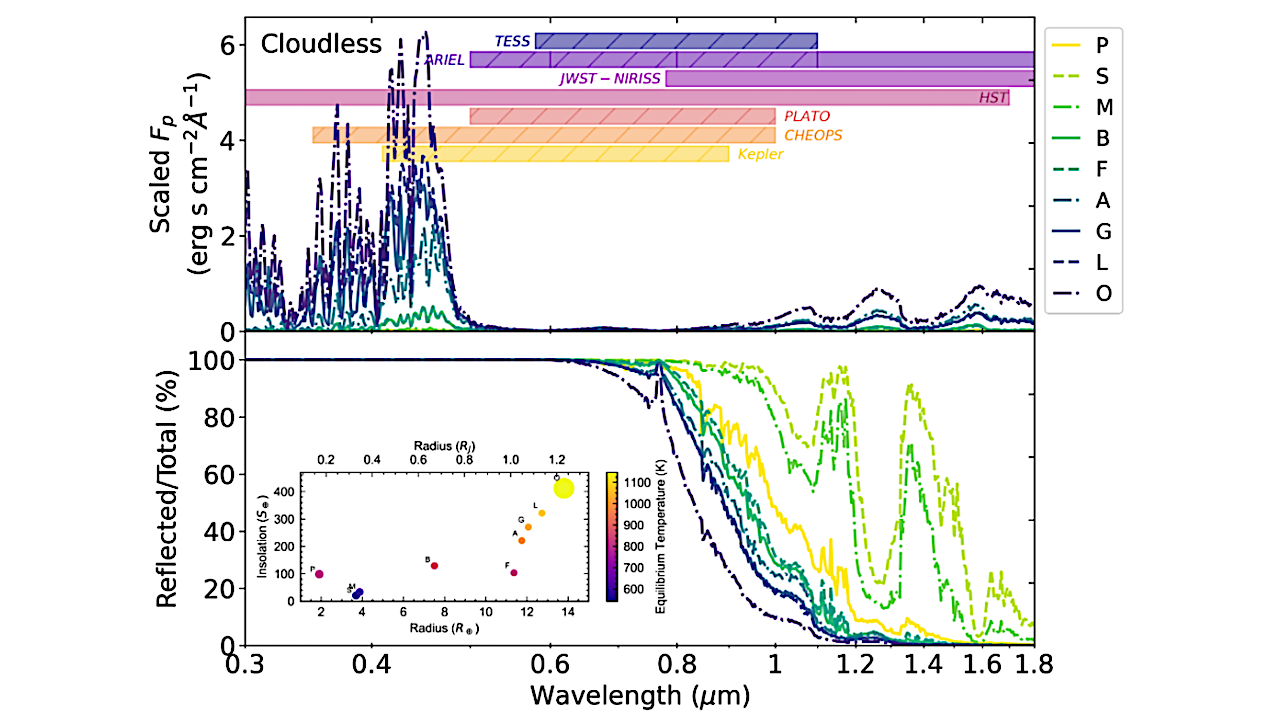
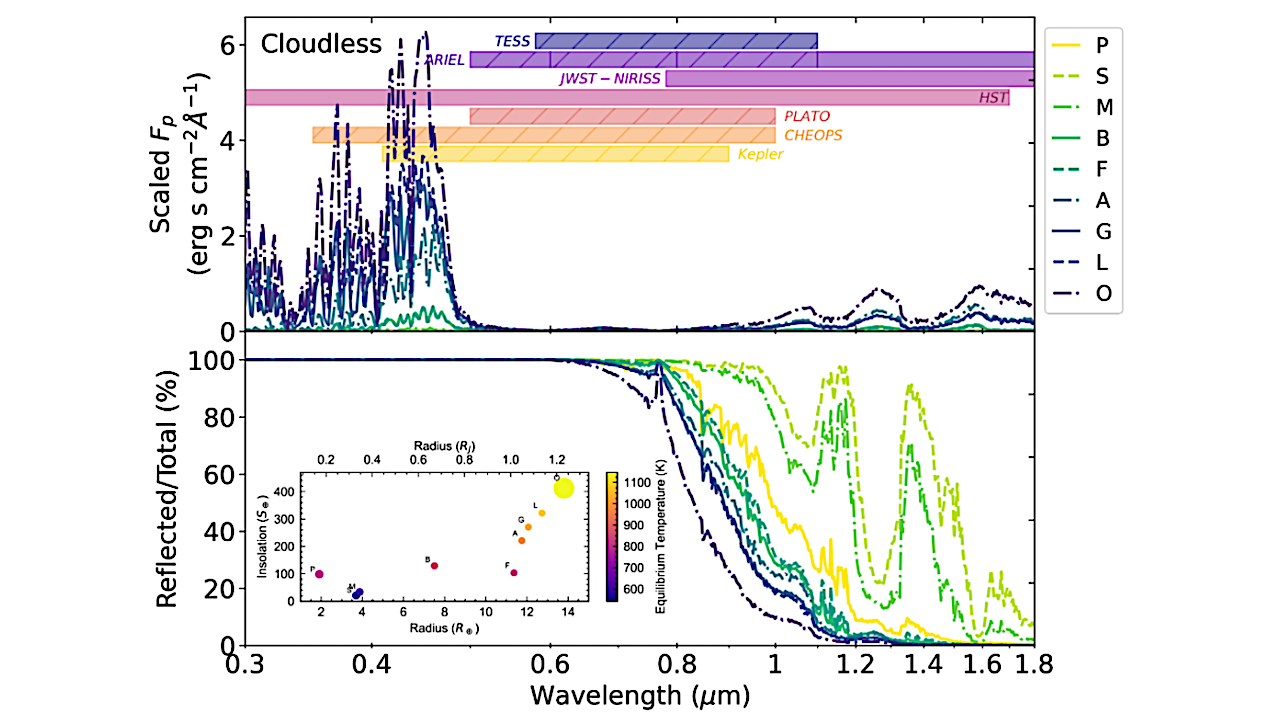
Top – the total planetary flux as measured in flux units for cloud-free planetary atmospheres. Bottom – the percent contribution of reflected light to the total flux as a function of wavelength (R = 300). Colored bands in the top panel show the photometric (hashed) and spectroscopic (solid) coverage from current and future facilities over this wavelength range. Figure updated from Mayorga + (2019) and included with permission of L. C. Mayorga. — astro-ph.IM
The transit method, during which a planet’s presence is inferred by measuring the reduction in flux as it passes in front of its parent star, is a highly successful exoplanet detection and characterization technique.
During transit, the small fraction of starlight that passes through a planet’s atmosphere emerges with the fingerprints of atmospheric gases, aerosols and structure. During eclipse, the relatively small contribution of light from the planet itself may be observed as the planet is occulted by the star. For planets in near-edge-on, short-period orbits, observing the system throughout an entire orbit allows the varying flux from the planet to be extracted as the illuminated `dayside’ rotates in and out of view.
With spectroscopic observations, we can characterize not only the overall composition of the atmosphere, but also glean insights into atmospheric structure and dynamics. With over 6,000 transiting planets now discovered, such observations are currently our only window into a consistent sample of planetary atmospheres large enough to attempt a population-level study, a critical next step for our understanding of atmospheric science.
The vast exoplanet population provides a laboratory for atmospheric physics, including chemistry, dynamics, cloud processes and evolution; extending these results to a larger number of targets will allow us to explore the effects of equilibrium temperature, gravity, mass and parent star type on atmospheric properties, as well as map observable trends to formation scenarios.
These findings are critical for addressing STFC’s Science Vision Challenge B: how do stars and planetary systems develop and how do they support the existence of life?. Here we outline how the UK must fit within this strategic context, suggest approaches and development for the future, and outline the unique capabilities and leadership of scientists across the UK.
Joanna K. Barstow, Hannah R. Wakeford, Sarah L. Casewell, Vatsal Panwar
Comments: White paper submitted to the UK Space Agency’s initiative “UK Space Frontiers 2035” this https URL
Subjects: Instrumentation and Methods for Astrophysics (astro-ph.IM); Earth and Planetary Astrophysics (astro-ph.EP)
Cite as: arXiv:2601.06236 [astro-ph.IM] (or arXiv:2601.06236v1 [astro-ph.IM] for this version)
https://doi.org/10.48550/arXiv.2601.06236
Focus to learn more
Submission history
From: Joanna Barstow (Eberhardt) Dr
[v1] Fri, 9 Jan 2026 15:15:15 UTC (760 KB)
https://arxiv.org/abs/2601.06236
Astrobiology, exoplanet,










Related Posts

Stay Informed With the Latest & Most Important News
Previous Post
Next Post


Advertisement
-
 01Two Black Holes Observed Circling Each Other for the First Time
 -
 02From Polymerization-Enabled Folding and Assembly to Chemical Evolution: Key Processes for Emergence of Functional Polymers in the Origin of Life
 -
 03Astronomy 101: From the Sun and Moon to Wormholes and Warp Drive, Key Theories, Discoveries, and Facts about the Universe (The Adams 101 Series)
 -
 04True Anomaly hires former York Space executive as chief operating officer
 -
 05Φsat-2 begins science phase for AI Earth images
 -
 06Hurricane forecasters are losing 3 key satellites ahead of peak storm season − a meteorologist explains why it matters
 -
 07Binary star systems are complex astronomical objects − a new AI approach could pin down their properties quickly