
Now Reading: Setting Up The Physical Principles Of Resilience In A Model Of The Earth System
-
01
Setting Up The Physical Principles Of Resilience In A Model Of The Earth System


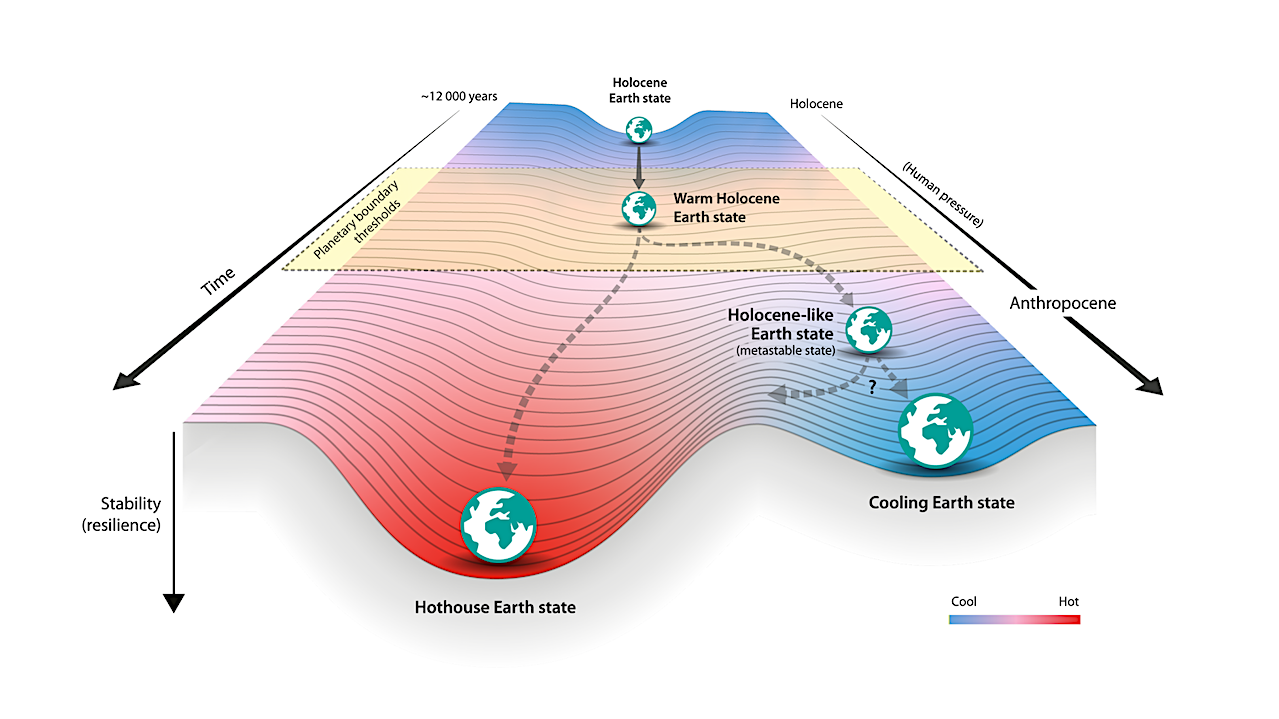
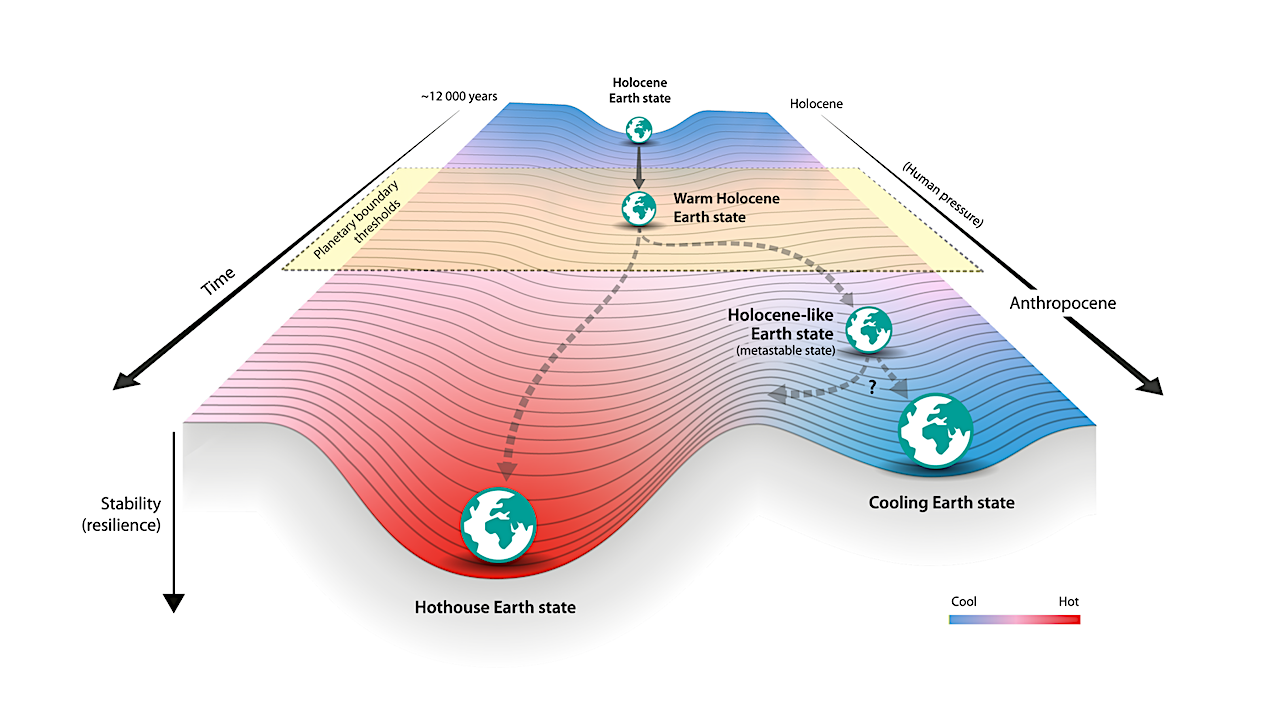
A schematic illustration of the evolution of the Earth System with a start from the Neolithic revolution ( 12.000 years ago). Leading up to its current state (i.e. ”warm Holocene Earth state”) 7 of 9 planetary boundaries have been transgressed. A continuation on this pathway suggests that the Earth system may end up in a Hothouse Earth state (Steffen et al. 2018) (left pathway). However, explicit dissipation of energy, and policies and actions geared at building resilience of a metastable ”Holocene-like Earth state” (see also Fig. 2) could provide an opportunity to build a trajectory toward a future ”cooling Earth state” (right pathway). — astro-ph.EP
Resilience is a property of social, ecological, social-ecological and biophysical systems. It describes the capacity of a system to cope with, adapt to and innovate in response to a changing surrounding.
Given the current climate change crisis, ensuring conditions for a sustainable future for the habitability on the planet is fundamentally dependent on Earth System (ES) resilience. It is thus particularly relevant to establish a model that captures and frames resilience of the ES, most particularly in physical terms that can be influenced by human policy (See page 4 for examples of strategies).
In this work we propose that resilience can serve as a theoretical foundation when unpacking and describing metastable states of equilibrium and energy dissipation in any dynamic description of the variables that characterise the ES. Since the impact of the human activities can be suitably gauged by the planetary boundaries (PBs) and the planet’s temperature is the net result of the multiple PB variables, such as CO2 concentration and radiative forcing, atmospheric aerosol loading, atmospheric ozone depletion, etc, then resilience features arise once conditions to avoid an ES runaway to a state where the average temperature is much higher than the current one.
Our model shows that this runaway can be prevented by the presence of metastable states and dynamic friction built out of the interaction among the PB variables once suitable conditions are satisfied.
In this work these conditions are specified. As humanity moves away from Holocene conditions, we argue that resilience features arising from metastable states might be crucial for the ES to follow sustainable trajectories in the Anthropocene that prevent it run into a much hotter potential equilibrium state.
Orfeu Bertolami, Magnus Nyström
Comments: 18 pages, 2 figures; Accepted for publication at EGUsphere
Subjects: Earth and Planetary Astrophysics (astro-ph.EP); Geophysics (physics.geo-ph); Physics and Society (physics.soc-ph)
Cite as: arXiv:2601.05994 [astro-ph.EP] (or arXiv:2601.05994v1 [astro-ph.EP] for this version)
https://doi.org/10.48550/arXiv.2601.05994
Focus to learn more
Submission history
From: Orfeu Bertolami
[v1] Fri, 9 Jan 2026 18:21:33 UTC (1,226 KB)
https://arxiv.org/abs/2601.05994
Astrobiology,











Related Posts
Stay Informed With the Latest & Most Important News
Previous Post
Next Post





Advertisement
-
 01Two Black Holes Observed Circling Each Other for the First Time
 -
 02From Polymerization-Enabled Folding and Assembly to Chemical Evolution: Key Processes for Emergence of Functional Polymers in the Origin of Life
 -
 03Astronomy 101: From the Sun and Moon to Wormholes and Warp Drive, Key Theories, Discoveries, and Facts about the Universe (The Adams 101 Series)
 -
 04True Anomaly hires former York Space executive as chief operating officer
 -
 05Φsat-2 begins science phase for AI Earth images
 -
 06Hurricane forecasters are losing 3 key satellites ahead of peak storm season − a meteorologist explains why it matters
 -
 07Binary star systems are complex astronomical objects − a new AI approach could pin down their properties quickly