
Now Reading: Proba-3: our eyes on the Sun’s inner corona
-
01
Proba-3: our eyes on the Sun’s inner corona


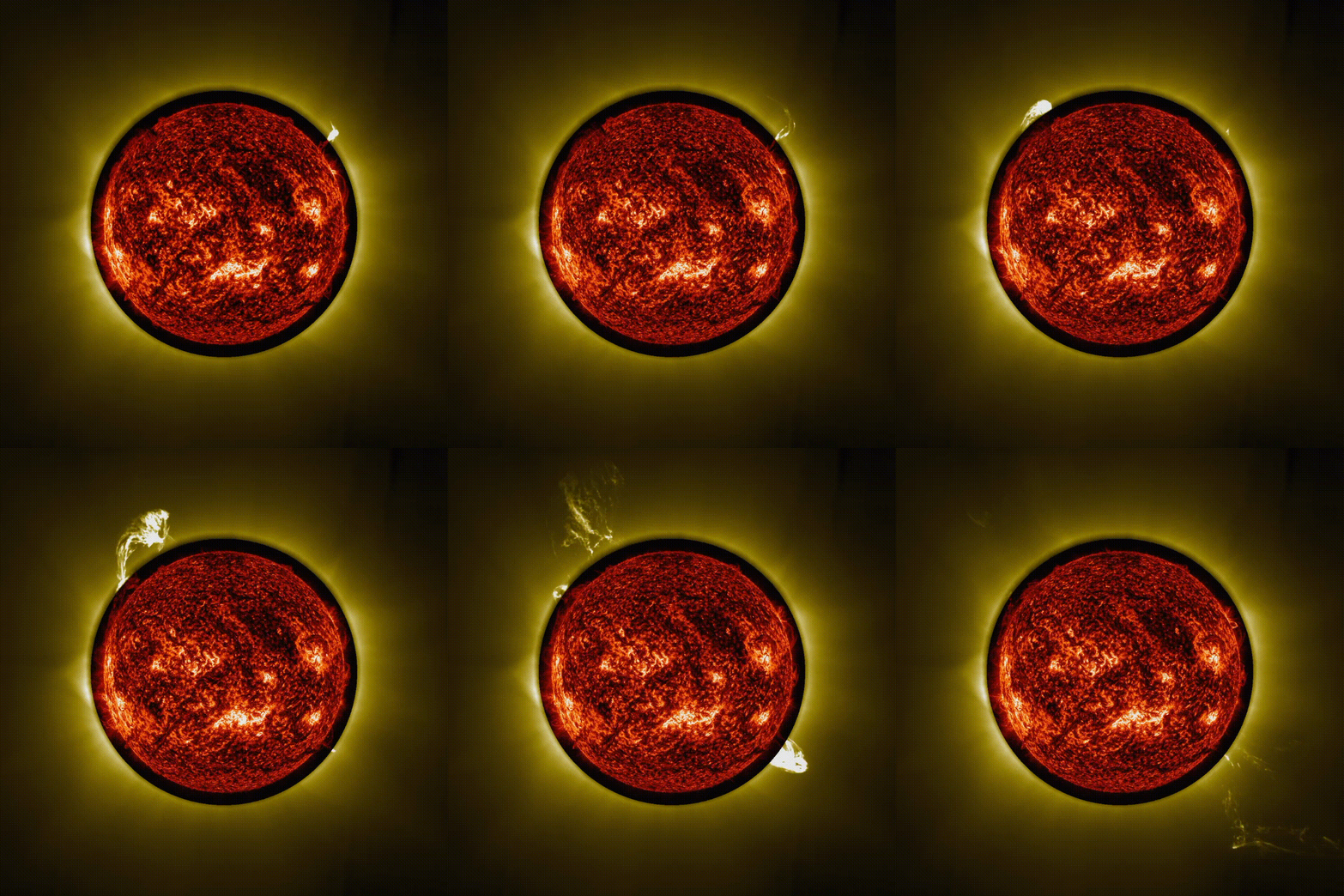

The Sun’s inner corona, the hottest part of our star’s atmosphere, appears faint yellow in this time-lapse made from images taken by the ASPIICS coronagraph aboard Proba-3.
The European Space Agency’s Proba-3 mission consists of two spacecraft capable of flying in precisely controlled formation to create artificial solar eclipses in orbit.
This animation combines data from Proba-3’s ASPIICS coronagraph (inner solar corona in yellow) and from the Atmospheric Imaging Assembly (AIA) aboard NASA’s Solar Dynamics Observatory (solar disc in dark orange).
“The corona is extremely hot, about two hundred times hotter than the Sun’s surface,” explains Andrei Zhukov from the Royal Observatory of Belgium, Principal Investigator for ASPIICS.
“Sometimes, structures made of relatively cold plasma (charged gas) are observed near the Sun – although these are still around 10 000 degrees, they are much colder than the surrounding million-degree hot corona – creating what we call ‘a prominence’.”
Prominences can expand outwards from the Sun and ‘erupt’, breaking up and sending plasma in different directions.
This animation resulted from ASPIICS observing the Sun during an active period on 21 September 2025, with one image taken every five minutes, capturing three prominence eruptions in five hours.
“Seeing so many prominence eruptions in such a short timeframe is rare, so I’m very happy we managed to capture them so clearly during our observation window,” adds Andrei.
The ASPIICS instrument captures the solar corona with several filters, including two different ‘spectral lines’, each line corresponding to a different element contained in the coronal gases.
The prominence eruptions seen in this animation were captured in the spectral line emitted by helium atoms, showing the solar atmosphere similarly to how a human eye would see it during a total eclipse through a yellow ASPIICS filter. The AIA image shows the emission in another spectral line produced by helium.
The remaining faint yellow glow of the corona is a result of the scattering of visible light from the Sun’s surface on coronal electrons.
A set of onboard positioning technologies allow the Proba-3 satellite duo to create solar eclipses in orbit. Thanks to this, the mission is able to observe the inner section of the Sun’s corona, providing scientists with the puzzle piece that has so far been missing from consistent solar observations.
[Image description: This is a gif animation made up of false-colour images taken by ESA’s Proba-3 mission and NASA’s Solar Dynamics Observatory. Against a dark background, the Sun’s disc is shown in dark orange, as captured by NASA’s Solar Dynamics Observatory. A thin halo of yellow light surrounds the Sun, giving it a luminous outline against the dark background of space. This yellow outline shows the Sun’s inner corona, as captured by Proba-3. Also in yellow, three solar prominence eruptions are visible, resembling bright yellow wave-like outburst extending outwards from the Sun. First, we can see a smaller one in the top right corner, followed by a larger one in the top left and a third one in the bottom right. The whole animation lasts about 4 seconds and plays in a loop.]










Related Posts

Stay Informed With the Latest & Most Important News
Previous Post
Next Post
Previous Post

Next Post




Advertisement
-
 01Two Black Holes Observed Circling Each Other for the First Time
 -
 02From Polymerization-Enabled Folding and Assembly to Chemical Evolution: Key Processes for Emergence of Functional Polymers in the Origin of Life
 -
 03Astronomy 101: From the Sun and Moon to Wormholes and Warp Drive, Key Theories, Discoveries, and Facts about the Universe (The Adams 101 Series)
 -
 04True Anomaly hires former York Space executive as chief operating officer
 -
 05Φsat-2 begins science phase for AI Earth images
 -
 06Hurricane forecasters are losing 3 key satellites ahead of peak storm season − a meteorologist explains why it matters
 -
 07Binary star systems are complex astronomical objects − a new AI approach could pin down their properties quickly