
Now Reading: Damaged DSN antenna out of service until May
-
01
Damaged DSN antenna out of service until May


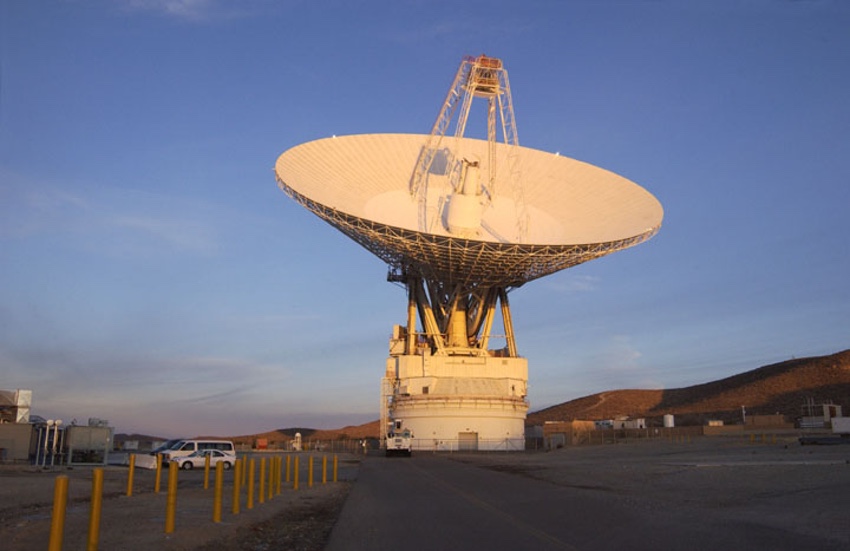

WASHINGTON — A key antenna in NASA’s Deep Space Network (DSN) that was damaged last fall is expected to remain offline until May, before being taken out of service again later this year for major upgrades.
The DSS-14 antenna, a 70-meter dish at the DSN complex in Goldstone, California, was damaged Sept. 16 when it over-rotated, stressing cabling and piping. The incident also damaged hoses in the antenna’s fire control system, causing flooding.
NASA publicly acknowledged the incident in early November after weeks of rumors about damage that took the antenna offline. DSS-14 is one of three 70-meter antennas in the DSN; the others are located near Madrid, Spain, and Canberra, Australia.
The 70-meter antennas are used to communicate with distant spacecraft or those experiencing technical problems. Each DSN site also operates several smaller antennas.
In addition to spacecraft communications, DSS-14 serves as a planetary radar, transmitting signals that reflect off nearby solar system objects and return to the antenna. Scientists use those data to characterize near-Earth asteroids, including their size and shape.
Lance Benner, a scientist at NASA’s Jet Propulsion Laboratory who uses DSS-14 for planetary radar work, said at a Jan. 14 meeting of the Small Bodies Assessment Group that the investigation into the incident is ongoing. He said the damage did not occur while the antenna was being used for planetary radar observations.
DSS-14 is officially scheduled to resume operations May 1, Benner said. “Unofficially, this might change. We’re hearing a variety of things,” he added, without specifying whether the return could be earlier or later.
He noted that DSS-14 had already been scheduled to go offline in August 2026 for extended maintenance expected to last until October 2028, replacing equipment that in some cases is 40 to 50 years old.
“This is an effort to extend the operational lifetime of the whole facility,” he said of the roughly 60-year-old antenna. “Every roughly 20 years, the DSN attempts to improve equipment and modernize things to extend the operational lifetime.”
With DSS-14 currently offline and expected to be taken out of service again later this year for a lengthy overhaul, Benner said researchers are turning to alternatives for planetary radar observations.
Those include using another Goldstone antenna, DSS-13, as a radar transmitter, with reflected signals received at the Green Bank Observatory in West Virginia. The sensitivity of that bistatic system is roughly one-tenth that of DSS-14, he said.
Although DSS-14 is not scheduled to return to full service until October 2028, Benner said it could be available for limited observations as early as April of that year. He emphasized that the antenna and its radar capabilities are expected to be operational months before the asteroid Apophis makes a very close flyby of Earth in April 2029.
Artemis pressures on DSN
Beyond the loss of one of its largest antennas, the DSN is also facing increased demands from the Artemis 2 mission, which is scheduled to launch as soon as early February. NASA will rely on the DSN to support communications with the Orion spacecraft during its 10-day flight around the moon.
Support for Artemis 1 in 2022 strained the network, forcing other missions to relinquish hundreds of hours of antenna time. A similar impact is expected for Artemis 2.
“The new requirements of Artemis are putting stress and pressure on the Deep Space Network,” said Greg Heckler, deputy program manager for capability development in NASA’s Space Communications and Navigation, or SCaN, program, in a later presentation at the meeting.
“But with that, there’s actually an opportunity,” he said. “An opportunity for us to get some folks interested in making sure the DSN has the capability, the capacity and is resilient as we move forward in human exploration.”
He said Artemis communications requirements have underscored the need to upgrade DSN infrastructure in ways that will also benefit science missions.
“With human spaceflight using the DSN, there’s so much opportunity to get the resources we need,” he said, citing both new capabilities and long-needed maintenance to ensure the network is robust.
He cautioned, however, that science missions should expect reduced access to the DSN during Artemis flights, which could eventually last up to four weeks.
“Artemis is going to drive the DSN, but only for four weeks a year,” he said. “The Science Mission Directorate community will have those other 11 months of the year, especially if we expand and have a more resilient capability, to run amok.”










Related Posts

Stay Informed With the Latest & Most Important News
Previous Post
Next Post




Advertisement
-
 01Two Black Holes Observed Circling Each Other for the First Time
 -
 02From Polymerization-Enabled Folding and Assembly to Chemical Evolution: Key Processes for Emergence of Functional Polymers in the Origin of Life
 -
 03Astronomy 101: From the Sun and Moon to Wormholes and Warp Drive, Key Theories, Discoveries, and Facts about the Universe (The Adams 101 Series)
 -
 04True Anomaly hires former York Space executive as chief operating officer
 -
 05Φsat-2 begins science phase for AI Earth images
 -
 06Hurricane forecasters are losing 3 key satellites ahead of peak storm season − a meteorologist explains why it matters
 -
 07Binary star systems are complex astronomical objects − a new AI approach could pin down their properties quickly