
Now Reading: Dragonfly Mission: Optomechanical Design Of The DragonCam Microscopic Camera
-
01
Dragonfly Mission: Optomechanical Design Of The DragonCam Microscopic Camera


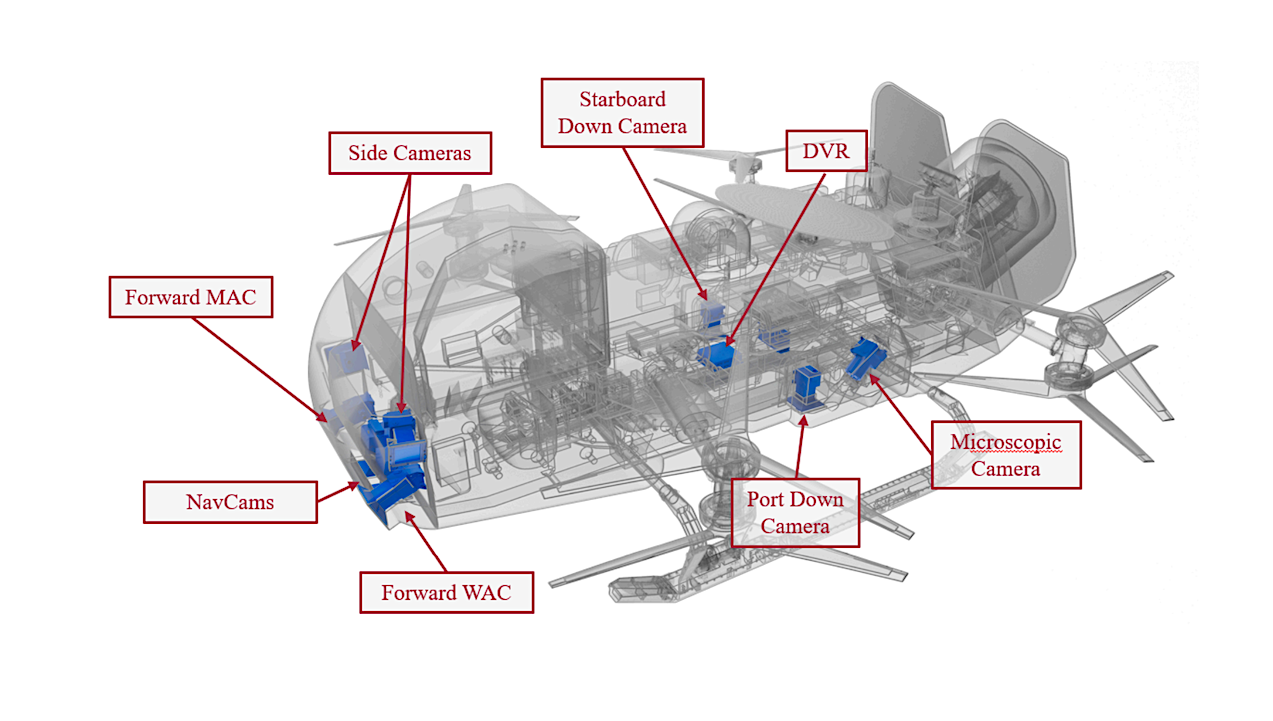
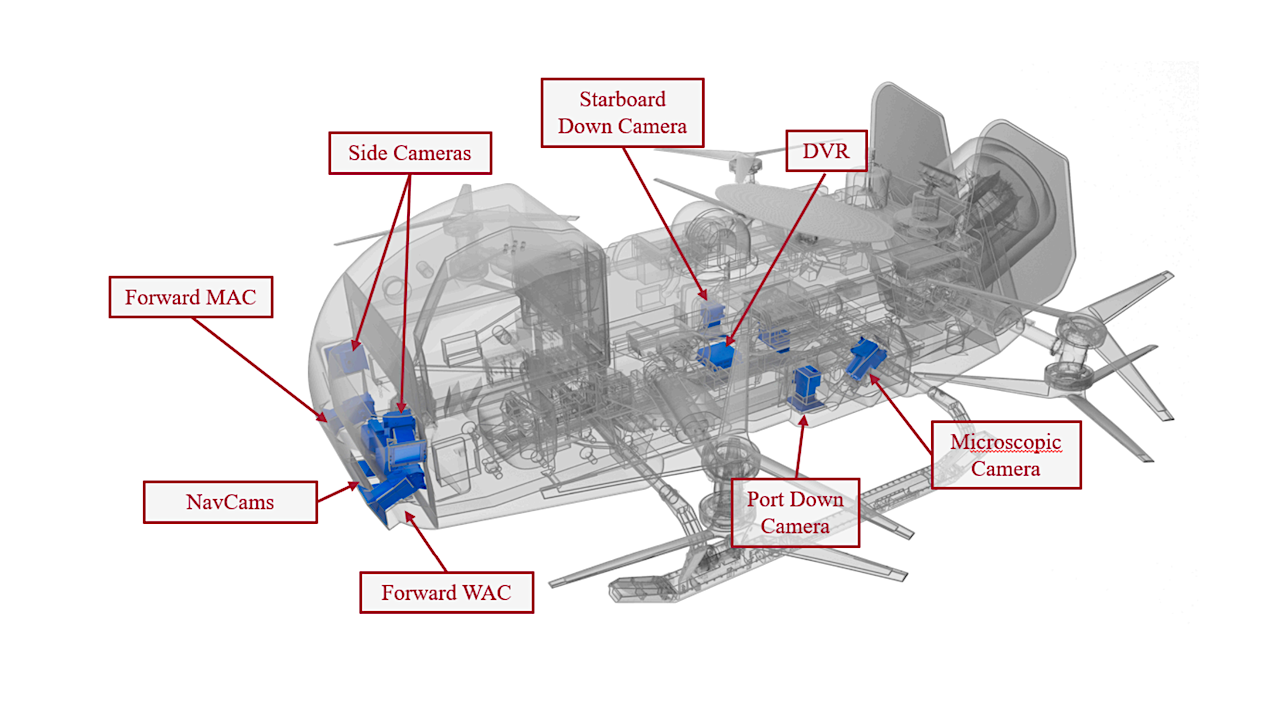
Locations of camera components within the Dragonfly spacecraft. — astro-ph.IM
The DragonCam Microscopic Camera is an instrument being developed for NASA’s Dragonfly mission [1] to Saturn’s moon Titan.
The Microscopic Camera will be body-fixed to the Dragonfly vehicle and will image the surface at a distance of about one meter (98.6 cm nominal) with a pixel scale of better than 60 microns/pixel and a nominal 52 degree angle to the Titan surface. With the 4.8 um pixel pitch of the sensor, this is a focal length of about 77.5 mm.
To accommodate range variations due to vehicle pose and surface topography, the Microscopic Camera has a focus mechanism to give it a depth of field (DOF) of about 130mm. Since the Microscopic Camera’s boresight is tilted by 52° off the vertical, the optical configuration has a compensating tilted focal plane, taking advantage of the Scheimpflug imaging principle. The optics are all-refractive with nine elements, a six-element stationary group and a three-element moving group.
A plano-plano window seals the optics from the environment and also serves as the substrate for a bandpass filter. The optomechanical system is derived from the Mars Hand Lens Imager [11]; the moving group is mounted to a linear slide which is translated via a cam follower by the rotation of a cam driven by a stepper motor. The Microscopic Camera is designed to survive at temperatures as low as -130C without power.
The camera is enclosed in a cavity in the foam insulation covering the spacecraft and looking through a single-pane window. Prior to imaging, the camera will be heated to operating temperature (nominal -30C) for proper actuation of the mechanism. STOP analysis has been performed to demonstrate that optical performance is maintained after heating. Software focus merging will be performed in the onboard camera control electronics to minimize image data downlink requirements.
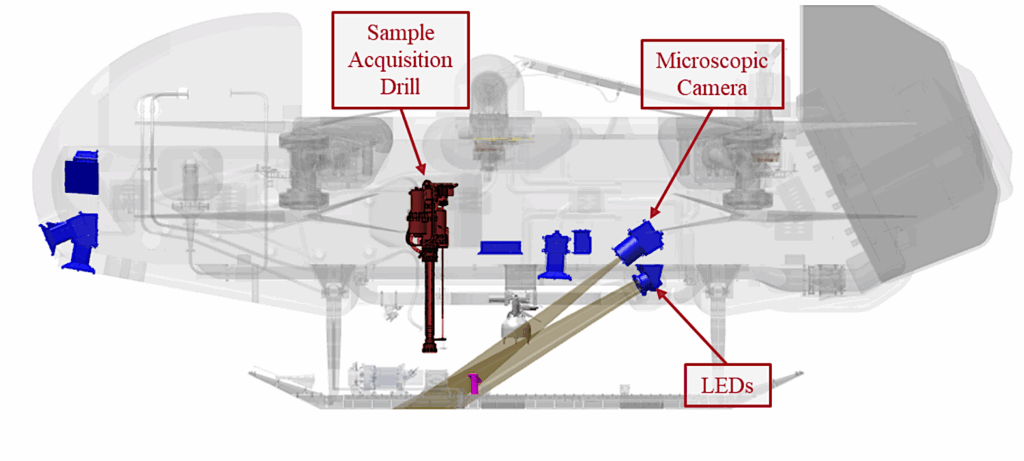
Side View of the Dragonfly Spacecraft showing the co-locating of the Microscopic Camera, LED array, and Sample Acquisition Drill. — astro-ph.IM
M. J. Clark, M. A. Ravine, M. A. Caplinger, B. A. Lindenfeld, J. D. Laramee, R. S. Bronson, A. D. Giglio, B. G. Crowther
Comments: 16 pages, 22 figures
Subjects: Instrumentation and Methods for Astrophysics (astro-ph.IM)
Cite as: arXiv:2601.13221 [astro-ph.IM] (or arXiv:2601.13221v1 [astro-ph.IM] for this version)
https://doi.org/10.48550/arXiv.2601.13221
Focus to learn more
Journal reference: Proceedings of the SPIE, Volume 13599, id. 135990B 16 pp. (2025)
Related DOI:
https://doi.org/10.1117/12.3065774
Focus to learn more
Submission history
From: Michael Caplinger
[v1] Mon, 19 Jan 2026 16:51:20 UTC (6,277 KB)
https://arxiv.org/abs/2601.13221
Astrobiology,










Related Posts

Stay Informed With the Latest & Most Important News
Previous Post
Next Post

Advertisement
-
 01Two Black Holes Observed Circling Each Other for the First Time
 -
 02From Polymerization-Enabled Folding and Assembly to Chemical Evolution: Key Processes for Emergence of Functional Polymers in the Origin of Life
 -
 03Astronomy 101: From the Sun and Moon to Wormholes and Warp Drive, Key Theories, Discoveries, and Facts about the Universe (The Adams 101 Series)
 -
 04True Anomaly hires former York Space executive as chief operating officer
 -
 05Φsat-2 begins science phase for AI Earth images
 -
 06Hurricane forecasters are losing 3 key satellites ahead of peak storm season − a meteorologist explains why it matters
 -
 07Binary star systems are complex astronomical objects − a new AI approach could pin down their properties quickly