
Now Reading: Biofilms: From The Cradle Of Life To life Support
-
01
Biofilms: From The Cradle Of Life To life Support


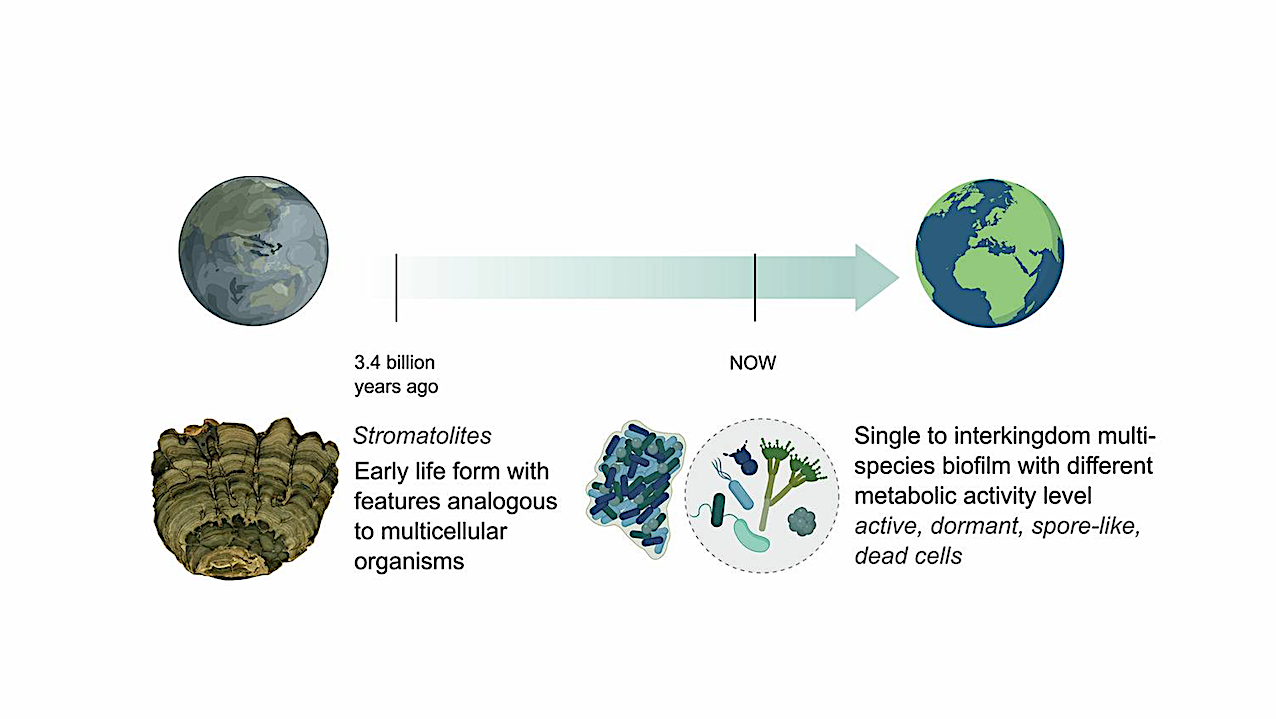
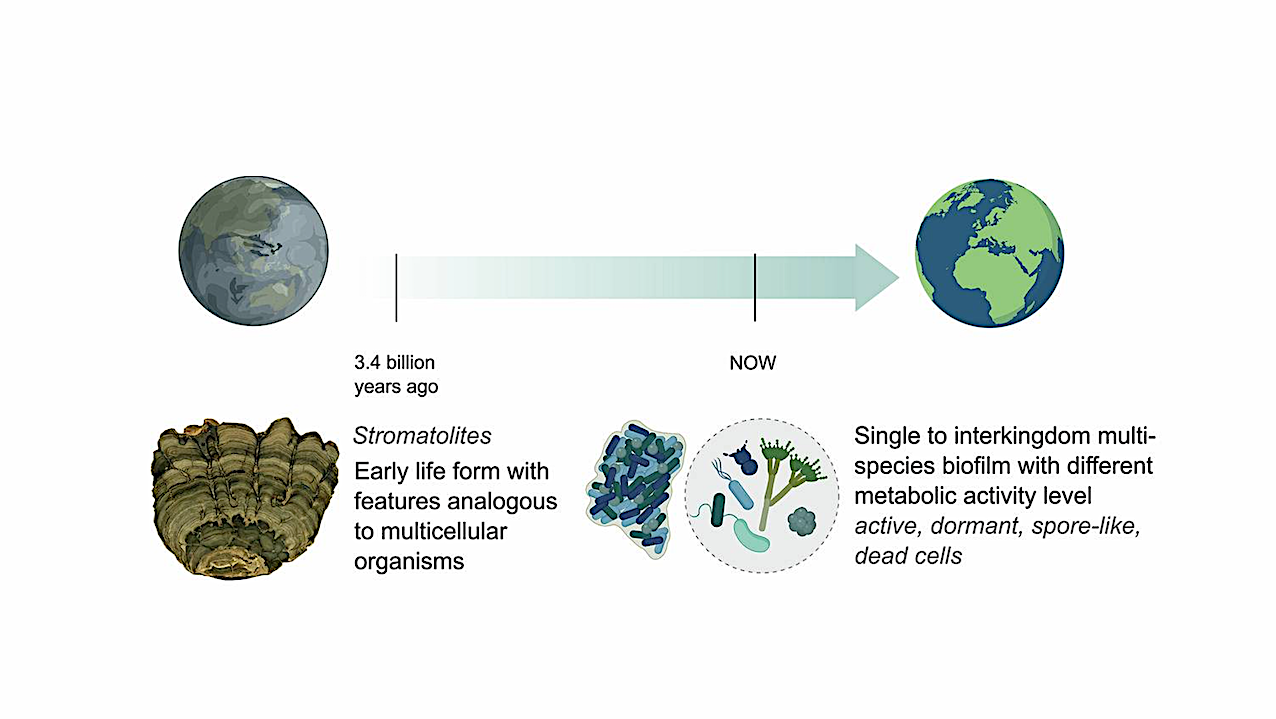
Evolutionary timeline showing early stromatolite biofilms to modern interkingdom biofilms.
Biofilms are intricately associated with life on Earth, enabling functions essential to human and plant systems, but their susceptibility to spaceflight stressors and functional disruption in space remains incompletely understood. During spaceflight, biofilms have largely been considered as potential infrastructure, life support or infection risks. This review focuses on the prevailing beneficial roles of biofilms in human and plant health, and examines evidence of biofilm adaptability in space environments.
Biofilms and the emergence of life
The earliest stages of life are thought to have involved the gradual transition from abiotic synthesis of simple organic molecules into nascent biotic chemistry at surface attached compartments, where physical scaffolding and local chemical exchange may have supported the emergence of primitive microbial life.
Mineral-rich environments, such as hydrothermal vents and hot springs, provide catalytic surfaces and sources of fluctuating energy, such as thermal fluxes, electrochemical gradients and photochemical processes, that could have supported nonadiabatic synthesis pathways to produce organic compounds without proto-enzymes. These environments may have promoted the aggregation or polymerisation of simple organic molecules through adsorptive forces and repeated hydration-evaporation cycles, which then condensed into structured assemblies or non-membrane bound “naked” matrices enriched in the basic building blocks of life, including amino acids, fatty acids, peptides and monosaccharides.
The accumulation of simple and macro amphiphilic molecules may have enhanced chemical partitioning and retention, supporting exchange with the environment while maintaining cooperative structure. These surface bound assemblies likely formed interconnected clusters, where spatial proximity facilitated molecular exchange, cohesion and rudimentary functional integration. Internal heterogeneity within these surface-bound and polymer-rich matrices may have supported simple metabolic cycling, directional transport and division of function, while also providing the spatial and chemical context for increasingly complex coordination, selective exchange and surface-level organisation. These emerging features define true biofilms the predominant microbial lifestyle across Earth’s major habitats.
Ancestral biofilm-embedded protocell networks would have supported cooperative and competitive interactions, aiding persistence in extreme environments. In extant biofilms, this persistence involves fundamental functions related to transformation, structure, communication and movement, derived from elemental processes (Fig. 1 which underpin survival and proliferation, but also enable the emergence of higher-order behaviour.
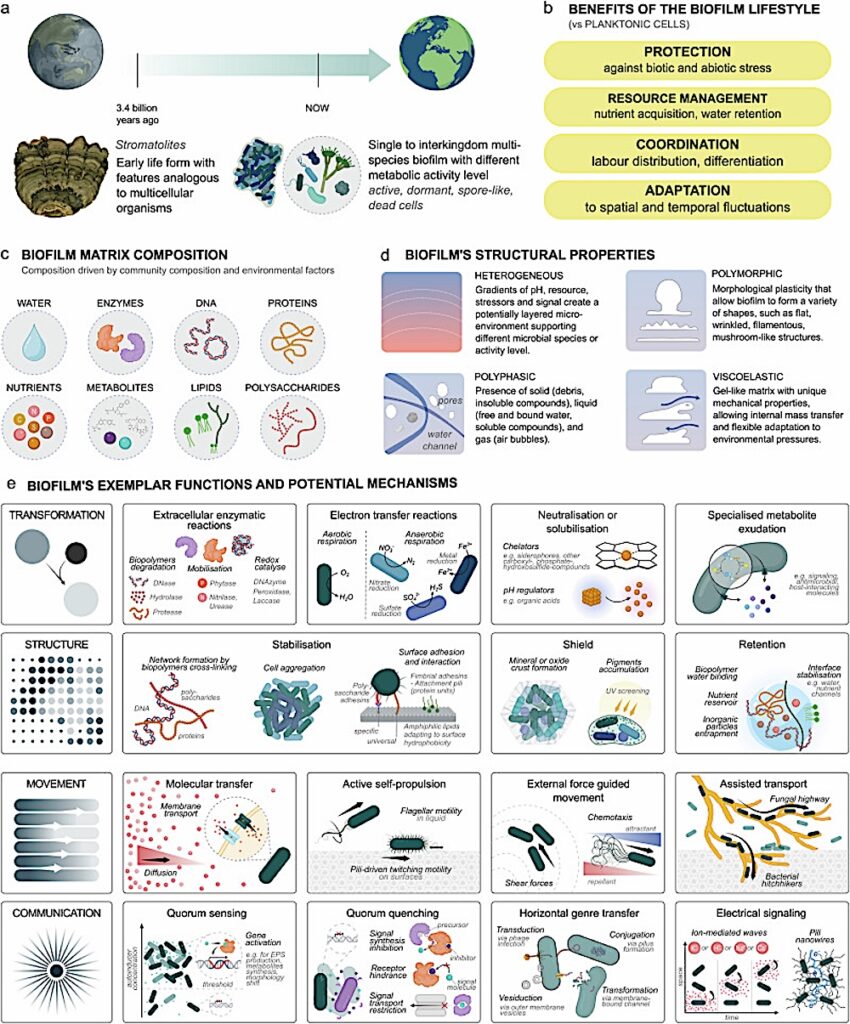
a Evolutionary timeline showing early stromatolite biofilms to modern interkingdom biofilms. b Biofilms provide fundamental benefits over planktonic life through protection against environmental stressors, efficient resource management and improved coordination and adaptability in response to spatial and temporal fluctuations. c Modern extracellular polymeric substances (EPS) matrices comprise water (up to 97% by mass), polysaccharides, proteins, extracellular DNA, lipids, secondary metabolites, nutrients, and exoenzymes, each contributing to hydration, cohesion, signalling, metabolism, structural integrity, and chemical defence. EPS composition is shaped by both microbial community structure and environmental conditions. d Biofilm structure varies by environmental gradients, containing solid, liquid, and gas phases, with flexible morphology and mechanical properties. e) Representative biofilm functions grouped by transformation, structure, movement, and communication, with example mechanisms.— NPJ Biofilms Microbiomes
Biofilms: from the cradle of life to life support, NPJ Biofilms Microbiomes via Pubmed (oen access)
Astrobiology, Microbiology, evolution,










Related Posts
Stay Informed With the Latest & Most Important News
![Astronomy Activity Book for Kids: 100+ Fun Ways to Learn About Space and Stargazing [Spiral-bound] Aurora Lipper and Victoria Stebleva [Spiral-bound]](https://flyingtomars.com/wp-content/uploads/2026/01/astronomy-activity-book-for-kids-100-fun-ways-to-learn-about-space-and-stargazing-spiral-bound-aurora-lipper-and-victoria-stebleva-spiral-bound.jpg)
Advertisement
-
 01Two Black Holes Observed Circling Each Other for the First Time
 -
 02From Polymerization-Enabled Folding and Assembly to Chemical Evolution: Key Processes for Emergence of Functional Polymers in the Origin of Life
 -
 03Astronomy 101: From the Sun and Moon to Wormholes and Warp Drive, Key Theories, Discoveries, and Facts about the Universe (The Adams 101 Series)
 -
 04True Anomaly hires former York Space executive as chief operating officer
 -
 05Φsat-2 begins science phase for AI Earth images
 -
 06Hurricane forecasters are losing 3 key satellites ahead of peak storm season − a meteorologist explains why it matters
 -
 07Binary star systems are complex astronomical objects − a new AI approach could pin down their properties quickly