
Now Reading: Satellite Imagery Reveals Vibrant Ecosystem and Environmental Challenges in the Pantanal
-
01
Satellite Imagery Reveals Vibrant Ecosystem and Environmental Challenges in the Pantanal

Satellite Imagery Reveals Vibrant Ecosystem and Environmental Challenges in the Pantanal

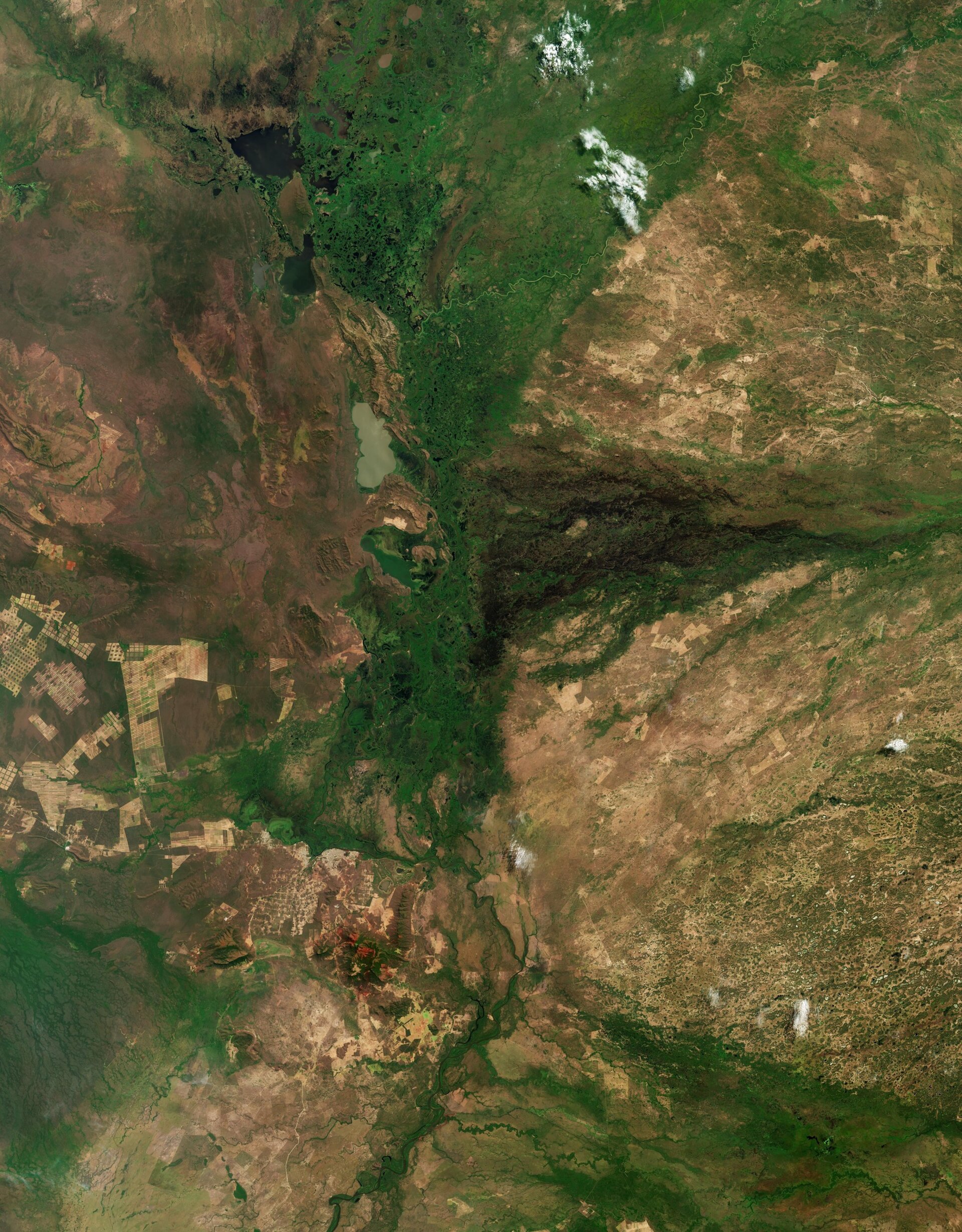

Recent imagery from the Copernicus Sentinel-2 mission unveils the striking landscape of the Pantanal, a vital ecological area straddling the Brazilian-Bolivian border. Spanning approximately 200,000 square kilometers, the Pantanal is recognized as the world’s largest tropical wetland, representing a site of immense environmental significance. The region primarily lies within the Brazilian states of Mato Grosso and Mato Grosso do Sul, while also extending into parts of Bolivia and Paraguay.
A September 2025 satellite image provides a glimpse of this expansive floodplain, showcasing a diverse array of ecosystems that include flooded grasslands, tropical forests, and interconnected waterways. Central to the image is a deep green corridor, indicative of rich riparian vegetation that thrives along waterways and permanent wetlands, contrasting with the surrounding brown savannas.
The Pantanal functions similarly to a vast internal delta, where a high number of rivers converge to sustain a complex network of wetlands. Notably, the Rio Paraguay, which winds gracefully through the lush landscape, plays an important role in this ecosystem by enabling the natural flood cycles that support the area’s rich biodiversity.
Moving southward along the river, the image reveals the Brazilian city of Corumbá, a significant urban hub that serves as an entry point to the Pantanal. Its organized rectangular layout is bordered by fields and pastures to the south, with reddish-brown patches indicating cracked clay soil exposed during the dry months. These barren regions experience a dramatic transformation during the wet season from November to April, flourishing into vibrant greenery.
Further west, urban centers emerge on the Bolivian side, identified as the inland ports of Puerto Suarez and Puerto Quijarro. The image also highlights light brown areas where savanna and forest have been cleared for agricultural purposes, particularly for cattle ranching and soybean cultivation. However, this region has seen considerable deforestation over recent years, shifting from lush forests to a patchwork of farms, underlining ongoing environmental challenges faced by this extraordinary ecosystem.










Related Posts

Stay Informed With the Latest & Most Important News
Previous Post
Next Post



Advertisement
-
 01Two Black Holes Observed Circling Each Other for the First Time
 -
 02From Polymerization-Enabled Folding and Assembly to Chemical Evolution: Key Processes for Emergence of Functional Polymers in the Origin of Life
 -
 03Astronomy 101: From the Sun and Moon to Wormholes and Warp Drive, Key Theories, Discoveries, and Facts about the Universe (The Adams 101 Series)
 -
 04True Anomaly hires former York Space executive as chief operating officer
 -
 05Φsat-2 begins science phase for AI Earth images
 -
 06Hurricane forecasters are losing 3 key satellites ahead of peak storm season − a meteorologist explains why it matters
 -
 07Binary star systems are complex astronomical objects − a new AI approach could pin down their properties quickly