
Now Reading: Amazon’s internet-beaming satellites are bright enough to disrupt astronomical research, study finds
-
01
Amazon’s internet-beaming satellites are bright enough to disrupt astronomical research, study finds

Amazon’s internet-beaming satellites are bright enough to disrupt astronomical research, study finds

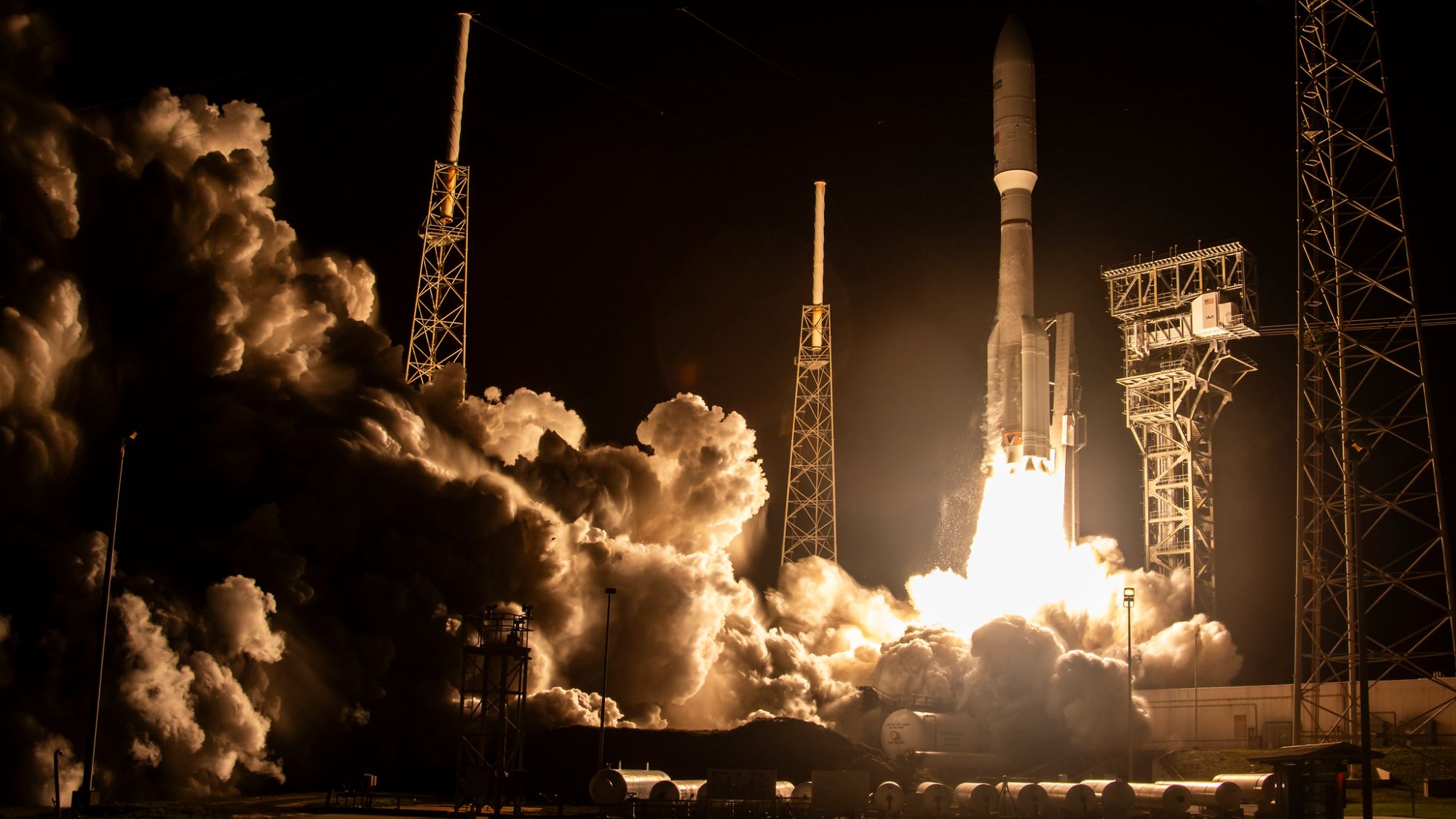
The satellites in Amazon’s new internet-beaming megaconstellation in low Earth orbit (LEO) are bright enough to disrupt astronomical research, a study has found.
The study — which was posted on the online repository Arxiv on Jan. 12 but has not yet been peer-reviewed — analyzed nearly 2,000 observations of Amazon Leo satellites. It concluded that the spacecraft exceed the brightness limit recommended by the International Astronomical Union (IAU) that aims to ensure harmless coexistence of satellite megaconstellation with astronomical research.
“Bright satellites are particularly troublesome for large-scale astronomical surveys being conducted at ground-based observatories such as the Vera C. Rubin Observatory,” study lead author Anthony Mallama, an astronomer at the IAU Center for Protection of the Dark And Quiet Sky, told Space.com in an email. “However, they can also interfere with orbiting observatories like the Hubble Space Telescope.”
Mallama and his colleagues have previously studied the brightness of other satellite networks, especially SpaceX‘s Starlink, which, with around 9,500 satellites, is by far the largest constellation in orbit today. They also observed the giant BlueBird satellite arrays operated by AST SpaceMobile, whose antennas, which cover 690 square feet (64 square meters), make them the brightest artificial objects in the night sky. (And the next-gen BlueBirds are even bigger, with antennas covering nearly 2,400 square feet, or 223 square m).
Mallama noted that satellites in the Amazon Leo constellation (which used to be known as Project Kuiper) are significantly dimmer than the BlueBirds and slightly fainter than most Starlink satellites, which orbit at a lower altitude of around 300 miles (480 km). Mallama, however, added that the Starlink constellation benefits from being in Earth’s shadow for most of its orbital time, which makes it less obtrusive.
Future Amazon Leo satellites are expected to orbit at lower altitudes of around 366 miles (590 km), which will further increase their brightness.
John Barentine, an astronomer at the Silverado Hills Observatory in Tucson, Arizona, and a dark sky expert who did not participate in the new study, said that the Amazon Leo satellites appear especially bright during twilight.
Amazon began launching its internet constellation in 2025. So far, only 180 satellites have been placed into orbit, but Amazon plans to grow the constellation to more than 3,200 spacecraft.
Mallama, however, lauded Amazon for its willingness to engage with astronomers and work on reducing the impact of its satellites on the night skies.
“Satellite operators such as Amazon and SpaceX are working with the astronomical community to reduce the brightness of their satellites,” Mallama said. “One method is by making the underside of the spacecraft mirror-like so that sunlight is reflected into space rather than scattering to the ground. Another is to orient the satellites’ components so that observers on the ground do not see the sunlit sides.”
Barentine added that, since the launch of Amazon’s first test satellites in 2023, the company’s engineers have managed to reduce the amount of light the orbiting satellites reflect to Earth and therefore their visibility in the night sky.
“Amazon Leo is an instance in which the operator established a dialogue with astronomers early in the design phase of their constellation,” said Barentine. “It is encouraging to see that this effort has yielded some success.”
Astronomers began sounding alarm bells about the impact of satellite megaconstellations on the observations of the universe shortly after the launch of the first batch of SpaceX’s Starlink satellites in 2019. Back then, they revealed streaked images, affected by the trails left behind by satellites passing in the view of telescopes. But since then, SpaceX too has worked on reducing the brightness of its satellites.
Still, an earlier report — published by Mallama and his colleagues in the journal Monthly Notices of the Royal Astronomical Society in November 2025 — found that, with the exception of OneWeb satellites, which orbit at higher altitudes of 745 miles (1,200 km), all currently operational internet-beaming constellations, including the Chinese projects Qianfan and Guowang, were exceeding the IAU-recommended brightness limits.










Related Posts


Stay Informed With the Latest & Most Important News
Previous Post
Next Post


Advertisement
-
 01Two Black Holes Observed Circling Each Other for the First Time
 -
 02From Polymerization-Enabled Folding and Assembly to Chemical Evolution: Key Processes for Emergence of Functional Polymers in the Origin of Life
 -
 03Astronomy 101: From the Sun and Moon to Wormholes and Warp Drive, Key Theories, Discoveries, and Facts about the Universe (The Adams 101 Series)
 -
 04True Anomaly hires former York Space executive as chief operating officer
 -
 05Φsat-2 begins science phase for AI Earth images
 -
 06Hurricane forecasters are losing 3 key satellites ahead of peak storm season − a meteorologist explains why it matters
 -
 07Binary star systems are complex astronomical objects − a new AI approach could pin down their properties quickly