
Now Reading: This galaxy cluster provides a lens on distant space
-
01
This galaxy cluster provides a lens on distant space



EarthSky’s 2026 lunar calendar shows the moon phase for every day of the year. Get yours today!
ESA originally published this story on January 22, 2026. Edits by EarthSky.
A galaxy cluster and its lensed galaxies
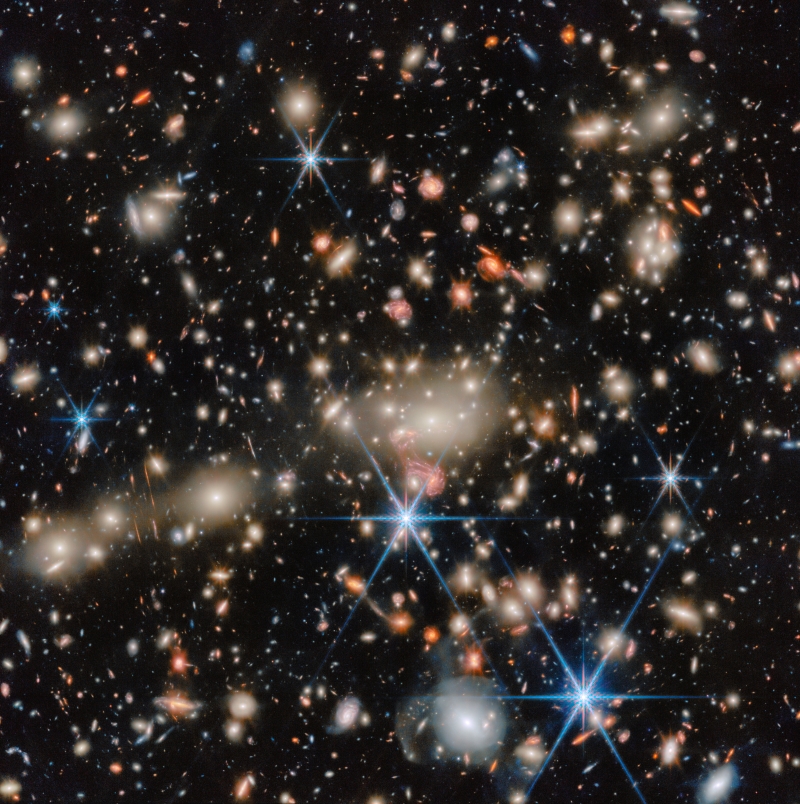
Check out the beautiful image above from the James Webb Space Telescope. It’s Webb’s Picture of the Month. Most of the specks you see pictured there are distant galaxies. At the center is the cluster itself, called MACS J1149.5+2223, or MACS J1149 for short. It’s the ghostly huddle of elliptical galaxies in the image’s center. Located about 5 billion light-years away in the direction of Leo the Lion, these galaxies’ immense gravity dominates the scene.
Gravity pulls together the hundreds of galaxies in the cluster itself. And that same gravity also bends, magnifies, and distorts the light of even more distant background galaxies, creating the faint curved arcs seen throughout the image.
This is the phenomenon of gravitational lensing. The mass of the main galaxy cluster provides a “lens” that lets us view the more distant galaxies behind it.
Notice the ‘pink jellyfish’
This phenomenon of gravitational lensing lets us see distant galaxies we wouldn’t be able to see otherwise. That’s what you’re seeing scattered across the image of MACS J1149: subtle and not-so-subtle examples of gravitational lensing, from galaxies that appear to have been stretched into narrow streaks of light to galaxy images that have morphed into strange shapes.
You can see a fantastic example of gravitational lensing near the center of the image. Look just below the brilliant white galaxies at the heart of the cluster. There, the image of a galaxy with distinct spiral arms has morphed into something resembling a pink jellyfish. This tangled-looking galaxy is home to what was once the most distant single star ever discovered as well as a supernova whose image appeared four times at once.
Pan through the spectacular galaxy cluster in this video from ESA.
A celebrity galaxy cluster
MACS J1149 has long received the celebrity treatment from leading telescopes, and for good reason. This cluster was one of six investigated through the Hubble Space Telescope’s Frontier Fields program. Scientists selected the Frontier Fields galaxy clusters for the strength of their gravitational lensing. Their ability to warp spacetime has granted researchers a glimpse into the early universe.
Now, Webb is pushing our knowledge horizon to even earlier times, enabling new discoveries like a feasting supermassive black hole less than 600 million years after the Big Bang. Using Webb’s Near-Infrared Spectrograph (NIRSpec), Near-InfraRed Camera (NIRCam), and Near-InfraRed Imager and Slitless Spectrograph (NIRISS), researchers are revealing never-before-seen details of the lives of early galaxies.
Scientists collected the Webb data for this image as part of the Canadian NIRISS Unbiased Cluster Survey (CANUCS) program #1208 (PI: C. J. Willott). This program uses Webb’s sensitive instruments to unveil the evolution of low-mass galaxies in the early universe, revealing their star formation, dust and chemistry. The data will also help researchers study the epoch of reionization, when the first stars and galaxies lit up the universe, map the distribution of mass within galaxy clusters, and understand how star formation can slow to a trickle in a cluster environment.
Bottom line: The Webb space telescope has imaged the stunning galaxy cluster MACS J1149, putting a spotlight on its prominent gravitational lensing.
Read more: A fast-growing supermassive black hole in the early universe
The post This galaxy cluster provides a lens on distant space first appeared on EarthSky.










Related Posts

Stay Informed With the Latest & Most Important News
Previous Post
Next Post




Advertisement
-
 01Two Black Holes Observed Circling Each Other for the First Time
 -
 02From Polymerization-Enabled Folding and Assembly to Chemical Evolution: Key Processes for Emergence of Functional Polymers in the Origin of Life
 -
 03Astronomy 101: From the Sun and Moon to Wormholes and Warp Drive, Key Theories, Discoveries, and Facts about the Universe (The Adams 101 Series)
 -
 04True Anomaly hires former York Space executive as chief operating officer
 -
 05Φsat-2 begins science phase for AI Earth images
 -
 06Hurricane forecasters are losing 3 key satellites ahead of peak storm season − a meteorologist explains why it matters
 -
 07Binary star systems are complex astronomical objects − a new AI approach could pin down their properties quickly