
Now Reading: NASA gets new F-15 fighter jet to chase its X-59 ‘quiet’ supersonic aircraft
-
01
NASA gets new F-15 fighter jet to chase its X-59 ‘quiet’ supersonic aircraft


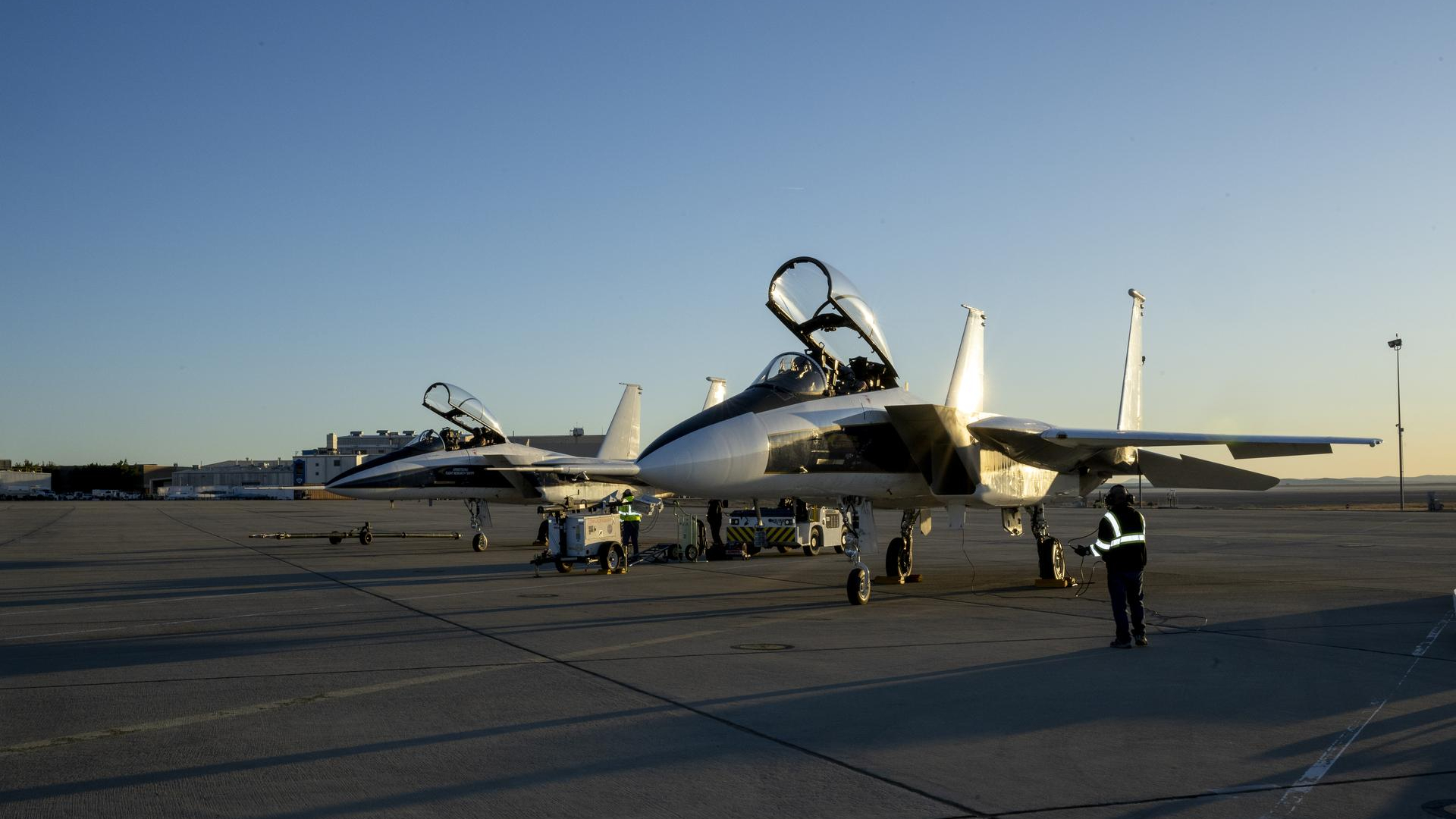
NASA just got a boost in its quest to unlock ‘quiet’ supersonic flight with a pair of retired F-15 jets from the U.S. Air Force.
The former fighter jets are the newest members of the agency’s flight research fleet, which is headquartered at NASA’s Armstrong Flight Research Center in California’s Mojave Desert. The F-15s will now be used to support research flights of NASA’s new X-59 ‘quiet’ supersonic jet, an aircraft designed to fly at supersonic speeds without producing the thunderous sonic booms typically associated with breaking the sound barrier. If such an aircraft can be built and commercialized, it could dramatically decrease flight times across the continental U.S. and revolutionize several industries that depend on rapid response times.
The F-15 jets will be used to support the testing campaign X-59 and the overall mission. “These two aircraft will enable successful data collection and chase plane capabilities for the X-59 through the life of the Low Boom Flight Demonstrator project,” Troy Asher, director for flight operations at NASA Armstrong, said in an announcement. One of the jets will fly again as a NASA aircraft, now used for research. The other F-15 will be used for parts to help sustain the fleet. Both were delivered to NASA in December 2025.
NASA has previously used F-15s to carry sensors that measure air pressure differences caused by the shock waves produced by the X-59 as it breaks the sound barrier, and to fly researchers carrying Schlieren photography systems. These specialized cameras can detect changes in air pressure and allow scientists to visualize air flowing away from the X-59 as it flies.

NASA’s plan is to modify one of the F-15 jets with new equipment and software, so that it can be specialized for research. Most commercial aircraft fly around 30,000 to 40,000 feet (9 to 12 km) above sea level, but the F-15 can maintain a much higher altitude.
Right now, the X-59 cruises at 55,000 feet (17 km) for its test flights, NASA says, and a specially outfitted F-15 jet can follow behind the X-59 at up to 60,000 (18 km) feet in order to collect important data for the mission.
These aircraft will continue a long tradition of using F-15s for research. “NASA has been flying F-15s since some of the earliest models came out in the early 1970s,” Asher said. “Dozens of scientific experiments have been flown over the decades on NASA’s F-15s and have made a significant contribution to aeronautics and high-speed flight research.”

After numerous tests, X-59 flew for the first time in October last year, with Lockheed Martin, the X-59’s manufacturer, saying the plane “performed exactly as planned.”
If you’re wondering what it looks like when an experimental supersonic aircraft zooms across the sky, check out this video, which tracks the X-59’s historic first flight.










Related Posts


Stay Informed With the Latest & Most Important News
Previous Post
Next Post

Advertisement
-
 01Two Black Holes Observed Circling Each Other for the First Time
 -
 02From Polymerization-Enabled Folding and Assembly to Chemical Evolution: Key Processes for Emergence of Functional Polymers in the Origin of Life
 -
 03Astronomy 101: From the Sun and Moon to Wormholes and Warp Drive, Key Theories, Discoveries, and Facts about the Universe (The Adams 101 Series)
 -
 04True Anomaly hires former York Space executive as chief operating officer
 -
 05Φsat-2 begins science phase for AI Earth images
 -
 06Hurricane forecasters are losing 3 key satellites ahead of peak storm season − a meteorologist explains why it matters
 -
 07Binary star systems are complex astronomical objects − a new AI approach could pin down their properties quickly