
Now Reading: Atmospheric Circulation Of High-Obliquity Mini-Neptunes
-
01
Atmospheric Circulation Of High-Obliquity Mini-Neptunes


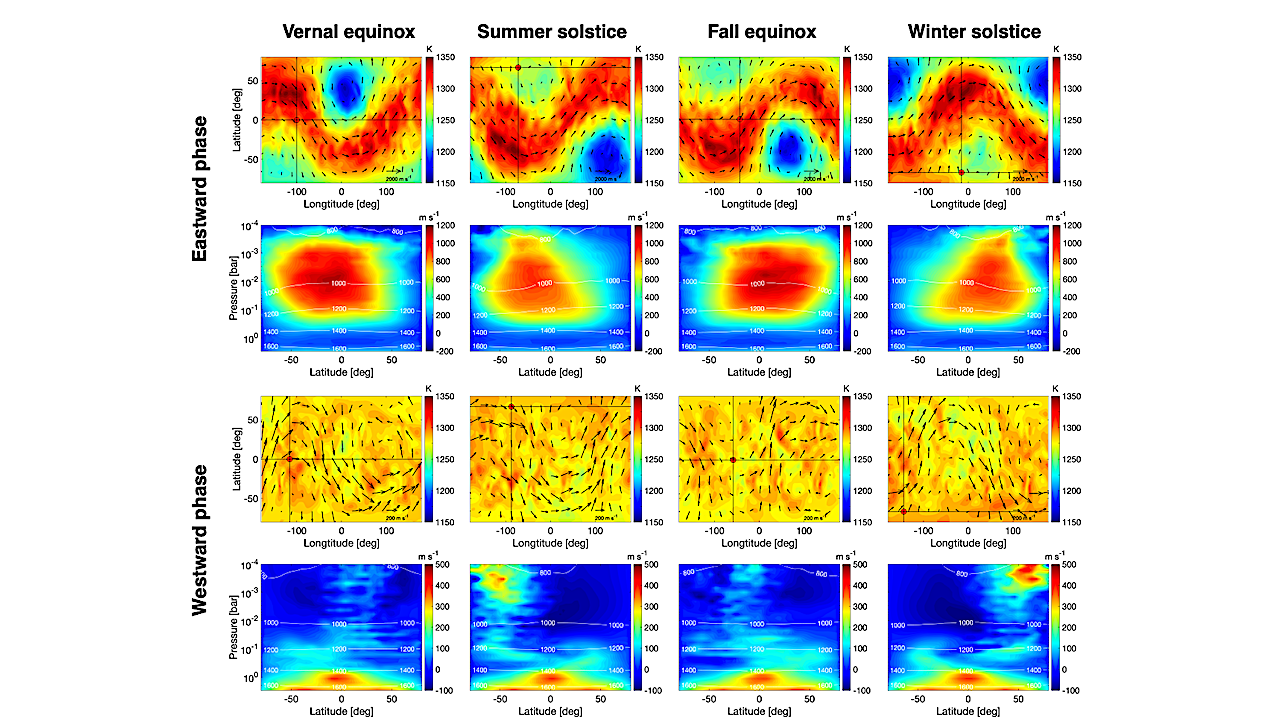
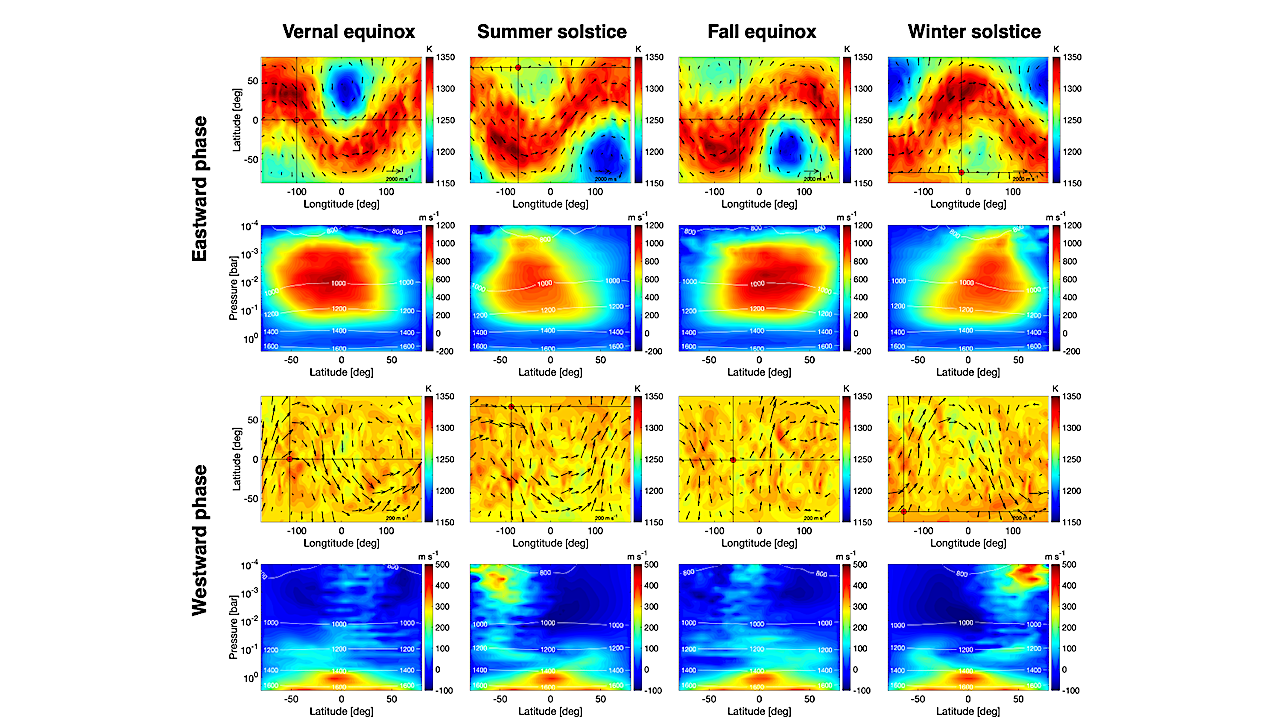
Seasonal variations of circulation patterns during the eastward phase (the top two rows) and the westward phase (the bottom two rows) under nonsynchronous rotation. Each row, from left to right, corresponds to the snapshot at vernal equinox, summer solstice, fall equinox, and winter solstice. For each phase: the top panels show horizontal temperature maps (K) near the photosphere (∼0.2 bar) with horizontal winds as arrows as functions of longitude and latitude. The intersection of the horizontal and vertical black lines (marked by red filled circles) denotes the substellar point. The bottom panels display zonal-mean zonal wind (colors, m s−1 ) and temperature (contours, K) as functions of latitude and pressure. — astro-ph.EP
With the operation of JWST, atmospheric characterization has now extended to low-mass exoplanets.
In compact multiplanetary systems, secular spin-orbital resonance may preserve high obliquities and asynchronous rotation even for tidally-despinning, low-mass planets, potentially leading to unique atmospheric circulation patterns.
To understand the impact on the atmospheric circulation and to identify the potential atmospheric observational signatures of such high-obliquity planets, we simulate the three dimensional circulation of a representative mini-Neptune K2-290 b, whose obliquity may reach about 67 degrees.
Whether synchronously rotating or not, the planet’s slow rotation, moderate temperature and radius result in a global Weak-Temperature-Gradient (WTG) behavior with moderate horizontal temperature contrasts. Under synchronous rotation, broad eastward superrotating jets efficiently redistribute heat.
Circulation in an asynchronous rotation exhibits a seasonal cycle driven by high obliquity, along with quasi-periodic oscillations in winds and temperatures with a period of about 70 orbital periods. These oscillations, driven by wave-mean flow interactions, extend from low to mid-latitudes due to the slow planetary rotation. Higher atmospheric metallicity strengthens radiative forcing, increasing temperature contrasts and jet speeds.
Clouds have minimal impact under synchronous rotation but weaken jets under nonsynchronous rotation by reducing temperature contrasts. In all cases, both thermal emission and transmission spectra exhibit moderate observational signals at a level of 100 ppm, and high-obliquity effects contribute differences at the 10 ppm level.
Our results are also applicable to a range of potential high-obliquity exoplanets, which reside in the WTG regime and likely exhibit nearly homogeneous horizontal temperature patterns.
Yanhong Lai, Xianyu Tan, Yubo Su
Comments: 27 pages, 17 figures, 2 tables; accepted for publication in ApJ
Subjects: Earth and Planetary Astrophysics (astro-ph.EP)
Cite as: arXiv:2601.18606 [astro-ph.EP] (or arXiv:2601.18606v1 [astro-ph.EP] for this version)
https://doi.org/10.48550/arXiv.2601.18606
Focus to learn more
Submission history
From: Yanhong Lai
[v1] Mon, 26 Jan 2026 15:46:42 UTC (39,803 KB)
https://arxiv.org/abs/2601.18606
Astrobiology, exoplanet,










Related Posts

Stay Informed With the Latest & Most Important News
Previous Post
Next Post


Advertisement
-
 01Two Black Holes Observed Circling Each Other for the First Time
 -
 02From Polymerization-Enabled Folding and Assembly to Chemical Evolution: Key Processes for Emergence of Functional Polymers in the Origin of Life
 -
 03Astronomy 101: From the Sun and Moon to Wormholes and Warp Drive, Key Theories, Discoveries, and Facts about the Universe (The Adams 101 Series)
 -
 04True Anomaly hires former York Space executive as chief operating officer
 -
 05Φsat-2 begins science phase for AI Earth images
 -
 06Hurricane forecasters are losing 3 key satellites ahead of peak storm season − a meteorologist explains why it matters
 -
 07Binary star systems are complex astronomical objects − a new AI approach could pin down their properties quickly