
Now Reading: Deuteration Of HC3N And CH3CCH In The Pre-stellar Core L1544
-
01
Deuteration Of HC3N And CH3CCH In The Pre-stellar Core L1544


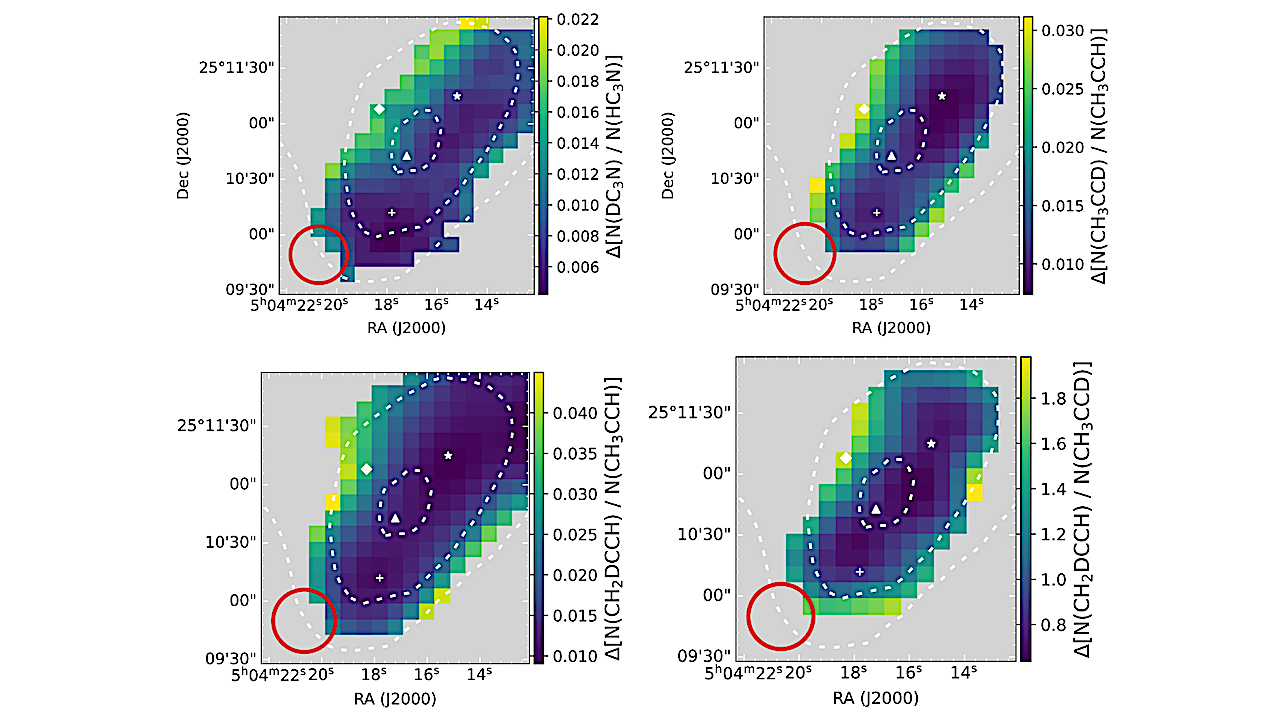
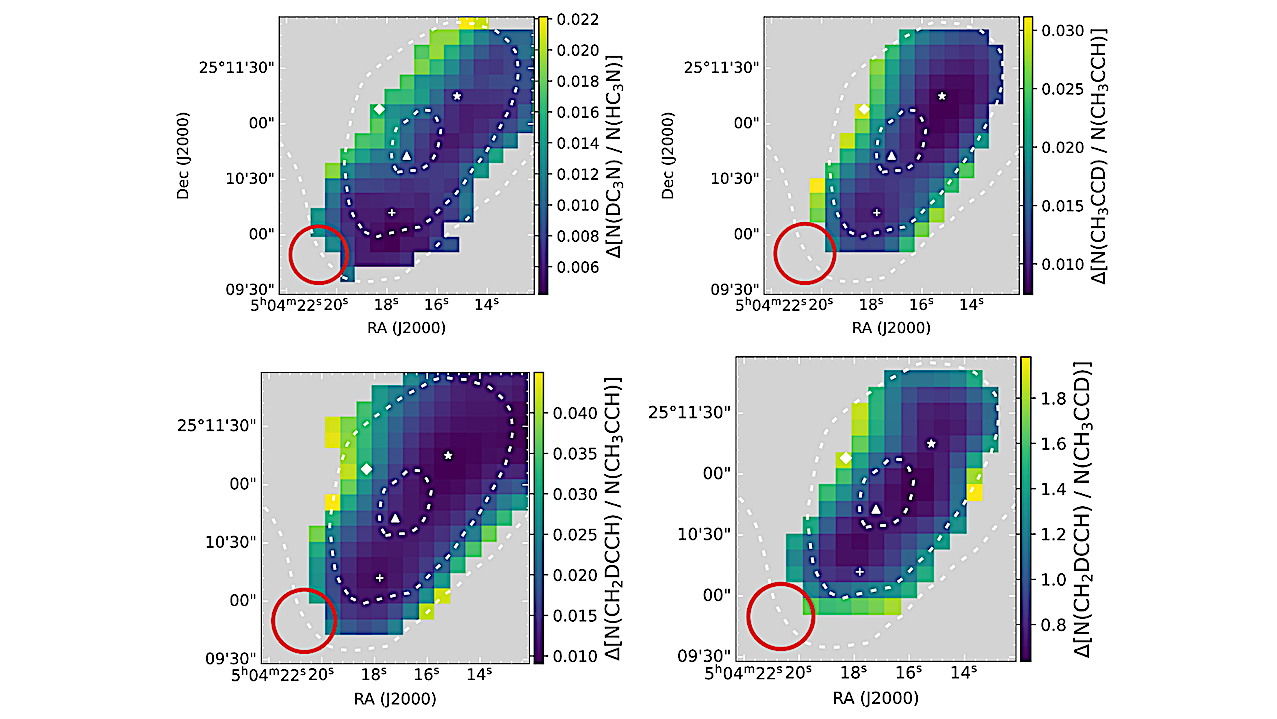
A.1: Error maps of the deuteration maps for HC3N and CH3CCH (presented in Figs. 8 and 9, respectively). Only pixels above the 3σ level of the respective integrated intensities are plotted. The dashed line contours represent 30%, 50%, and 90% of the H2 column density peak derived from Herschel maps (Spezzano et al. 2016). The circle in the bottom-left corner indicates the beam size of the IRAM 30 m telescope (31″). The markers in white represent the dust peak (triangle) and the molecular emission peaks of CH3OH (diamond), CH3CCH (star), and c-C3H2 (plus sign). — astro-ph.GA
Deuterated molecules are a useful diagnostic tool to probe the evolution and the kinematics in the earliest stages of star formation.
Due to the low temperatures and high densities in the centre of pre-stellar cores, the deuterium fraction is enhanced by several orders of magnitude. We study the distribution of the emission and the deuteration of the two carbon chains HC3N and CH3CCH throughout the pre-stellar core L1544.
We analyse emission maps of CH3CCH, CH2DCCH, CH3CCD, HC3N, HCC13CN, and DC3N, observed with the IRAM 30m single-dish radio telescope. We use non-LTE radiative transfer calculations, combined with chemical modelling of the molecular abundances, to constrain physical parameters of the observed species. Following this, we derive the column density and deuteration maps. We find D-fractions of N(DC3N)/N(HC3N)=0.04-0.07, N(CH2DCCH)/N(CH3CCH)=0.09-0.15, and N(CH3CCD)/N(CH3CCH)=0.07-0.09.
The deuteration of HC3N appears homogeneous across the core, with widespread D-fraction values above 0.06, tracing intermediate-density gas in the outer layers of the core. CH3CCD is most efficiently formed in the higher-density regions towards the core centre, while the D-fraction of CH2DCCH traces a local density enhancement in the north-east of the core, coinciding with the CH3OH emission peak.
The results suggest that gas-phase reactions dominate the formation and deuteration of both HC3N and CH3CCH in L1544, with spatial variations driven by physical structure, density and external radiation. The significantly higher D-fraction of CH2DCCH compared to CH3CCD and a tentative gradient with higher values in the north suggest different deuteration mechanisms for the two functional groups. Similarities between the CH2DCCH emission and CH2DOH might indicate an additional deuteration pathway of CH3CCH on the surfaces of dust grains, as observed for H2CO.
K. Giers, S. Spezzano, Y. Lin, P. Caselli, O. Sipilä
Comments: 15 pages, 13 figures, accepted for publication in A&A
Subjects: Astrophysics of Galaxies (astro-ph.GA)
Cite as: arXiv:2601.15791 [astro-ph.GA] (or arXiv:2601.15791v1 [astro-ph.GA] for this version)
https://doi.org/10.48550/arXiv.2601.15791
Focus to learn more
Submission history
From: Katharina Giers
[v1] Thu, 22 Jan 2026 09:27:03 UTC (488 KB)
https://arxiv.org/abs/2601.15791
Astrobiology, Astrochemistry,










Related Posts


Stay Informed With the Latest & Most Important News
Previous Post
Next Post


Advertisement
-
 01Two Black Holes Observed Circling Each Other for the First Time
 -
 02From Polymerization-Enabled Folding and Assembly to Chemical Evolution: Key Processes for Emergence of Functional Polymers in the Origin of Life
 -
 03Astronomy 101: From the Sun and Moon to Wormholes and Warp Drive, Key Theories, Discoveries, and Facts about the Universe (The Adams 101 Series)
 -
 04True Anomaly hires former York Space executive as chief operating officer
 -
 05Φsat-2 begins science phase for AI Earth images
 -
 06Hurricane forecasters are losing 3 key satellites ahead of peak storm season − a meteorologist explains why it matters
 -
 07Binary star systems are complex astronomical objects − a new AI approach could pin down their properties quickly