
Now Reading: OQ Technology plots smartphone test amid SpaceX’s C-band D2D push
-
01
OQ Technology plots smartphone test amid SpaceX’s C-band D2D push


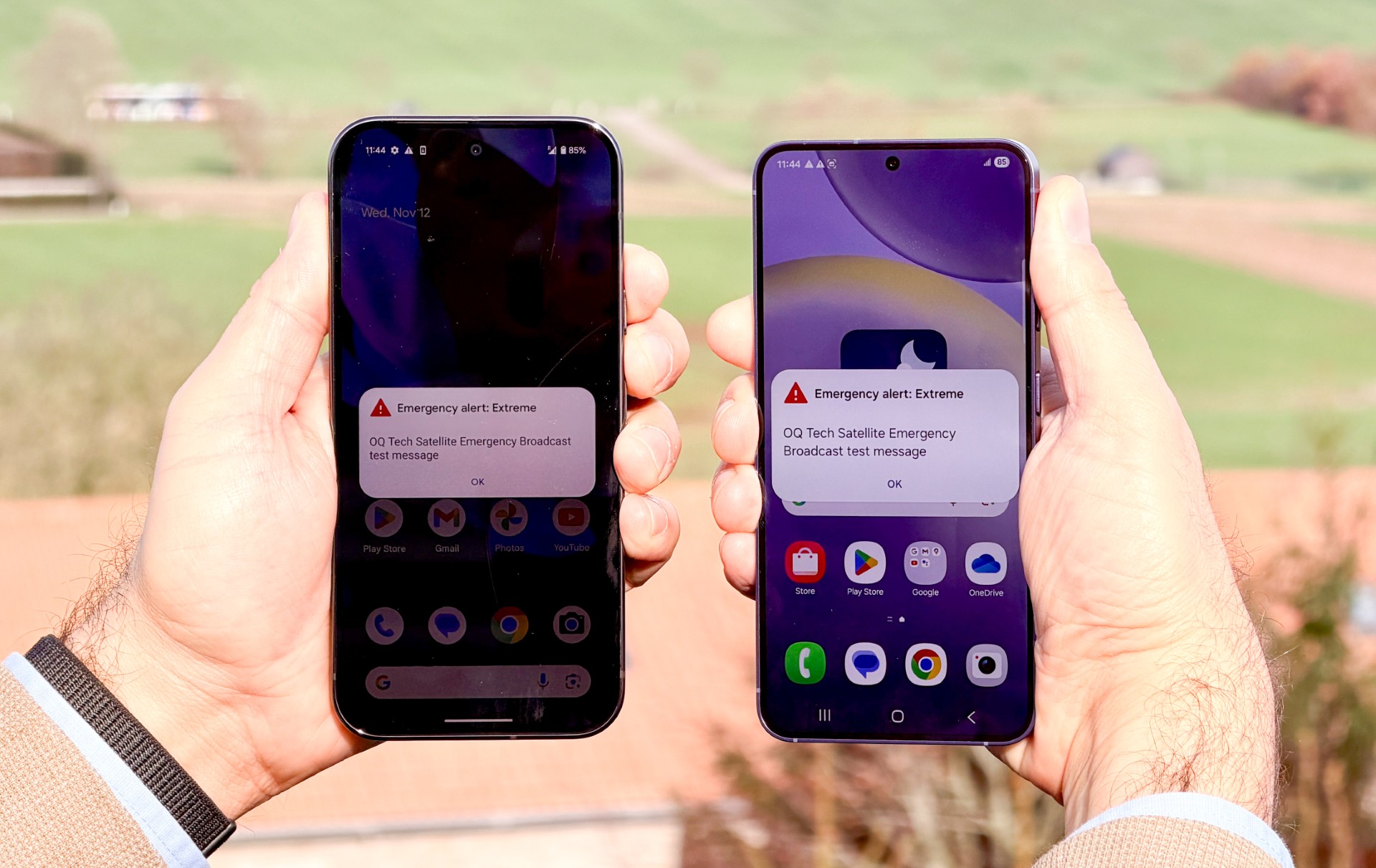

TAMPA, Fla. — Luxembourg-based OQ Technology is preparing to deploy a small satellite to test using C-band to connect smartphones from low Earth orbit, joining SpaceX in a push to repurpose part of the spectrum for direct-to-device (D2D) services.
The operator plans to deploy what would be its first dedicated D2D satellite around the middle of this year, CEO Omar Qaise told SpaceNews, joining a constellation currently using S-band to connect proprietary and mass-market off-the-grid tracking and monitoring devices.
Qaise said OQ aims to deploy a dedicated S-band D2D payload later in the year, after recently using one of the 10 Internet of Things (IoT) satellites launched so far to send a test emergency broadcast message to unmodified smartphones.
C-band offers significantly more bandwidth than S-band to enable higher-throughput voice and data services beyond the reach of cell towers, he added, as well as improved propagation characteristics that allow for narrower beams to better guard against interference.
OQ is also plotting a third D2D satellite this year that would potentially include a dual S-band and C-band capability for smartphones, alongside capacity for an IoT service the company recently opened up to mass-market devices following tests late last year.
The C-band D2D opportunity
Subject to regulatory approvals, Qaise said OQ plans to demonstrate a C-band D2D service in Luxembourg and then the United States, after lodging filings for the frequencies with international regulators.
“It’s still early,” he cautioned, “there is no regime for C-band D2D. It’s for fixed geostationary satellites today.
“However, as we saw with the S-band, this seems to move very fast — once you have demonstrations, studies and interactions with policymakers toward pushing this.”
The Federal Communications Commission is exploring how to repurpose 3.98-4.2 gigahertz of upper C-band spectrum in the United States, which is mainly used by satellite operators to distribute TV services.
In July, the One Big Beautiful Bill Act directed the FCC to auction at least 100 megahertz of upper C-band by July 2027, as well as a cumulative total of 300 megahertz of spectrum overall by 2034.
The FCC has proposed repurposing between 100 megahertz and 180 megahertz of upper C-band for terrestrial operators, using largely the same framework that saw the regulator auction off 280 megahertz of lower C-band spectrum in 2020.
That auction raised more than $80 billion as Verizon, AT&T, T-Mobile and other terrestrial operators scrambled to secure mid-band frequencies to support 5G deployments.
About $13.4 billion of those proceeds were given to incumbent spectrum holders — primarily SES and Intelsat — to encourage them to rapidly relocate services into the remaining 200 megahertz of C-band, alongside a 20-megahertz guard band to protect against interference.
Luxembourg-based SES controls the vast majority of upper C-band capacity in the U.S. following its merger with Intelsat last year.
In a Jan. 20 regulatory filing, SES said it supports using a similar incentive-based framework for upper C-band, but warned clearing any more than the minimum 100 megahertz would require new hybrid Ku-band satellites with optimized beam designs to protect existing services.
The operator also urged the FCC to maintain at least 40 megahertz of upper C-band for Fixed Satellite Services, so that “incumbents may continue to provide more meaningful service to customers for whom the C-band is uniquely essential.”
Enter SpaceX
SpaceX currently uses cellular frequencies from partners such as T-Mobile in the U.S. to enable messaging, calls and other D2D services from space.
However, the company is spending more than $20 billion to acquire a mix of mid-band cellular and S-band satellite spectrum to significantly upgrade those services starting next year, and sees upper C-band as another opportunity to further improve D2D capabilities.
In a Jan. 20 filing, SpaceX urged the FCC to reserve part of upper C-band for next-generation satellite services, arguing that terrestrial wireless networks cannot use the top end of the band without risking interfering with radio altimeters operating in adjacent spectrum.
SpaceX also called on the FCC to:
- Enable what the regulator calls Supplemental Coverage from Space (SCS) across C-band, allowing satellites to extend terrestrial mobile networks with the spectrum.
- Permit secondary satellite use of C-band on a non-interference basis in areas where terrestrial networks are not deployed.
- Allow satellite coverage to help satisfy terrestrial buildout requirements, while strengthening performance milestones to prevent spectrum warehousing.
- Consider future satellite use of vacated C-band uplink spectrum as legacy satellite systems are relocated.
“The Commission can no longer afford to treat satellite service alongside terrestrial networks as an afterthought or an exotic experiment,” SpaceX said.
“Satellite coverage must be an essential element of the Commission’s planning in each terrestrial wireless band to ensure that all Americans receive ubiquitous and resilient network access and to ensure that U.S.-licensed satellite operators are able to compete effectively at home and abroad.
“While the Commission may need to move quickly to meet its legislative deadline for auctioning Upper C-band spectrum, this haste should not prevent the Commission from establishing a strategic plan for satellite service in the band.”
According to SpaceX, its D2D service has expanded to 22 countries since launching in the U.S. in July, providing coverage to more than 400 million people worldwide with over six million users accessing the network each month.










Related Posts
Stay Informed With the Latest & Most Important News
Previous Post
Next Post
Advertisement
-
 01Two Black Holes Observed Circling Each Other for the First Time
 -
 02From Polymerization-Enabled Folding and Assembly to Chemical Evolution: Key Processes for Emergence of Functional Polymers in the Origin of Life
 -
 03Astronomy 101: From the Sun and Moon to Wormholes and Warp Drive, Key Theories, Discoveries, and Facts about the Universe (The Adams 101 Series)
 -
 04True Anomaly hires former York Space executive as chief operating officer
 -
 05Φsat-2 begins science phase for AI Earth images
 -
 06Hurricane forecasters are losing 3 key satellites ahead of peak storm season − a meteorologist explains why it matters
 -
 07Binary star systems are complex astronomical objects − a new AI approach could pin down their properties quickly