
Now Reading: Orbital Stability Of Closely-Spaced Four-planet Systems
-
01
Orbital Stability Of Closely-Spaced Four-planet Systems


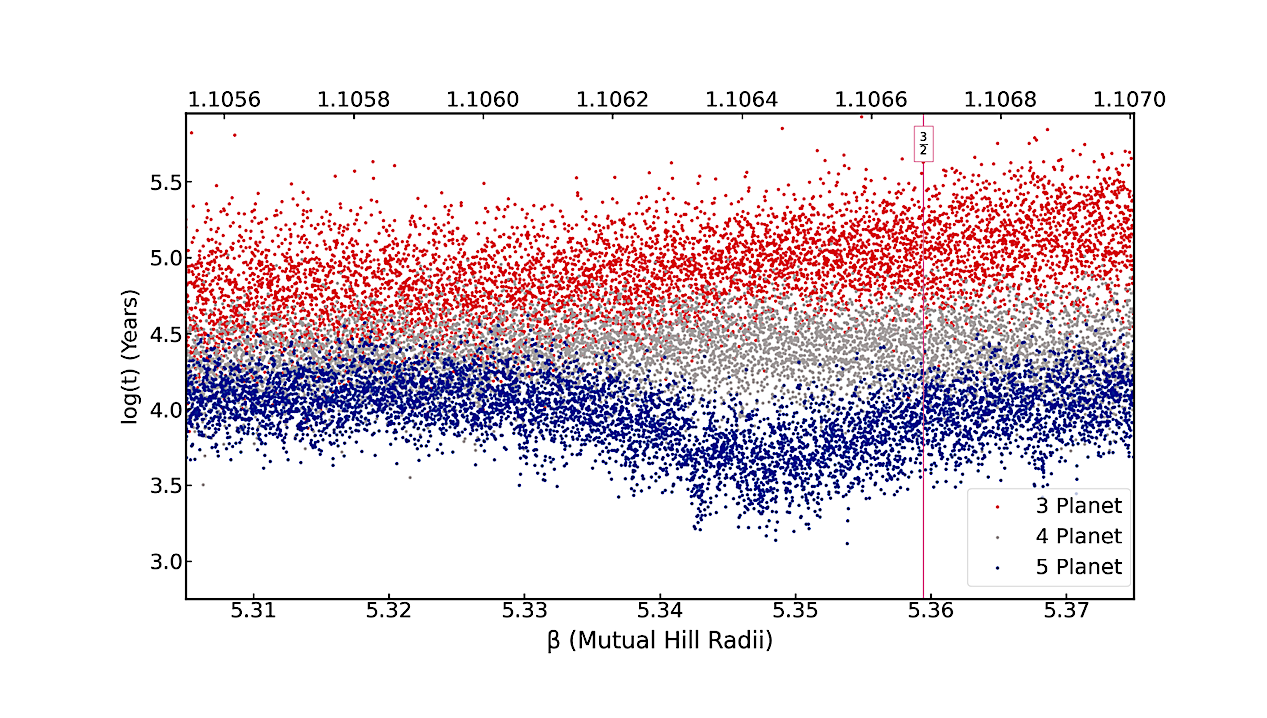
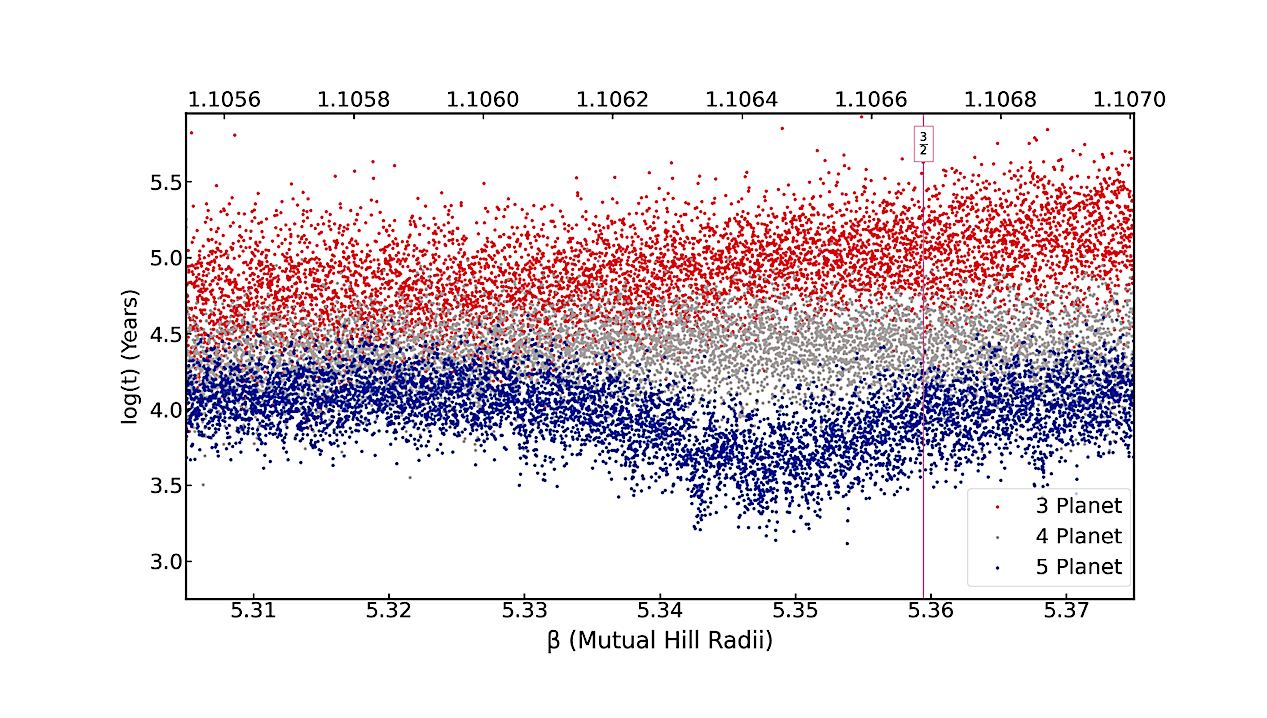
Lifetimes of three-, four-, and five-planet systems with SL09 initial longitudes and orbital separations at a resolution of 10−6 mutual Hill radii are superimposed in the region corresponding to a 3/2 first-order resonance between the first and fifth planets in five-planet systems. Within this small window, typical lifetimes of the three- and fourplanet systems increase roughly linearly with orbital separation. However, there is a significant decrease in system lifetimes in the five-planet systems close to and somewhat narrow of the 3/2 first-order resonance between the first and fifth planets, a resonance not present for systems with fewer planets. — astro-ph.EP
We investigate the orbital dynamics of four-planet systems consisting of Earth-mass planets on initially-circular, coplanar orbits around a star of one solar mass.
In our simulations, the innermost planet’s semimajor axis is set at 1 AU, with subsequent semimajor axes spaced equally in terms of planets’ mutual Hill radii. Several sets of initial planetary longitudes are investigated, with integrations continuing for up to 1010 orbits of the innermost planet, stopping if a pair of planets pass within 0.01 AU of each other or if a planet is ejected from the system.
We find that the simulated lifetimes of four-planet systems follow the general trend of increasing exponentially with planetary spacing, as seen by previous studies of closely-spaced planets. Four-planet system lifetimes are intermediate between those of three- and five-planet systems and more similar to the latter.
Moreover, as with five-planet systems, but in marked contrast to the three-planet case, no initial semimajor axes spacings are found to yield systems that survive several orders of magnitude longer than other similar spacings. First- and second-order mean-motion resonances (MMRs) between planets correlate with reductions in system lifetimes.
Additionally, we find that third-order MMRs between planets on neighboring orbits also have a substantial, though smaller, destabilizing effect on systems very near resonance that otherwise would be very long-lived. Local extrema of system lifetimes as a function of planetary spacing occur at slightly smaller initial orbital separation for systems with planets initially at conjunction relative to those in which the planets begin on widely-separated longitudes.
This shift is produced by the asymmetric mutual planetary perturbations as the planets separate in longitude from the initial aligned configuration that cause orbits to spread out in semimajor axis.
Bennet Outland, Gretchen Noble, Andrew W. Smith, Jack J. Lissauer
Comments: Revised following reviewer comments. Feedback is appreciated before 01/23/2025
Subjects: Earth and Planetary Astrophysics (astro-ph.EP)
Cite as: arXiv:2601.11692 [astro-ph.EP](or arXiv:2601.11692v1 [astro-ph.EP] for this version)
https://doi.org/10.48550/arXiv.2601.11692
Focus to learn more
Submission history
From: Bennet Outland
[v1] Fri, 16 Jan 2026 16:20:21 UTC (3,952 KB)
https://arxiv.org/abs/2601.11692
Astrobiology










Related Posts

Stay Informed With the Latest & Most Important News
![Discovery Of 1H-cyclopent[cd]indene (c-C11H8) In TMC-1 With The QUIJOTE Line Survey: A New Three-ringed Polycyclic Aromatic Hydrocarbon](https://flyingtomars.com/wp-content/uploads/2026/01/discovery-of-1h-cyclopentcdindene-c-c11h8-in-tmc-1-with-the-quijote-line-survey-a-new-three-ringed-polycyclic-aromatic-hydrocarbon.png)

Advertisement
-
 01Two Black Holes Observed Circling Each Other for the First Time
 -
 02From Polymerization-Enabled Folding and Assembly to Chemical Evolution: Key Processes for Emergence of Functional Polymers in the Origin of Life
 -
 03Astronomy 101: From the Sun and Moon to Wormholes and Warp Drive, Key Theories, Discoveries, and Facts about the Universe (The Adams 101 Series)
 -
 04True Anomaly hires former York Space executive as chief operating officer
 -
 05Φsat-2 begins science phase for AI Earth images
 -
 06Hurricane forecasters are losing 3 key satellites ahead of peak storm season − a meteorologist explains why it matters
 -
 07Binary star systems are complex astronomical objects − a new AI approach could pin down their properties quickly