
Now Reading: Rocket Lab launches Korean disaster-monitoring satellite after long delay
-
01
Rocket Lab launches Korean disaster-monitoring satellite after long delay


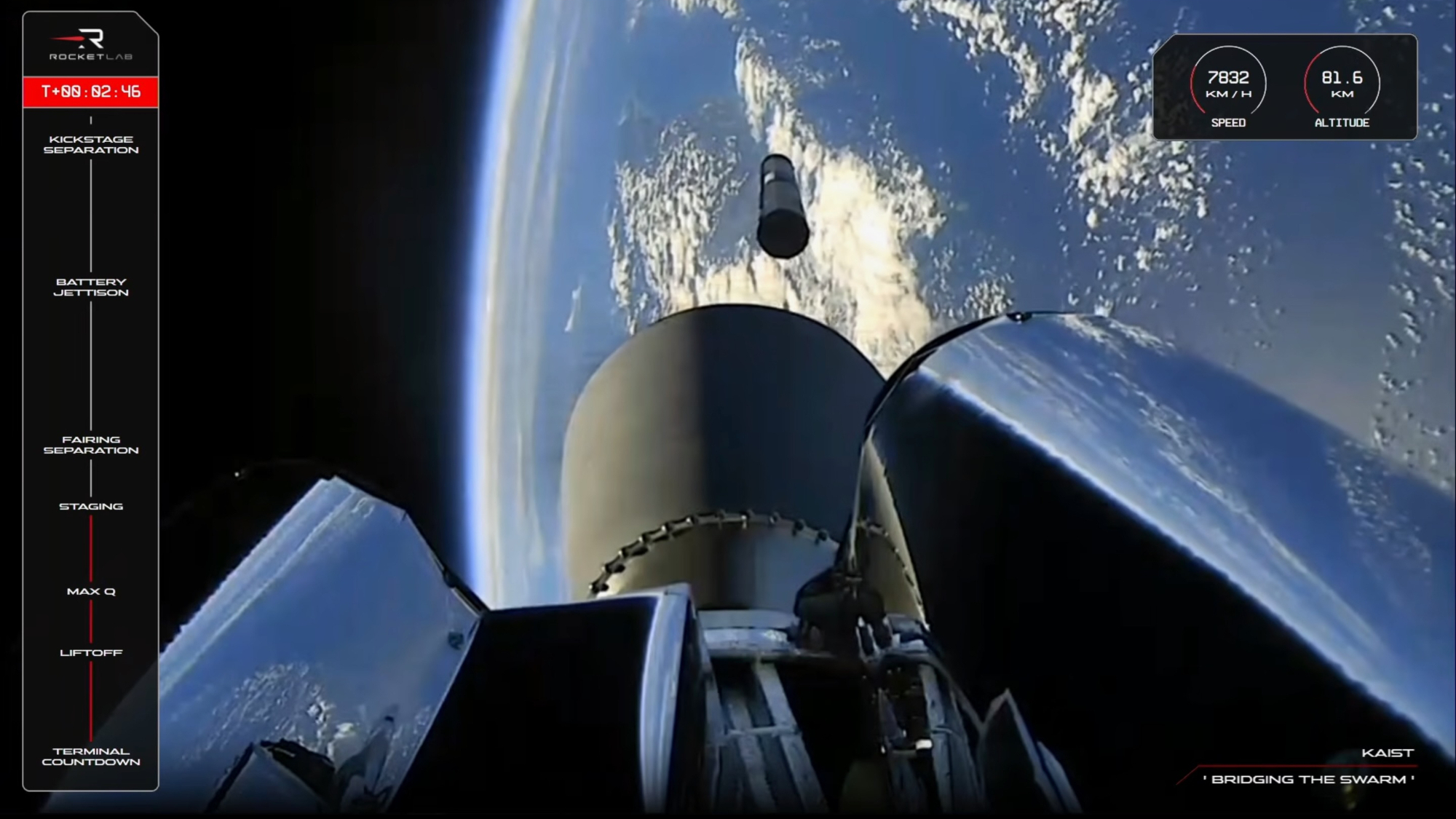
Rocket Lab launched a South Korean disaster-monitoring satellite from New Zealand on Thursday (Jan. 29), about six weeks later than originally planned.
A 59-foot-tall (18-meter-tall) Electron rocket launched the “Bridging the Swarm” mission from Rocket Lab‘s New Zealand site on Thursday at 8:21 p.m. EST (0121 GMT and 2:21 p.m. local New Zealand time on Jan. 30).

“Bridging the Swarm” lofted a single payload for the Satellite Technology Research Center (SaTReC) at the Korea Advanced Institute of Science and Technology (KAIST).
That payload is NEONSAT-1A, “an advanced Earth-observation satellite equipped with a high-resolution optical camera,” Rocket Lab wrote in a mission description.
“Designed to capture near-real time natural disaster monitoring for the Korean peninsula, KAIST’s NEONSAT constellation is a collaboration across multiple Korean academic, industry and research institutions, including SaTReC, which is leading the program’s system design and engineering,” the company added.
NEONSAT is not a constellation yet. Previously, just one satellite in the program had reached low Earth orbit — NEONSAT-1, which flew atop an Electron in April 2024.
The NEONSAT program is funded by the Korean government — namely, the Ministry of Science and ICT. (ICT stands for “Information and Communication Technology.”)
If all goes to plan on Thursday, the Electron’s “kick stage” will deploy NEONSAT-1A about 54 minutes after launch, setting it free 336 miles (540 kilometers) above our planet.
“Bridging The Swarm” was Rocket Lab’s second launch of 2026 and its 81st overall to date. The company launched 21 missions last year, setting a new Rocket Lab record.
Editor’s note: This story was updated at 8:30 p.m. ET on Jan. 29 with news of successful liftoff.










Related Posts
Stay Informed With the Latest & Most Important News
Previous Post
Next Post

Advertisement
-
 01Two Black Holes Observed Circling Each Other for the First Time
 -
 02From Polymerization-Enabled Folding and Assembly to Chemical Evolution: Key Processes for Emergence of Functional Polymers in the Origin of Life
 -
 03Astronomy 101: From the Sun and Moon to Wormholes and Warp Drive, Key Theories, Discoveries, and Facts about the Universe (The Adams 101 Series)
 -
 04True Anomaly hires former York Space executive as chief operating officer
 -
 05Φsat-2 begins science phase for AI Earth images
 -
 06Hurricane forecasters are losing 3 key satellites ahead of peak storm season − a meteorologist explains why it matters
 -
 07Binary star systems are complex astronomical objects − a new AI approach could pin down their properties quickly