
Now Reading: H182O In The Terrestrial Planet-forming Regions Of Protoplanetary Disks
-
01
H182O In The Terrestrial Planet-forming Regions Of Protoplanetary Disks


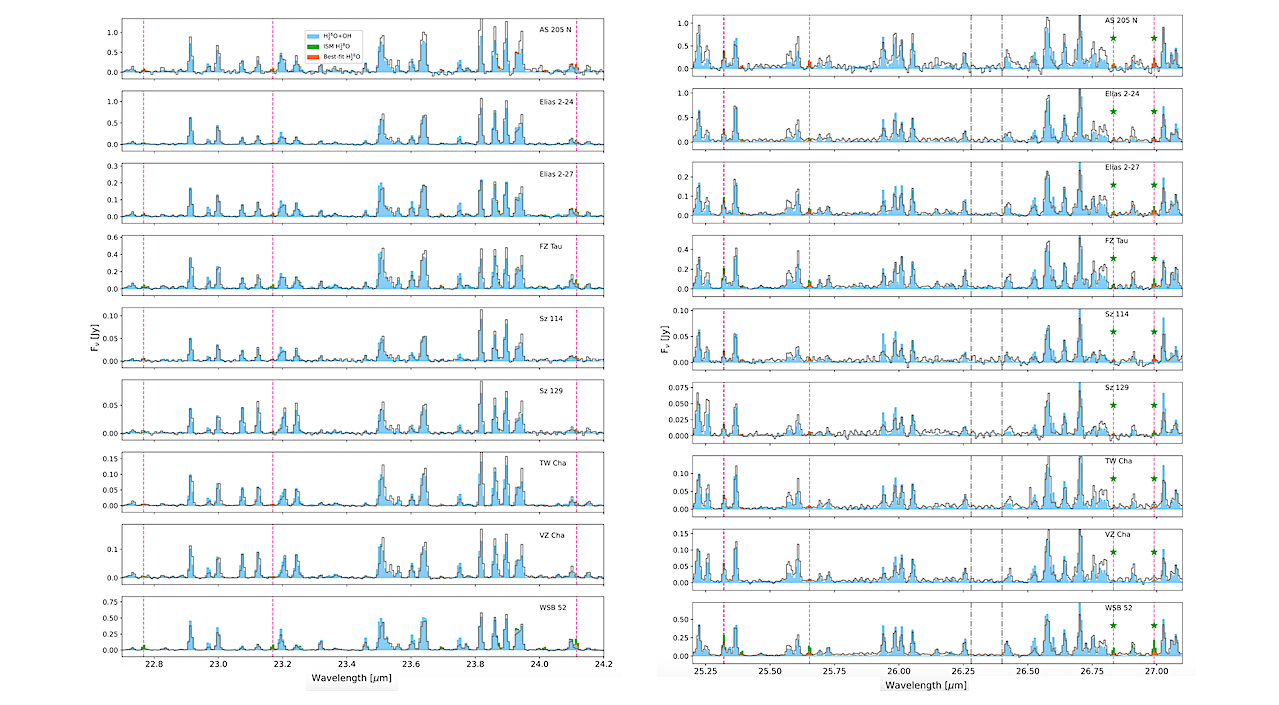
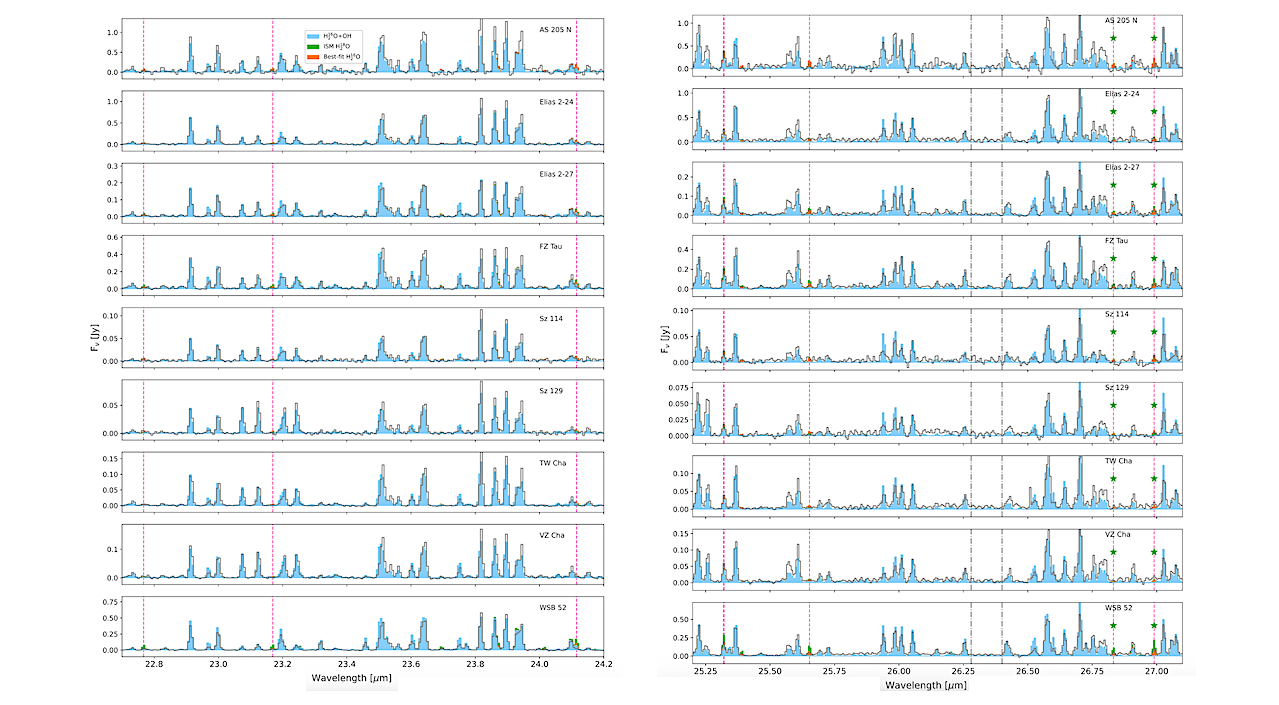
[L] Spectra of targets meeting our selection criteria for further analysis (P/C>0.2 and H218O SNR>2), between 22.7 and 24.2 µm, along with best-fit 3-component water models (blue; see Table 1), 3-component H218O models (green) assuming an ISM 16O/18O ratio of 557, and 3-component H218O models with a best-fit 16O/18 ratio (orange). Vertical dashed lines show H218O lines from Table 2. [R] Same as Figure 1 but for the wavelength range of 25.2 to 27.1 µm. Gray vertical dash-dot lines mark the location used for determination of the noise level. Green stars mark the H218O lines used to fit the H216O/H218O ratio. A zoomed-in portion of these features is provided in Figure 11. — astro-ph.EP
Isotopologues play an important role in solar system cosmochemistry studies, revealing details of early planet formation physics and chemistry.
Oxygen isotopes, as measured in solar system materials, reveal evidence for both mass-dependent fractionation processes and a mass-independent process commonly attributed to isotope-selective photodissociation of CO in the solar nebula. The sensitivity of JWST’s MIRI-MRS enables studies of isotopologues in the terrestrial planet-forming regions around nearby young stars.
We report here on a search for H218O in 22 disks from the JDISC Survey with evidence for substantial water vapor reservoirs, with the goal of measuring H216O/H218O ratios, and potentially revealing the predicted enhancement of H218O caused by isotope-selective photodissociation.
We find marginal detections of H218O in six disks, and a more significant detection of H218O in the disk around WSB 52. Modeling of the detected H218O lines assuming an ISM ratio of H216O/H218O predicts H218O features consistent with observations for four of the modeled disks, but stronger H218O features than are observed in three of the modeled disks, which includes WSB 52. Therefore, these latter three disks require a higher H216O/H218O ratio than the ISM in the water-emitting region, in contrast to long-standing theoretical expectations.
We suggest that either the H218O-rich water has been removed from the emitting region and replaced by H218O-poor water formed by reactions with 18O-poor CO, or that the gas-phase water is depleted in 18O via mass-dependent fractionation processes at the water snowline.
Colette Salyk, Klaus M. Pontoppidan, Ke Zhang, Sophie Heinzen, Jenny K. Calahan, Andrea Banzatti, D. Annie Dickson-Vandervelde, Edwin A. Bergin, Geoffrey A. Blake, Nicole Arulanantham, Sebastiaan Krijt, John Carr, Joan Najita, Joel Green, Carlos Romero-Mirza
Comments: 20 pages, 11 figures
Subjects: Earth and Planetary Astrophysics (astro-ph.EP); Solar and Stellar Astrophysics (astro-ph.SR)
Cite as: arXiv:2601.20096 [astro-ph.EP] (or arXiv:2601.20096v1 [astro-ph.EP] for this version)
https://doi.org/10.48550/arXiv.2601.20096
Focus to learn more
Related DOI:
https://doi.org/10.3847/1538-4357/ae3db1
Focus to learn more
Submission history
From: Colette Salyk
[v1] Tue, 27 Jan 2026 22:30:41 UTC (9,665 KB)
https://arxiv.org/abs/2601.20096
Astrobiology










Related Posts
Stay Informed With the Latest & Most Important News
Previous Post
Next Post



Advertisement
-
 01Two Black Holes Observed Circling Each Other for the First Time
 -
 02From Polymerization-Enabled Folding and Assembly to Chemical Evolution: Key Processes for Emergence of Functional Polymers in the Origin of Life
 -
 03Astronomy 101: From the Sun and Moon to Wormholes and Warp Drive, Key Theories, Discoveries, and Facts about the Universe (The Adams 101 Series)
 -
 04True Anomaly hires former York Space executive as chief operating officer
 -
 05Φsat-2 begins science phase for AI Earth images
 -
 06Hurricane forecasters are losing 3 key satellites ahead of peak storm season − a meteorologist explains why it matters
 -
 07Binary star systems are complex astronomical objects − a new AI approach could pin down their properties quickly