
Now Reading: Live coverage: SpaceX to launch overnight Starlink flight as it unveils new ‘Stargaze’ space situational awareness system
-
01
Live coverage: SpaceX to launch overnight Starlink flight as it unveils new ‘Stargaze’ space situational awareness system

Live coverage: SpaceX to launch overnight Starlink flight as it unveils new ‘Stargaze’ space situational awareness system

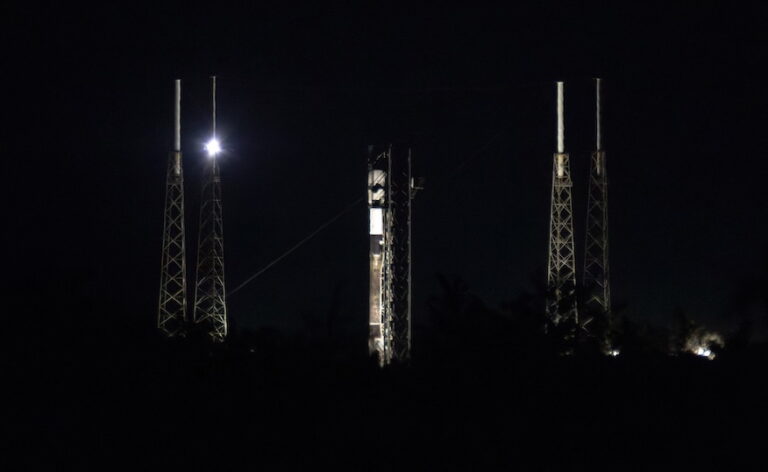
SpaceX is preparing for its 13th and final Falcon 9 rocket launch of the month, which is scheduled to fly from Cape Canaveral Space Force Station on Thursday night.
The Starlink 6-101 mission will add another 29 broadband internet satellites to SpaceX’s low Earth orbit megaconstellation. Prior to liftoff, the company had more than 9,500 satellites in orbit, according to stats maintained by Dr. Johnathan McDowell, an expert orbital tracker and astronomer.
Liftoff from Space Launch Complex 40 is scheduled for 2:22 a.m. EST (0722 UTC) with the rocket flying on a south easterly trajectory.
Spaceflight Now will have live coverage beginning about an hour prior to liftoff.
The 45th Weather Squadron forecast a 95 percent chance for favorable conditions at liftoff, citing a small chance for interference from cloud cover.
SpaceX will launch the mission using the Falcon 9 first stage booster with the tail number 1095. This will be its fifth flight following the launches of four other batches of Starlink satellites.
Nearly 8.5 minutes after liftoff, B1095 will target a landing on the drone ship, ‘Just Read the Instructions,’ positioned in the Atlantic Ocean. If successful, this will be the 149th landing on this vessel and the 566th booster landing for SpaceX to date.
Tracking potential threats
In an update Thursday night, SpaceX announced a new system it set up for what’s known as Space Situational Awareness or SSA. The new software is called “Stargaze” and SpaceX said it will be available to all satellite operators “free of charge, via its space-traffic management platform” in the coming weeks.
“Practices—such as leaving rocket bodies in [low Earth orbit], operators maneuvering their satellites without sharing trajectory predictions or coordinating with other active satellites, and countries conducting anti-satellite tests—have heightened the risk of collision, necessitating improvements in space-traffic coordination,” SpaceX wrote. “Conventional methods typically observe objects only a limited number of times per day, causing large uncertainties in orbital predictions, further compounded by volatile space weather.
“Stargaze delivers a several-order-of-magnitude increase in detection capability compared to conventional ground-based systems. Stargaze uses data collected from nearly 30,000 star trackers, each of which makes continuous observations of nearby objects, resulting in approximately 30 million transits detected daily across the fleet.”
SpaceX has developed a novel Space Situational Awareness (SSA) system, called Stargaze → https://t.co/vE0qSpfDt2
To maximize safety for all satellites in space, @SpaceX will be making Stargaze conjunction data available to all operators, free of charge. By providing this… pic.twitter.com/N7St7dvpz2
— Starlink (@Starlink) January 30, 2026
Built into SpaceX’s more than 9,500 satellites on orbit are the company’s own star trackers. As the name suggests, these sensors allow the satellites to understand its altitude, orientation and location in space.
SpaceX said its Stargaze system is designed to allow for assessing possible conjunctions or collisions in space on the order of minutes instead of several hours, which is the current standard. It pointed to an example of its use late last year.
“In late 2025, a Starlink satellite encountered a conjunction with a third-party satellite that was performing maneuvers, but whose operator was not sharing ephemeris (trajectory predictions),” the company said. “ Until five hours before the conjunction, the close approach was anticipated to be ~9,000 meters — considered a safe miss-distance with zero probability of collision.
“With just five hours to go, the third-party satellite performed a maneuver which changed its trajectory and collapsed the anticipated miss distance to just ~60 meters. Stargaze quickly detected this maneuver and published an updated trajectory to the screening platform, generating new CDMs which were immediately distributed to relevant satellites. Ultimately, the Starlink satellite was able to react within an hour of the maneuver being detected, planning an avoidance maneuver to reduce collision risk back down to zero.”
SpaceX said this technology has been in a “closed beta with over a dozen participating satellite operators,” but didn’t state which companies.










Related Posts
Stay Informed With the Latest & Most Important News
Previous Post
Next Post




Advertisement
-
 01Two Black Holes Observed Circling Each Other for the First Time
 -
 02From Polymerization-Enabled Folding and Assembly to Chemical Evolution: Key Processes for Emergence of Functional Polymers in the Origin of Life
 -
 03Astronomy 101: From the Sun and Moon to Wormholes and Warp Drive, Key Theories, Discoveries, and Facts about the Universe (The Adams 101 Series)
 -
 04True Anomaly hires former York Space executive as chief operating officer
 -
 05Φsat-2 begins science phase for AI Earth images
 -
 06Hurricane forecasters are losing 3 key satellites ahead of peak storm season − a meteorologist explains why it matters
 -
 07Binary star systems are complex astronomical objects − a new AI approach could pin down their properties quickly