
Now Reading: RBC Signals partners with in-orbit relay developer Apolink
-
01
RBC Signals partners with in-orbit relay developer Apolink




TAMPA, Fla. — Apolink has partnered with ground segment provider RBC Signals to resell the startup’s proposed in-orbit relay services, aiming to fill connectivity gaps when satellites are out of view of terrestrial command-and-control links.
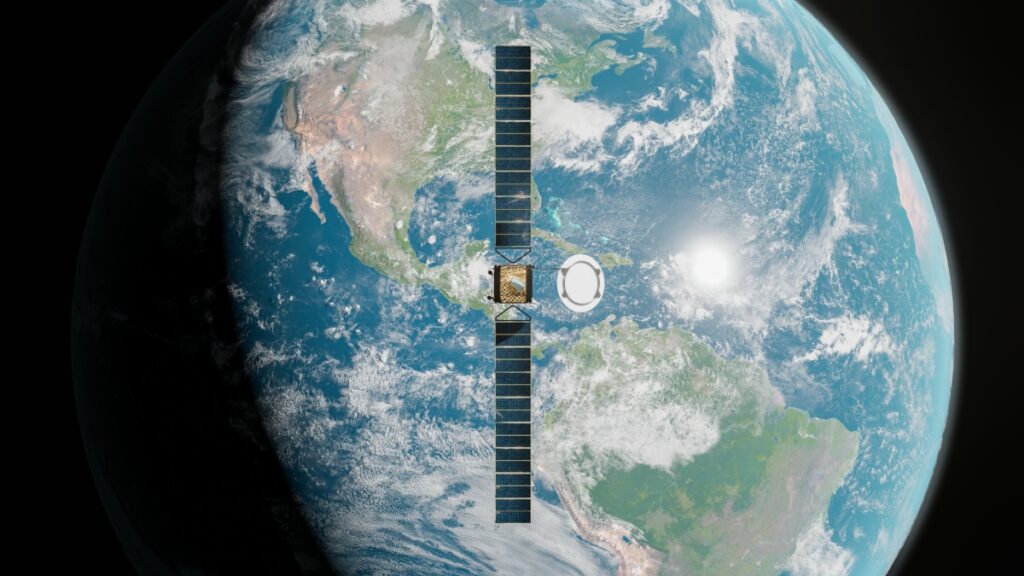
The Palo Alto, California-based venture, which is preparing to deploy a cubesat later this year to test receiving signals from other low Earth orbit (LEO) spacecraft and forwarding them to the ground, also plans use RBC Signals’ network of nearly 100 antennas across more than 60 sites as part of the end-mile teleport for its relay architecture.
Beyond the initial demonstration, Apolink plans a follow-on system built around a larger fleet of interconnected spacecraft designed to provide continuous telemetry, tracking and command coverage without relying solely on ground pass availability.
The company ultimately aims to scale that architecture into a higher-capacity relay network that would further reduce reliance on ground infrastructure.
Apolink founder Onkar Batra declined to disclose financial details of the arrangement with RBC Signals, or the partners lined up to help validate a receive-only S-band relay capability on its debut spacecraft, designed to work with their existing onboard equipment.
He said the startup has received more than $150 million in customer commitments since its founding in 2024.
The relay capability would target single-satellite operators and emerging constellations seeking near-real-time connectivity beyond ground-only architectures for faster tasking, data delivery and more responsive mission operations.
Most LEO spacecraft are connected to the ground for less than about 8% of each orbit, according to Batra.
“The blackouts are there, anywhere from 45-90%, even after a hundred antennas and 60 sites,” he said.
Relying solely on ground station networks can also be expensive, he added, requiring advance scheduling of passes, “and can be a regulatory mess sometimes.”
Apolink also sees demand from sovereign programs looking for secure communications backhaul without extensive ground infrastructure.
The demonstration satellite is scheduled to fly aboard SpaceX’s Transporter-17 rideshare mission in the second quarter of 2026.
Large constellations such as SpaceX’s Starlink increasingly rely on proprietary inter-satellite links to reduce dependence on ground infrastructure, while some satellite makers are offering customers access to existing relay networks rather than building their own. Apolink is among several companies pursuing commercial data-relay systems aimed at smaller operators and sovereign users.










Related Posts
Stay Informed With the Latest & Most Important News
Previous Post
Next Post





Advertisement
-
 01Two Black Holes Observed Circling Each Other for the First Time
 -
 02From Polymerization-Enabled Folding and Assembly to Chemical Evolution: Key Processes for Emergence of Functional Polymers in the Origin of Life
 -
 03Astronomy 101: From the Sun and Moon to Wormholes and Warp Drive, Key Theories, Discoveries, and Facts about the Universe (The Adams 101 Series)
 -
 04True Anomaly hires former York Space executive as chief operating officer
 -
 05Φsat-2 begins science phase for AI Earth images
 -
 06Hurricane forecasters are losing 3 key satellites ahead of peak storm season − a meteorologist explains why it matters
 -
 07Binary star systems are complex astronomical objects − a new AI approach could pin down their properties quickly