
Now Reading: Architectures of Exoplanetary Systems. IV: A Multi-planet Model for Reproducing the Radius Valley and Intra-system Size Similarity of Planets around Kepler’s FGK Dwarfs
-
01
Architectures of Exoplanetary Systems. IV: A Multi-planet Model for Reproducing the Radius Valley and Intra-system Size Similarity of Planets around Kepler’s FGK Dwarfs

Architectures of Exoplanetary Systems. IV: A Multi-planet Model for Reproducing the Radius Valley and Intra-system Size Similarity of Planets around Kepler’s FGK Dwarfs

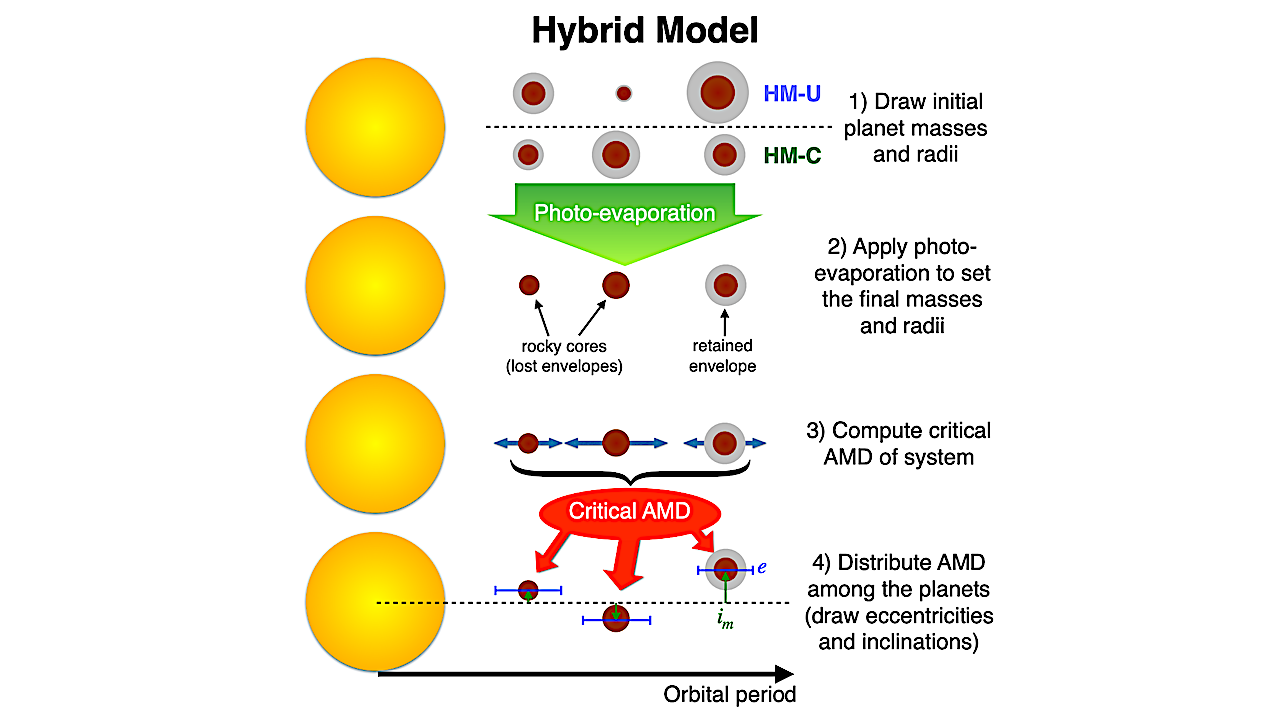
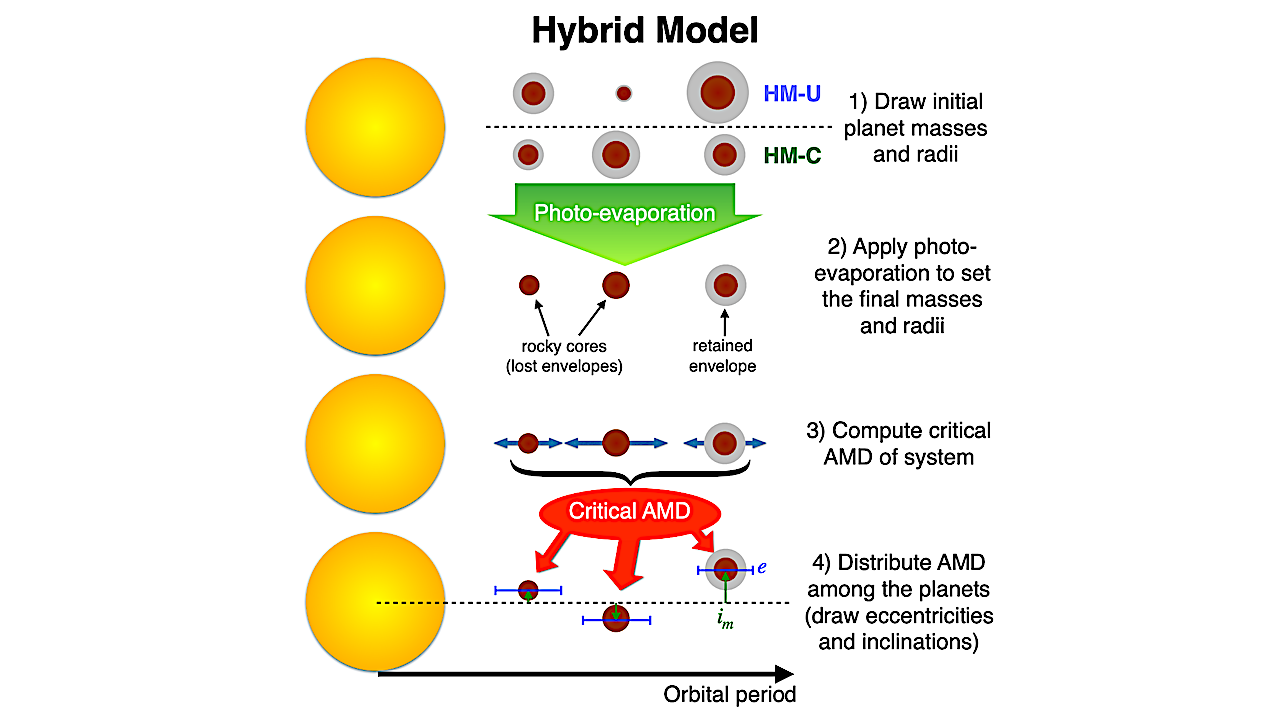
Cartoon illustration of the hybrid models. The difference between HM-U and HM-C is in the first step, where the initial planet masses and radii are drawn (HMC draws clustered initial masses as in §2.2.2, while HM-U does not). The planets are also assigned envelope masses in this step. The planets are then subject to photoevaporation and some lose their gaseous envelopes, resulting in the final masses and radii (§2.2.3). Finally, the critical AMD of the system is computed and distributed among the individual planets to draw their orbital eccentricities and mutual inclinations, as in the H20 model. — astro-ph.EP
The Kepler-observed distribution of planet sizes have revealed two distinct patterns: (1) a radius valley separating super-Earths and sub-Neptunes and (2) a preference for intra-system size similarity.
We present a new model for the exoplanet population observed by Kepler, which is a “hybrid” of a clustered multi-planet model in which the orbital architectures are set by the angular momentum deficit (AMD) stability (He et al. 2020; arXiv:2007.14473) and a joint mass-radius-period model involving envelope mass-loss driven by photoevaporation (Neil & Rogers 2020; arXiv:1911.03582).
We find that the models that produce the deepest radius valleys have a primordial population of planets with initial radii peaking at ∼2.1R⊕, which is subsequently sculpted by photoevaporation into a bimodal distribution of final planet radii. The hybrid model requires strongly clustered initial planet masses in order to match the distributions of the size similarity metrics.
Thus, the preference for intra-system radius similarity is well explained by a clustering in the primordial mass distribution. The hybrid model also naturally reproduces the observed radius cliff (steep drop-off beyond ∼2.5R⊕). Our hybrid model is the latest installment of the SysSim forward models, and is the first multi-planet model capable of simultaneously reproducing the observed radius valley and the intra-system size similarity patterns.
We compute occurrence rates and fractions of stars with planets for a variety of planet types, and find that the occurrence of Venus and Earth-like planets drops by a factor of ∼2-4 for the hybrid models compared to previous clustered models in which there is no envelope mass-loss.
Matthias Y. He, Eric B. Ford
Comments: 43 pages, 17+2 figures, 3 tables. Under review in AAS Journals
Subjects: Earth and Planetary Astrophysics (astro-ph.EP)
Cite as: arXiv:2601.13480 [astro-ph.EP] (or arXiv:2601.13480v1 [astro-ph.EP] for this version)
https://doi.org/10.48550/arXiv.2601.13480
Focus to learn more
Submission history
From: Matthias Yang He
[v1] Tue, 20 Jan 2026 00:29:39 UTC (5,837 KB)
https://arxiv.org/abs/2601.13480
Astrobiology











Related Posts

Stay Informed With the Latest & Most Important News
Previous Post
Next Post





Advertisement
-
 01Two Black Holes Observed Circling Each Other for the First Time
 -
 02From Polymerization-Enabled Folding and Assembly to Chemical Evolution: Key Processes for Emergence of Functional Polymers in the Origin of Life
 -
 03Astronomy 101: From the Sun and Moon to Wormholes and Warp Drive, Key Theories, Discoveries, and Facts about the Universe (The Adams 101 Series)
 -
 04True Anomaly hires former York Space executive as chief operating officer
 -
 05Φsat-2 begins science phase for AI Earth images
 -
 06Hurricane forecasters are losing 3 key satellites ahead of peak storm season − a meteorologist explains why it matters
 -
 07Binary star systems are complex astronomical objects − a new AI approach could pin down their properties quickly