
Now Reading: Peak Design 25L Outdoor Backpack review
-
01
Peak Design 25L Outdoor Backpack review


Key specs
External dimensions: 19.09 x 11.02 x 5.91-inches (48.5 x 28 x 15 cm) with roll top down; 25.98 x 11.02 x 5.91-inches (66 x 28 x 15 cm) with roll top extended
Internal dimensions: 18.90 x 10.83 x 5.71-inches (48 x 27.5 x 14.5 cm) with roll top down; 25.79 x 10.83 x 5.71-inches (65.5 x 27.5 x 14.5 cm) with roll top extended
Capacity: 20 L with roll top down; 25 L with roll top extended (45 L version also available)
Compatible camera cube: Fits one S-medium camera cube, with the option to place an X-small camera cube above it
Hydration/carry laptop: One internal hydration sleeve, one external hydration sleeve (center Flex Pocket); internal sleeve fits up to a 16-inch MacBook Pro
Weight: 2.54 lbs (1.15 kg)
Astrophotography requires a bag that can handle rugged terrain and satisfy photographers’ needs. After all, you want to be able to carry your best camera for astrophotography around with confidence.
Peak Design 25L Outdoor Backpack: Design
★★★1⁄2

- Odd color choice (white) for an outdoor bag
- Easy roll-top entry
- Deep pockets that comfortably fit a tripod
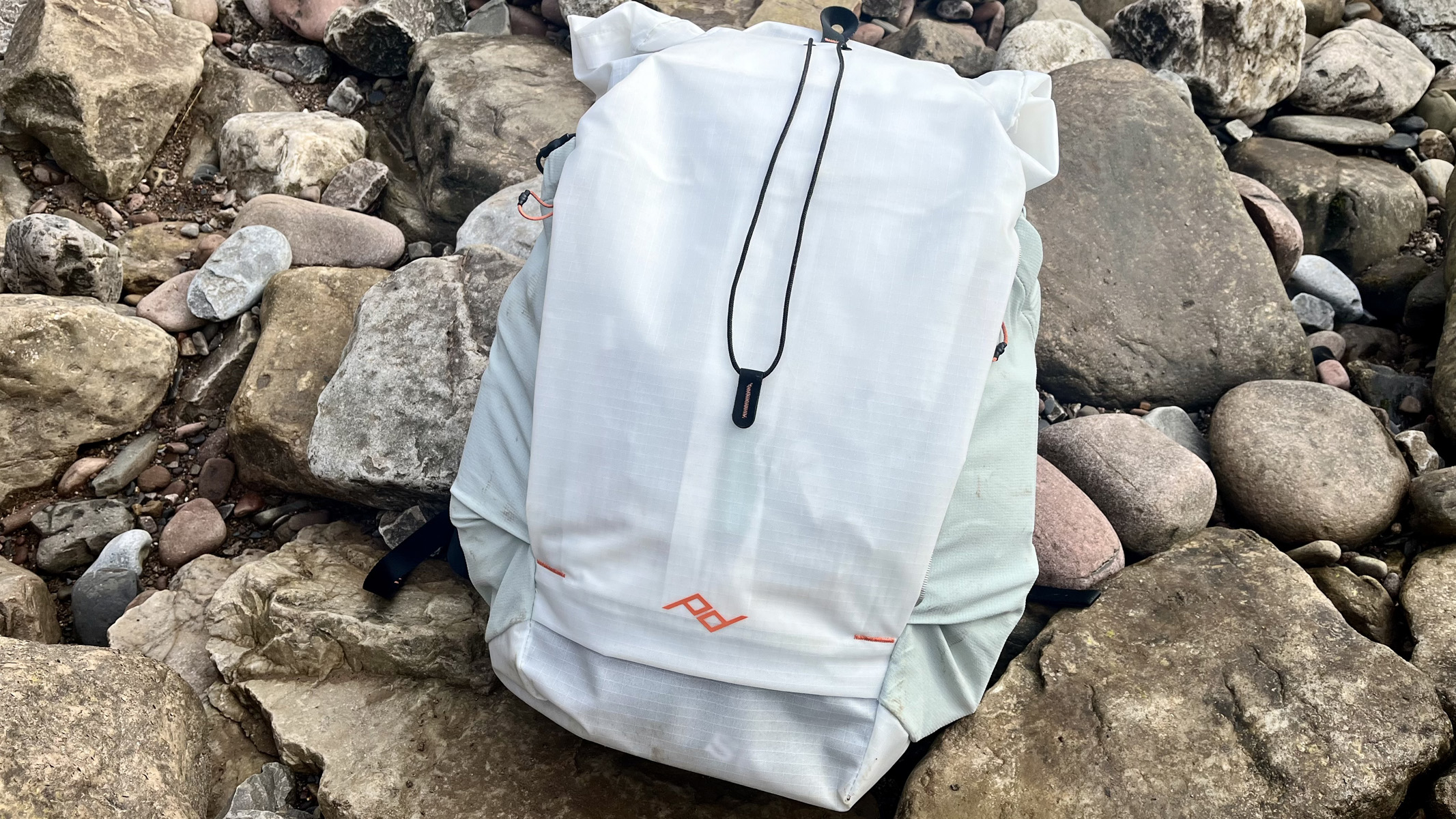
It’s clear that a lot of thought went into the Peak Design 25L Outdoor Backpack, with its accessibility, versatility and quality of materials. Designed as an outdoor bag that photographers can use with one of the compatible camera cubes, it’s suitable for hiking to remote dark-sky sites with all of your photography equipment and everything you need to stay warm and hydrated.
It has two deep side pockets that can easily hold a tripod and a water bottle, a laptop sleeve (that can also be used for a hydration pouch) and an easy-to-access roll-top opening to reach your gear without having to open the back panel. The zippers are easy to grab and very strong, but there’s not much padding to protect your gear.
Peak Design 25L Outdoor Backpack: Performance
★★★

- Wide straps, which are uncomfortable for users with a small frame
- Easy access to gear
- Cinch feature that keeps the bag secure
There are two sides to the coin when it comes to performance. The first includes the bag’s practicality and ease of use out in the field. We found it easy to access our gear and really liked the roll-top entry with the cinch hook to tighten and loosen the top compartment. There are mesh pockets in the straps to keep your phone or a power bank, which made it very easy for us to access our phone during a hike. We would have liked this bag to be compatible with a Capture clip, though.
The other side of the coin is comfort. Although we found this backpack fairly comfortable to wear for long periods when we wore a coat while walking around a nature reserve, we can’t say the same for when we wore this bag on an 8-mile (13 kilometers) hike in just a long-sleeved shirt. For most users, it will likely be fine, but for people with small frames, the straps will be too wide. We found the straps digging into our arms while we walked, and as a result, the straps didn’t fit over our chest properly when we had to tighten the sternum straps.
Peak Design 25L Outdoor Backpack: Functionality
★★★1⁄2

- No internal storage
- Utility as an outdoor bag
- One large compartment
Although the Peak Design 25L Outdoor Backpack is very functional as a general outdoor bag (which is what it’s designed for, after all), it’s not very useful for photographers without a camera cube.
There’s no internal storage — not even small pockets for cards, batteries or filters. And even when a camera cube is inside, you need to fully open the rear panel to access your gear. This adds an extra cost to an already expensive bag. Therefore, the Peak Design Outdoor Backpack is best suited to users who do as much hiking as they do photography, so it can be used for both activities.
How we test
I wore the Peak Design 25L Outdoor Backpack on multiple outdoor trips, including a walk around a nature reserve in a padded coat and an 8-mile waterfall hike in a thinner T-shirt.
I fully assessed all of the compartments, straps and attachments for quality, practicality and comfort in a range of conditions to give a thorough review of how the bag would perform for different uses.
Should you buy the Peak Design 25L Outdoor Backpack?
Buy it if:
✅ You already own Peak Design camera cubes: If so, this backpack is a good option.
✅ You’re outdoors a lot: This isn’t a cheap option, so better suited to those who will get a lot of use out of it.
Don’t buy it if:
❌ You have a small frame: The wider straps are slightly uncomfortable for those with a smaller frame.
❌ You’re on a budget: There are other options out there if you have a tighter budget.
The Peak Design Outdoor Backpack better serves as a general outdoor or hiking bag as opposed to a dedicated photography bag, so if you’re looking for a versatile bag that can also comfortably fit your camera gear as and when you need it, it’s a good pick.
That said, there are other more affordable alternatives that could do the job just as well. For photographers who want to use it specifically for remote shoots, I’d only recommend it if you already have camera cubes.
If this product isn’t for you
If the Peak Design Outdoor Backpack didn’t hit the mark, consider the Peak Design Everyday Backpack, which has internal storage. This makes it better for photographers, because there’s no need for a separate camera cube. Plus, there’s space for a Capture clip.
For something more lightweight, consider Peak Design’s 7L sling bag. It’s surprisingly roomy, but there’s no internal padding. You also may want to look at the Wandrd Prvke, which is a favorite among photographers. It has internal storage and an easy-to-access roll-top entry that make this bag a great option for traveling.










Related Posts


Stay Informed With the Latest & Most Important News
Previous Post
Next Post





Advertisement
-
 01Two Black Holes Observed Circling Each Other for the First Time
 -
 02From Polymerization-Enabled Folding and Assembly to Chemical Evolution: Key Processes for Emergence of Functional Polymers in the Origin of Life
 -
 03Astronomy 101: From the Sun and Moon to Wormholes and Warp Drive, Key Theories, Discoveries, and Facts about the Universe (The Adams 101 Series)
 -
 04True Anomaly hires former York Space executive as chief operating officer
 -
 05Φsat-2 begins science phase for AI Earth images
 -
 06Hurricane forecasters are losing 3 key satellites ahead of peak storm season − a meteorologist explains why it matters
 -
 07Binary star systems are complex astronomical objects − a new AI approach could pin down their properties quickly