
Now Reading: High-Pressure Torsion-Induced Transformation of Adenosine Monophosphate: Insights into Prebiotic Chemistry of RNA by Astronomical Impacts
-
01
High-Pressure Torsion-Induced Transformation of Adenosine Monophosphate: Insights into Prebiotic Chemistry of RNA by Astronomical Impacts

High-Pressure Torsion-Induced Transformation of Adenosine Monophosphate: Insights into Prebiotic Chemistry of RNA by Astronomical Impacts

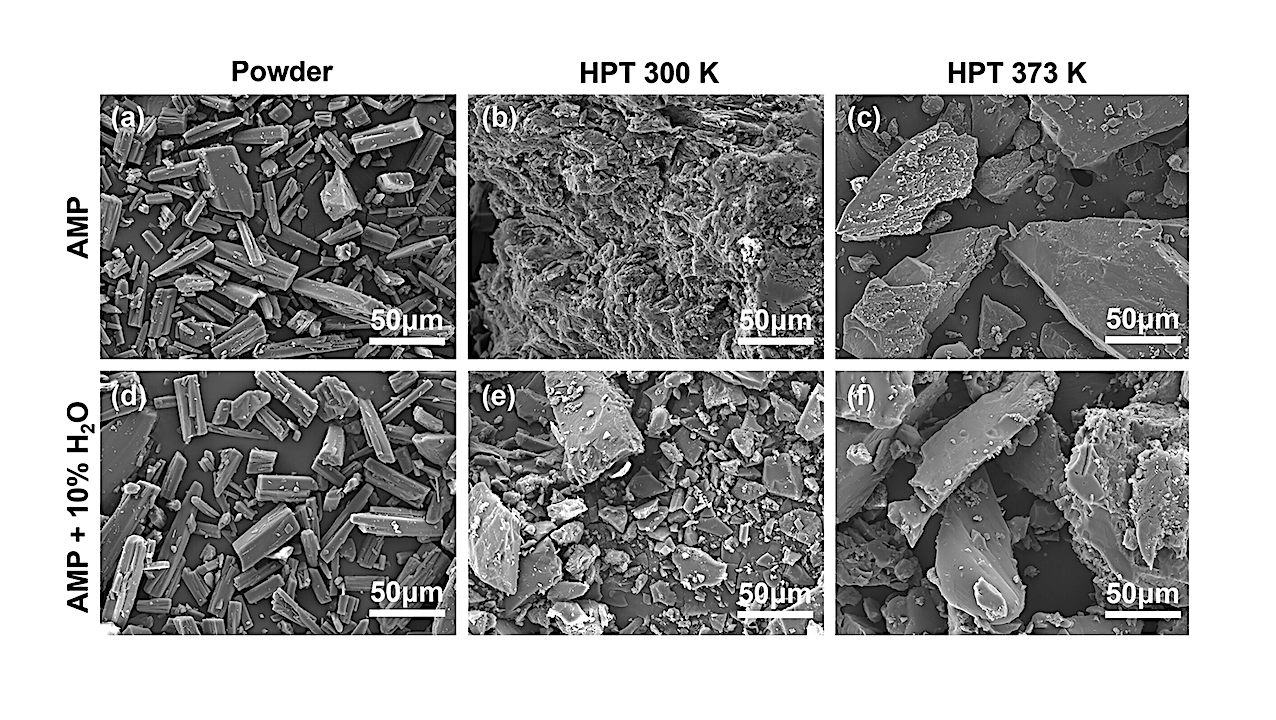
Scanning electron microscopy images of AMP in (a–c) dry condition and (d–f) hydrated condition prior to and following treatment through HPT at ambient and boiling water temperatures. — Astrobiology via Sage
The origin of life is yet a compelling scientific mystery that has sometimes been attributed to high-pressure impacts by small solar system bodies such as comets, meteoroids, asteroids, and transitional objects.
Extreme conditions of astronomical impacts and offers insights relevant to prebiotic chemistry. In the present study, we investigated the polymerization and stability of adenosine monophosphate (AMP), a key precursor to ribonucleic acid (RNA), in dry and hydrated conditions (10 wt% water) under 6 GPa at ambient and boiling water temperatures.
Comprehensive analyses with the use of X-ray diffraction, Raman spectroscopy, Fourier-transform infrared spectroscopy, nuclear magnetic resonance, scanning electron microscopy, and matrix-assisted laser desorption/ionization time-of-flight mass spectrometry revealed no evidence of polymerization, while AMP partly transformed to other organic compounds such as nucleobase-derived fragments of adenine, phosphoribose fragments, dehydrated adenosine, protonated adenosine, and oxidized adenosine. The torque measurements during HPT further highlighted the mechanical behavior of AMP under extreme conditions.
These findings suggest that, while HPT under the conditions tested does not facilitate polymerization, the formation of various compounds from AMP confirms the significance of astronomical impacts on the prebiotic chemistry of RNA on early Earth. Key Words: Ribonucleic acid (RNA)-Origin of life-Phase transformations-Chemical reactions-Small solar system bodies. Astrobiology 26, 1-9.
Astrobiology, Astrochemistry











Related Posts
Stay Informed With the Latest & Most Important News
Previous Post
Next Post



Advertisement
-
 01Two Black Holes Observed Circling Each Other for the First Time
 -
 02From Polymerization-Enabled Folding and Assembly to Chemical Evolution: Key Processes for Emergence of Functional Polymers in the Origin of Life
 -
 03Astronomy 101: From the Sun and Moon to Wormholes and Warp Drive, Key Theories, Discoveries, and Facts about the Universe (The Adams 101 Series)
 -
 04True Anomaly hires former York Space executive as chief operating officer
 -
 05Φsat-2 begins science phase for AI Earth images
 -
 06Hurricane forecasters are losing 3 key satellites ahead of peak storm season − a meteorologist explains why it matters
 -
 07Binary star systems are complex astronomical objects − a new AI approach could pin down their properties quickly