
Now Reading: Tricorder Tech: Opportunities and Limitations of Nuclear Magnetic Resonance Spectroscopy in Astrobiology
-
01
Tricorder Tech: Opportunities and Limitations of Nuclear Magnetic Resonance Spectroscopy in Astrobiology

Tricorder Tech: Opportunities and Limitations of Nuclear Magnetic Resonance Spectroscopy in Astrobiology

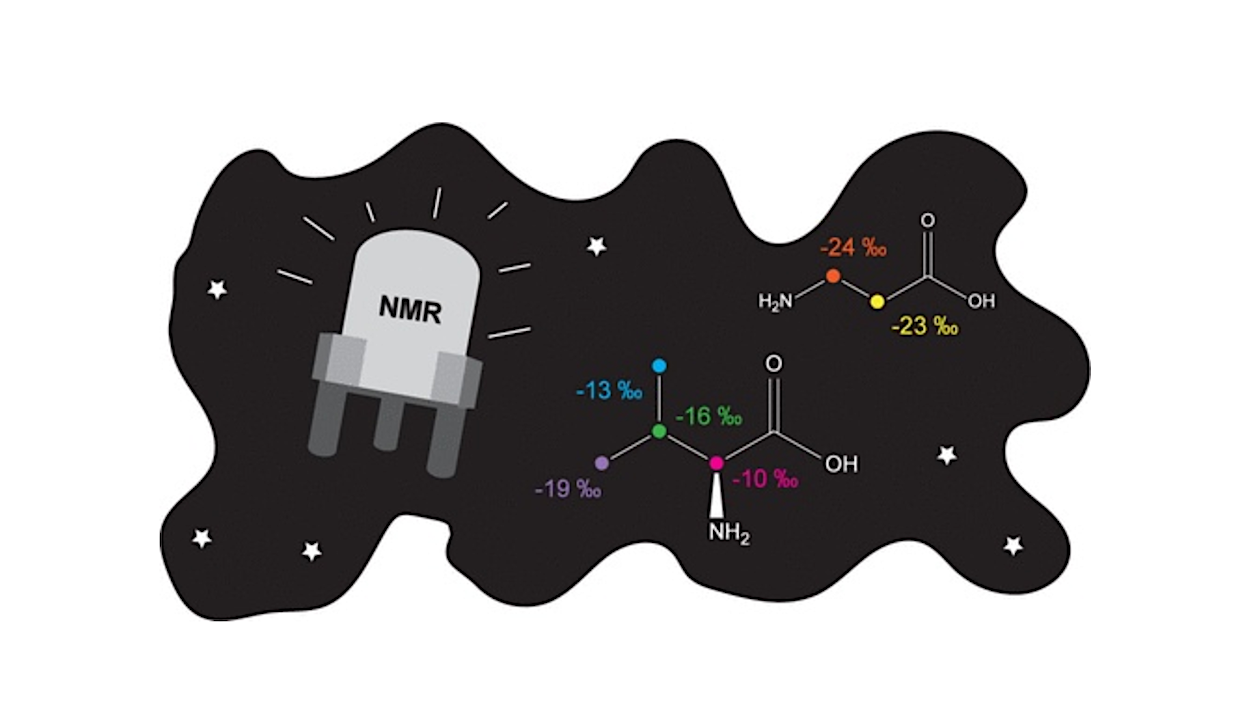
Graphical Abstract – ACS Earth and Space Chemistry via Xmol
For decades, nuclear magnetic resonance (NMR) spectroscopy has been utilized as a powerful tool in various scientific disciplines, most prominently in chemistry, to determine molecular structures or monitor reactions.
While well established in various fields, NMR applications in astrobiology are still unclear. This work aims to explore the potential of NMR in astrobiology, highlighting strengths but also weaknesses.
We illustrate the capabilities of NMR with two applications: (1) recently developed methods for position-specific carbon isotope analysis of complex organics; and (2) well-established tools for performing quantitative compositional analysis of complex organic mixtures.
By utilizing samples relevant to astrobiology, specifically the amino acid valine and analogue mixtures of organics, we showcase that molecules retain a source-dependent and distinct intramolecular carbon isotope fingerprint. We demonstrate that compositional sample analysis provides an independent and complementary line of evidence pointing toward the origin of a molecule or mixture. Together, these NMR tools have the potential to support life detection efforts and aid in distinguishing between biotic and abiotic samples.
Finally, we discuss sensitivity, detection limits, and the portability of NMR, and propose how integration with mass-spectrometry techniques will be imperative to enable more targeted and comprehensive analyses relevant to astrobiology, including in situ analysis, but also sample return missions.
Opportunities and Limitations of Nuclear Magnetic Resonance Spectroscopy in Astrobiology,
ACS Earth and Space Chemistry via Xmol
Astrobiology











Related Posts
Stay Informed With the Latest & Most Important News




Advertisement
-
 01Two Black Holes Observed Circling Each Other for the First Time
 -
 02From Polymerization-Enabled Folding and Assembly to Chemical Evolution: Key Processes for Emergence of Functional Polymers in the Origin of Life
 -
 03Astronomy 101: From the Sun and Moon to Wormholes and Warp Drive, Key Theories, Discoveries, and Facts about the Universe (The Adams 101 Series)
 -
 04True Anomaly hires former York Space executive as chief operating officer
 -
 05Φsat-2 begins science phase for AI Earth images
 -
 06Hurricane forecasters are losing 3 key satellites ahead of peak storm season − a meteorologist explains why it matters
 -
 07Binary star systems are complex astronomical objects − a new AI approach could pin down their properties quickly