
Now Reading: Transcelestial to provide satellite laser communication terminals to Gilmour Space
-
01
Transcelestial to provide satellite laser communication terminals to Gilmour Space


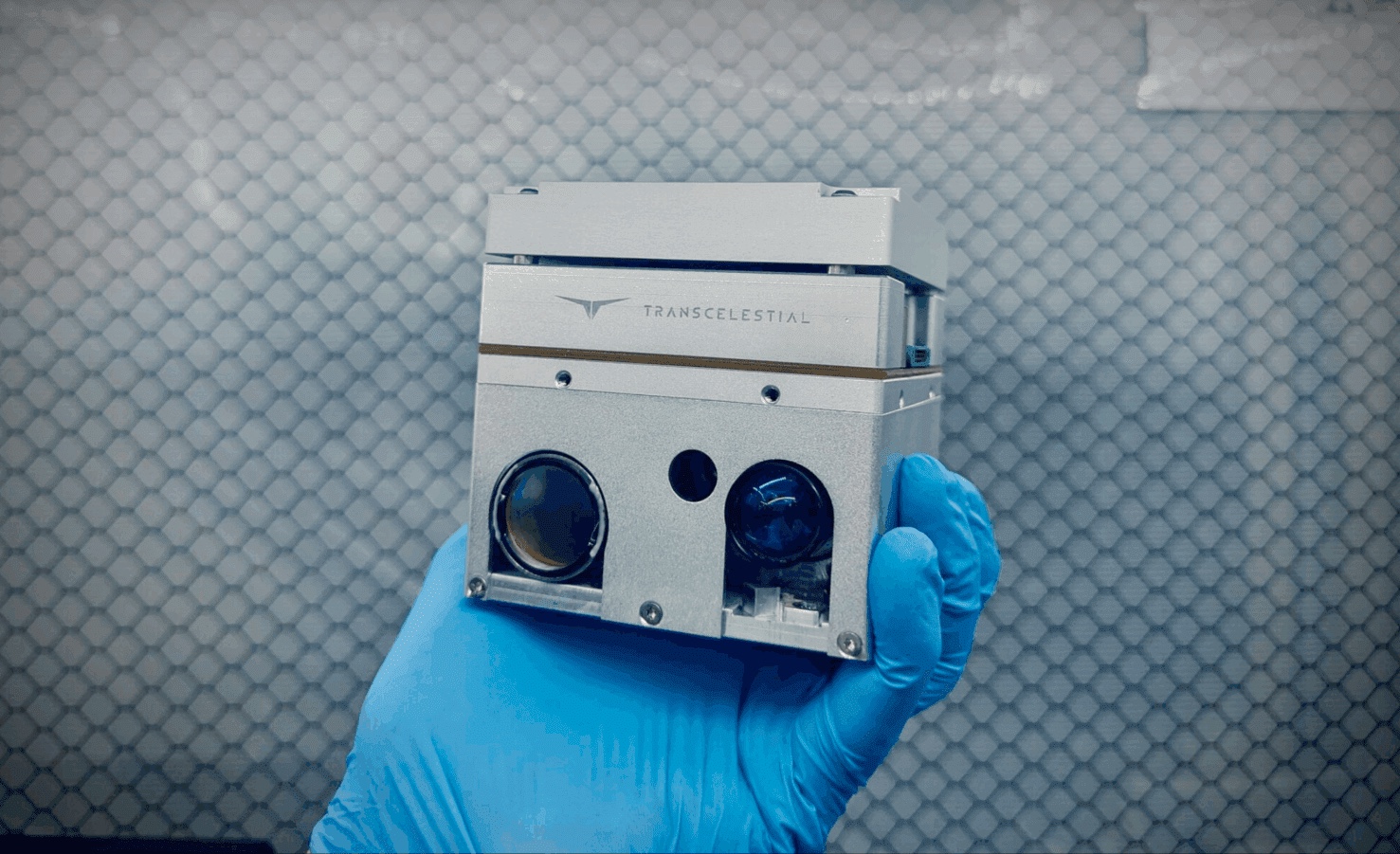

WASHINGTON — Transcelestial, a startup developing optical communications technologies, has signed an agreement with Gilmour Space Technologies to incorporate its technology on Gilmour Space spacecraft.
Singapore-based Transcelestial announced Feb. 2 a strategic partnership with the Australian launch vehicle and satellite manufacturer that will begin with a demonstration on a Gilmour Space spacecraft launching later this year.
A Transcelestial terminal will be integrated into a Gilmour Space satellite launching on SpaceX’s Transporter-18 rideshare mission. The terminal will test the use of lasers to provide high-speed data transmission from the spacecraft to the ground.
“One of the key limitations in satellite operations is data transmission from the platform to the ground,” Mark Grimminck, head of satellites at Gilmour Space, said in a statement announcing the partnership. “Laser communication links are one of the clearest paths to relieving that bottleneck, and our collaboration with Transcelestial is about proving how it performs in real operations.”
If the demonstration is successful, it could lead to the use of Transcelestial terminals on future Gilmour Space satellites. The companies will also study establishing a Transcelestial optical ground station in Queensland, Australia.
Rohit Jha, co-founder and chief executive of Transcelestial, said in an interview that he has known Gilmour Space and its founders since the company began in Singapore before relocating to Australia.
“We’ve always been in touch, and we said, ‘What does space really need? It needs an undersea cable alternative,’” he said.
He said he believes the space equivalent of undersea cables, which carry the bulk of intercontinental internet traffic, is lasers. “It’s a technology of the future. It’s a thousand to a million times faster than RF,” he said. “That’s how it really started.”
Transcelestial, which initially offered terrestrial point-to-point laser communications systems, is expanding into space. The company provided a terminal for 6GStarLab, a cubesat built by Open Cosmos for Spanish company i2CAT and launched on a Transporter mission in November 2025. Jha said the company secretly tested the technology in space several years earlier but did not disclose details.
In addition to its partnership with Gilmour Space, Transcelestial is supplying intersatellite laser terminals for a pair of satellites being built by ST Engineering, also launching on Transporter-18.
Lasers are increasingly used for intersatellite links, including on constellations such as SpaceX’s Starlink. Their use for space-to-ground communications is far less common, despite the promise of gigabit data rates and resistance to jamming that radio-frequency communications can be vulnerable to.
One challenge is weather, as clouds and precipitation can block laser transmissions that radio-frequency signals can penetrate. Jha said the company has developed technologies for its terrestrial laser communications systems that can compensate for some weather conditions by increasing power, and it plans to apply those techniques to its space-to-ground systems.
“But heavy rain or dark clouds, obviously we can’t penetrate,” he said. Transcelestial’s approach is to develop a network of optical ground stations large enough that at least one station should be accessible to a satellite at any given time, even if others are clouded out.
“Both of these combined give us a substantial amount of resiliency to weather conditions,” he said.
The company currently operates optical ground stations in Singapore and Barcelona and plans to establish additional stations within the next year in Australia, Japan, Taiwan and the United States.
Transcelestial plans to leverage a production line in Singapore capable of producing thousands of terminals annually for terrestrial applications to support its space business. Jha said the company’s space terminals share about 70% to 80% of their subsystems with its terrestrial terminals.
The company is focused on delivering the lowest cost per bit, which Jha said is critical for any communications network. “If you have the lowest cost per bit, you win,” he said.
The high data rates of laser communications, combined with the potential for low-cost, mass-produced terminals, could give the company that advantage, he said. “You get a cost-per-bit equation that is cheaper than anything else in RF,” he said.
Transcelestial has ambitions beyond selling optical terminals and ground stations. Jha said the company plans a constellation of 40 spacecraft in equatorial orbit that would offer network capacity exceeding 100 gigabits per second.
“What it allows us to do is let people like Gilmour and others connect directly onto our network in orbit,” he said. “They can freely connect to an always-on network in space, which gives them sub-100-millisecond access to cloud capabilities.”
Jha said deployment of the constellation could begin within the next two years but acknowledged that Transcelestial, which has raised nearly $35 million to date, will need additional funding to develop the satellite system.










Related Posts
Stay Informed With the Latest & Most Important News
Previous Post
Next Post


Advertisement
-
 01Two Black Holes Observed Circling Each Other for the First Time
 -
 02From Polymerization-Enabled Folding and Assembly to Chemical Evolution: Key Processes for Emergence of Functional Polymers in the Origin of Life
 -
 03Astronomy 101: From the Sun and Moon to Wormholes and Warp Drive, Key Theories, Discoveries, and Facts about the Universe (The Adams 101 Series)
 -
 04True Anomaly hires former York Space executive as chief operating officer
 -
 05Φsat-2 begins science phase for AI Earth images
 -
 06Hurricane forecasters are losing 3 key satellites ahead of peak storm season − a meteorologist explains why it matters
 -
 07Binary star systems are complex astronomical objects − a new AI approach could pin down their properties quickly