
Now Reading: At Blue Origin, Hegseth escalates criticism of legacy defense procurement
-
01
At Blue Origin, Hegseth escalates criticism of legacy defense procurement


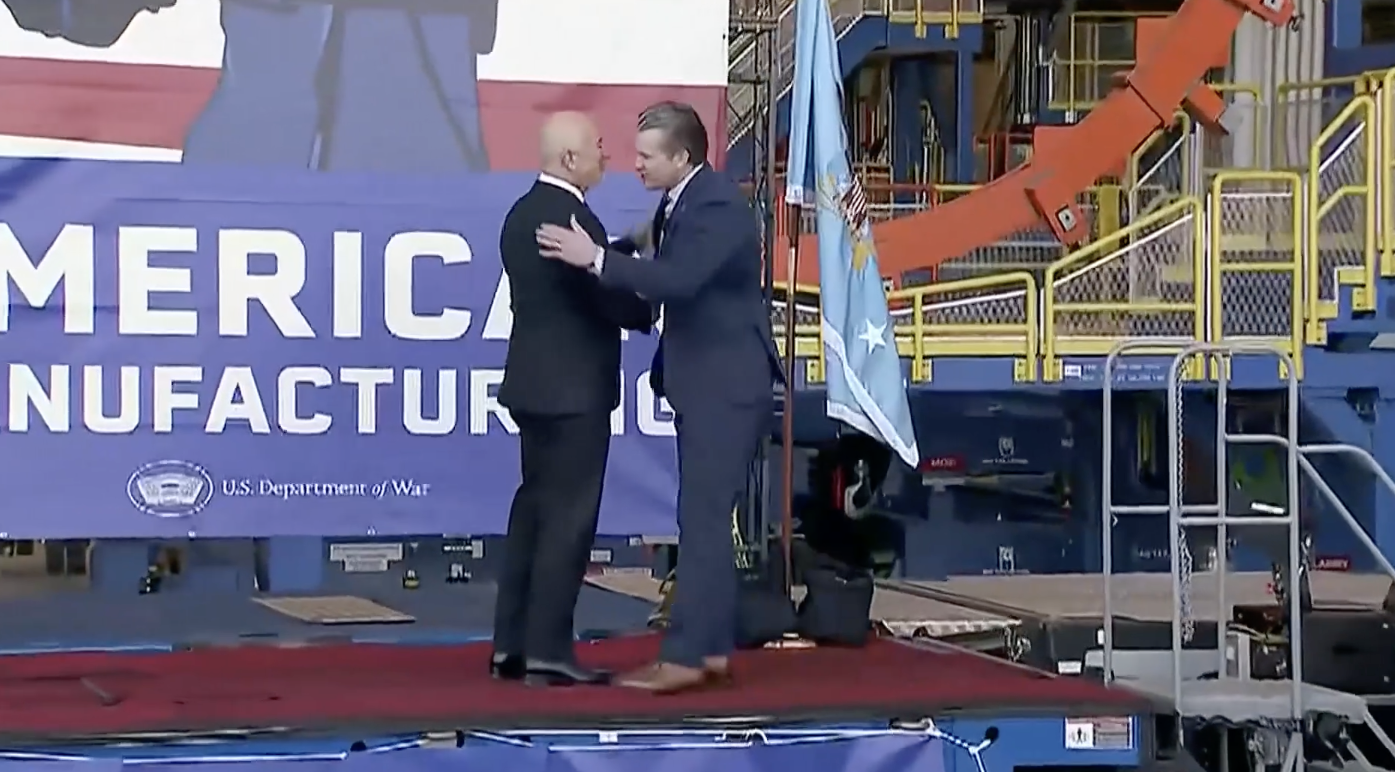

WASHINGTON — Defense Secretary Pete Hegseth used a visit to Blue Origin’s Florida rocket factory to sharpen the Trump administration’s message that the Pentagon intends to favor faster, commercially driven innovation — and hold traditional defense contractors to account for what officials say has been years of missed schedules and misaligned incentives.
Speaking Feb. 2 at Blue Origin’s 750,000-square-foot manufacturing complex on Merritt Island, Hegseth framed commercial space companies as central players in an effort to overhaul how the Defense Department buys weapons and space systems. The stop was part of his “Arsenal of Freedom” tour, a series of high-profile appearances aimed at signaling a shift in Pentagon culture toward speed, scale and production capacity.
The Merritt Island facility, located at Exploration Park next to NASA’s Kennedy Space Center, is designed to produce and integrate Blue Origin’s heavy-lift New Glenn rocket. The vehicle has flown twice and is seeking certification for national security space launch missions after four successful launches.
Hegseth’s visit followed a test flight aboard a Northrop F-5 military jet flown by NASA Administrator Jared Isaacman. At Blue Origin he reinforced a theme in his recent public remarks: criticism of large defense contractors that, in the administration’s view, have prioritized shareholder returns over manufacturing throughput and on-time delivery.
Hegseth said partnerships with private aerospace firms like Blue Origin strengthen national security and give the Pentagon alternatives to legacy suppliers. He praised President Donald Trump for pressing for a major increase in defense spending while publicly calling on large contractors to rein in stock buybacks, dividends and executive compensation.
“I don’t mind people making lots and lots of money … but if you’re going to do so, deliver for the American people and the taxpayers the capabilities you said you would deliver,” Hegseth said.
Push for faster acquisitions
The secretary has delivered similar messages in recent weeks during stops at SpaceX’s Starbase facility in Texas and at Rocket Lab in Southern California. Across those visits, the emphasis has been less on specific program announcements than on a broader strategic argument: that success in future conflicts will depend on faster acquisition cycles, closer ties with commercial industry and a willingness to accept incremental capability over protracted development timelines.
At Blue Origin, Hegseth tied that argument to the administration’s proposed Golden Dome missile defense initiative, which would rely heavily on space-based sensors and interceptors. He said Golden Dome will “revolutionize our homeland defense through cutting edge space based capabilities,” describing a future architecture built around persistent sensors and space-based interceptors designed to counter ballistic missiles, hypersonic weapons and drones.
“We have to dominate the space domain,” Hegseth told workers at the factory. “That means we’ll ensure that we keep building rockets and engines and landers that you make here at scale and at speed.”
Hegseth also cast the Pentagon itself as an obstacle the administration intends to reform. “President Trump has directed us to overturn the way we are doing business,” he said, arguing against waiting years and spending tens of billions of dollars on systems that fail to reach operational use.
Commercial firms like Blue Origin, he said, will have more opportunities to compete — and to challenge incumbents that are now being scrutinized more closely for performance. “No more egregious executive bonuses, no more stock buybacks, no more ridiculous CEO salaries when you can’t even deliver weapons on time for the war fighter,” Hegseth said.










Related Posts
Stay Informed With the Latest & Most Important News
Previous Post
Next Post


Advertisement
-
 01Two Black Holes Observed Circling Each Other for the First Time
 -
 02From Polymerization-Enabled Folding and Assembly to Chemical Evolution: Key Processes for Emergence of Functional Polymers in the Origin of Life
 -
 03Astronomy 101: From the Sun and Moon to Wormholes and Warp Drive, Key Theories, Discoveries, and Facts about the Universe (The Adams 101 Series)
 -
 04True Anomaly hires former York Space executive as chief operating officer
 -
 05Φsat-2 begins science phase for AI Earth images
 -
 06Hurricane forecasters are losing 3 key satellites ahead of peak storm season − a meteorologist explains why it matters
 -
 07Binary star systems are complex astronomical objects − a new AI approach could pin down their properties quickly