
Now Reading: Viridian inks cooperative agreement with Air Force Research Laboratory
-
01
Viridian inks cooperative agreement with Air Force Research Laboratory


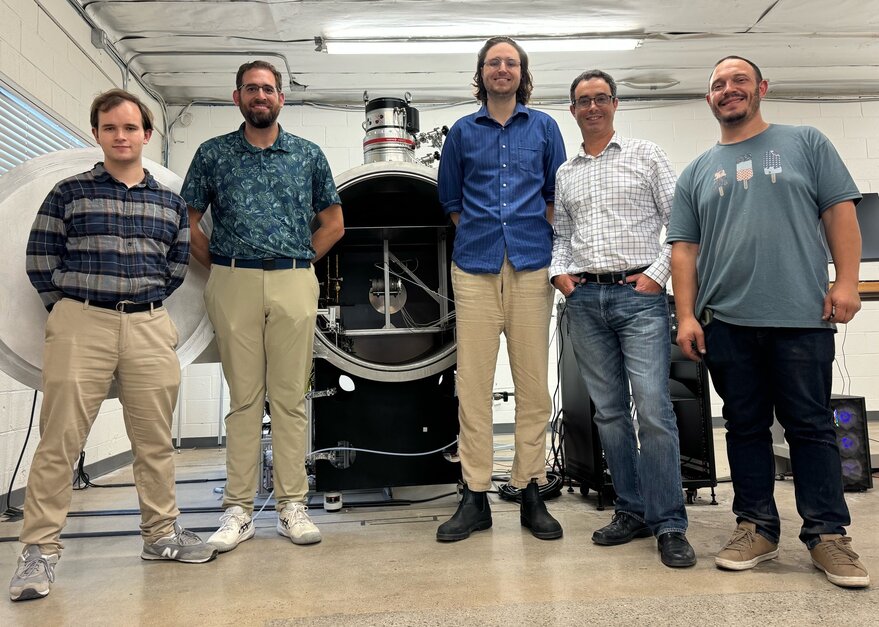

SAN FRANCISCO — Viridian Space Corp. signed a cooperative research and development agreement (CRADA) with the Air Force Research Laboratory.
The five-year CRADA will provide the Southern California startup with access to testing facilities and satellite-operations expertise at AFRL’s Kirtland Air Force Base in New Mexico.
“There seems to be a good collaborative opportunity for testing our technology on the ground and, when we fly, collecting and sharing data from the [Very Low Earth Orbit] VLEO environment,” Viridian Space CEO Rostislav Spektor told SpaceNews. “Characterizing the VLEO environment is important for satellites that fly in VLEO and for satellites traveling to higher orbits that fly through VLEO.”
Viridian was established to develop an air-breathing electric propulsion system that ingests atmosphere at an altitude between 200 and 300 kilometers to feed a plasma thruster. In addition to supporting sustained operations in VLEO, the company aims “to achieve true agility and maneuverability for satellites by enabling them to refuel in VLEO,” Spektor said. “They can refuel there and then can go up in orbit or change the orbit. Agility is what we’re going after.”
Climbing the TRL Ladder
In tandem with the AFRL CRADA, El Segundo, California-based Viridian is working under a $1.25 million Phase 2 award from the U.S. Space Force technology innovation arm SpaceWERX to develop an air-fed cathode to withstand erosion in the oxygen-rich VLEO environment. Through another $1.7 million Small Business Innovation Research award from the Air Force technology innovation agency AFWERX, Viridian is developing an “end-to-end propulsion system,” Spektor said.
With government interest in satellite maneuverability and sustained operations growing, Viridian welcomes the opportunity to work closely with government agencies, Spektor said, adding, “We are very thankful for government support in getting us up the [technology readiness level] ladder.”
In 2026, is “testing components on the ground and building up to the end-to-end test,” Spektor said. “Once that’s demonstrated, that’s going to be important validation that this technology will work once we get into space.”










Related Posts
Stay Informed With the Latest & Most Important News
Previous Post
Next Post



Advertisement
-
 01Two Black Holes Observed Circling Each Other for the First Time
 -
 02From Polymerization-Enabled Folding and Assembly to Chemical Evolution: Key Processes for Emergence of Functional Polymers in the Origin of Life
 -
 03Astronomy 101: From the Sun and Moon to Wormholes and Warp Drive, Key Theories, Discoveries, and Facts about the Universe (The Adams 101 Series)
 -
 04True Anomaly hires former York Space executive as chief operating officer
 -
 05Φsat-2 begins science phase for AI Earth images
 -
 06Hurricane forecasters are losing 3 key satellites ahead of peak storm season − a meteorologist explains why it matters
 -
 07Binary star systems are complex astronomical objects − a new AI approach could pin down their properties quickly