
Now Reading: James Webb Space Telescope finds most distant galaxy ever detected: ‘It looks nothing like what we predicted’
-
01
James Webb Space Telescope finds most distant galaxy ever detected: ‘It looks nothing like what we predicted’

James Webb Space Telescope finds most distant galaxy ever detected: ‘It looks nothing like what we predicted’

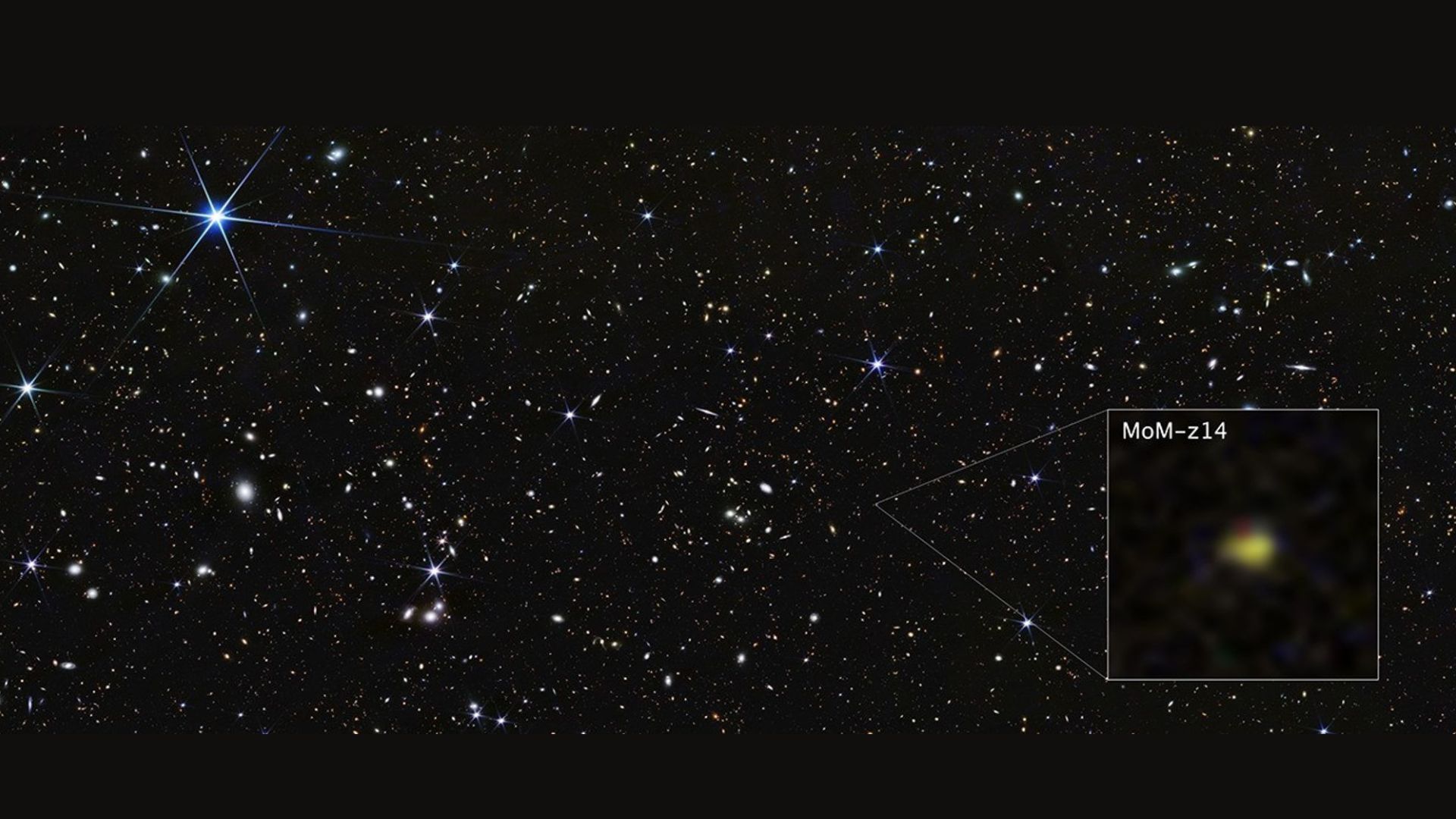
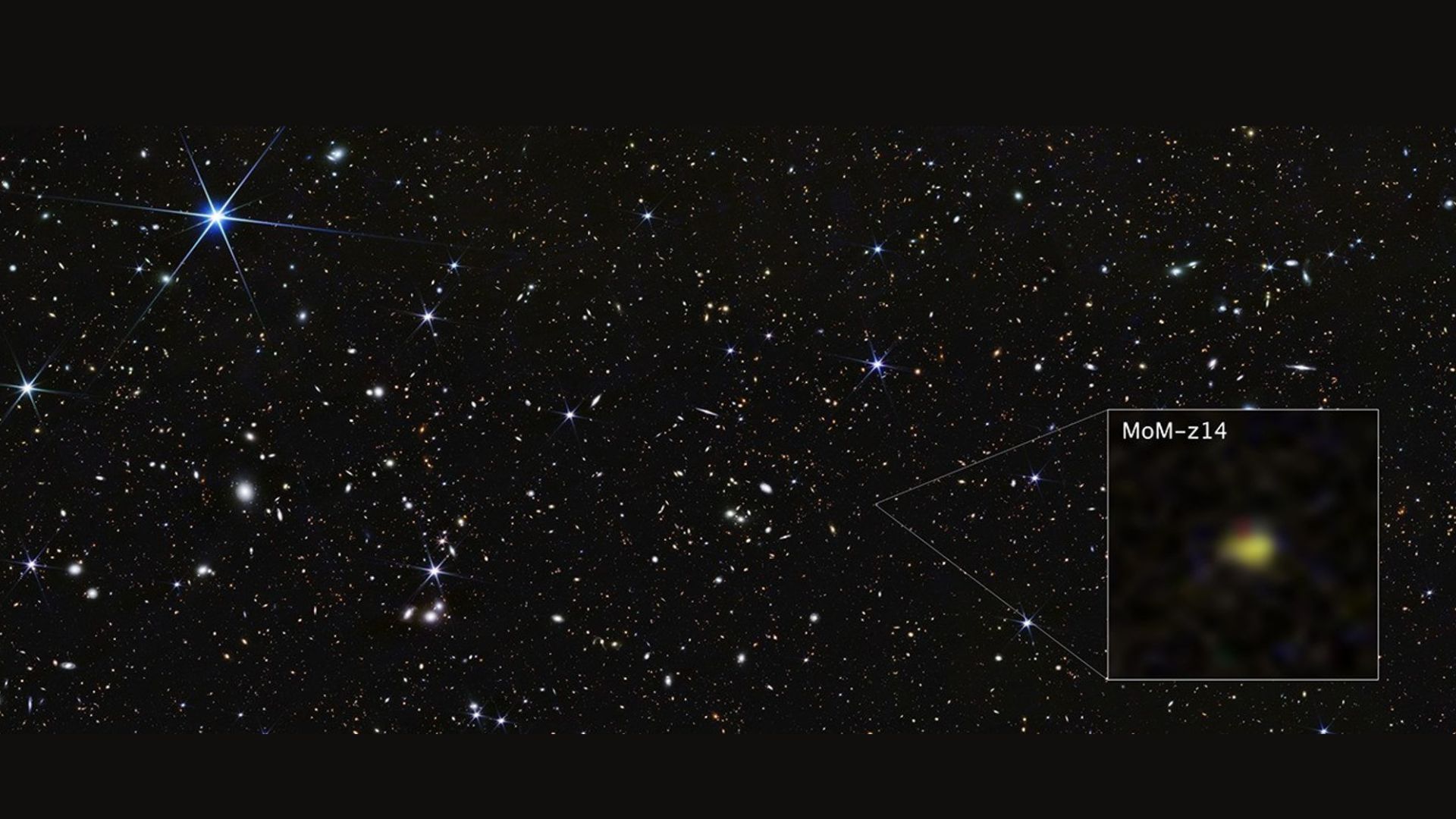
The James Webb Space Telescope has spotted the most distant galaxy yet detected, NASA announced Wednesday (Jan. 28), allowing astronomers to peer closer than ever before to the era when the first stars and galaxies formed, known as cosmic dawn.
The galaxy, named MoM-z14, offers a rare glimpse into the universe just 280 million years after the Big Bang. Its light has traveled for about 13.5 billion years to reach Earth, making it the farthest and one of the earliest known galaxies ever observed.
The discovery, based on JWST data from April 2025 and published this month in the Open Journal of Astrophysics, adds MoM-z14 to a growing list of unexpectedly luminous young galaxies that challenge existing theories about how quickly stars and galaxies formed after the universe began. According to NASA, MoM-z14 is “brighter, more compact, and more chemically enriched” than astronomers anticipated for such an early era.
Among its most surprising features are elevated levels of nitrogen, which suggest that massive stars may have formed and evolved more rapidly in the dense early universe than current models predict. The galaxy also appears to have cleared its surrounding region of primordial hydrogen gas — an unexpected finding, the researchers say, given that the early universe was filled with neutral hydrogen.
“There is a growing chasm between theory and observation related to the early universe, which presents compelling questions to be explored going forward,” study co-author Xuejian (Jacob) Shen, a postdoctoral researcher at MIT, said in the statement.
Before JWST’s launch, theoretical models suggested that detecting bright galaxies beyond a redshift of 10, past the reach of the Hubble Space Telescope, would be extraordinarily difficult. Those models assumed early galaxies would be small, faint, and rare, leading astronomers to expect only a handful of dim sources that would require tens of hours of spectroscopic observations to confirm, the new study notes.
Instead, JWST has routinely exceeded expectations, its powerful infrared eye capturing light from tens of young galaxies that existed just a few hundred million years after the Big Bang.
“While we were hoping for some very early objects, I don’t think any of us expected to break the redshift record!” study co-author Pieter van Dokkum, a professor of astronomy and physics at Yale University, told Space.com in May last year, when a preprint version of the paper was released.
That the telescope continues to break its own records suggests that even more record-breaking discoveries lie ahead, astronomers say.
“It’s an incredibly exciting time,” study co-author Yijia Li of the Pennsylvania State University said in the NASA statement, “with Webb revealing the early universe like never before and showing us how much there still is to discover.”










Related Posts
Stay Informed With the Latest & Most Important News
Previous Post
Next Post

Advertisement
-
 01Two Black Holes Observed Circling Each Other for the First Time
 -
 02From Polymerization-Enabled Folding and Assembly to Chemical Evolution: Key Processes for Emergence of Functional Polymers in the Origin of Life
 -
 03Astronomy 101: From the Sun and Moon to Wormholes and Warp Drive, Key Theories, Discoveries, and Facts about the Universe (The Adams 101 Series)
 -
 04True Anomaly hires former York Space executive as chief operating officer
 -
 05Φsat-2 begins science phase for AI Earth images
 -
 06Hurricane forecasters are losing 3 key satellites ahead of peak storm season − a meteorologist explains why it matters
 -
 07Binary star systems are complex astronomical objects − a new AI approach could pin down their properties quickly