
Now Reading: Simulation of Enceladus’ ocean shows strong potential for life
-
01
Simulation of Enceladus’ ocean shows strong potential for life


EarthSky’s 2026 lunar calendar shows the moon phase for every day of the year. Get yours today!
- Saturn’s moon Enceladus has a global ocean beneath its icy crust. The Cassini spacecraft found various kinds of organic molecules in Enceladus’ plumes. Could life itself exist in those alien waters?
- Scientists simulated the conditions of the ocean in experiments in a lab on Earth. The tests created many of the same organics that Cassini found, both simple and complex.
- So molecular building blocks of life can form easily in Enceladus’ ocean, according to the results. This increases the possibility of life.
Recreation of Enceladus’ ocean
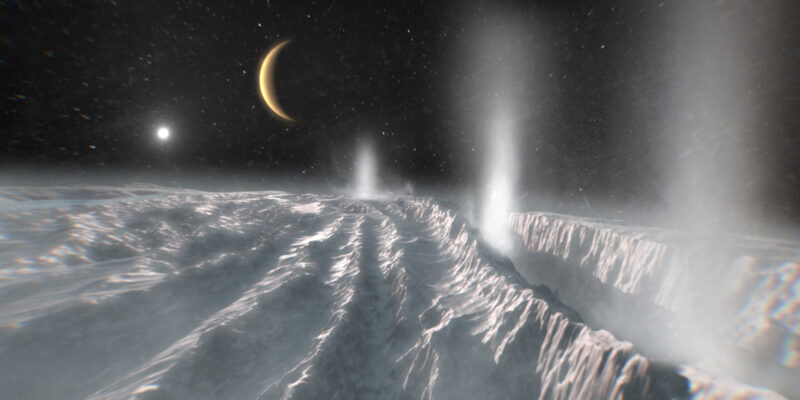
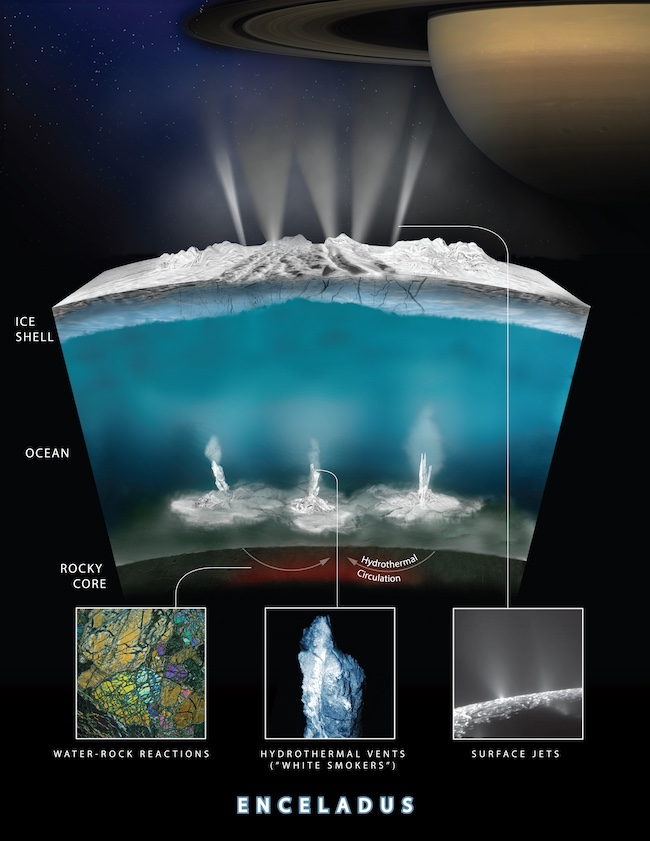
Saturn’s moon Enceladus has a global subsurface ocean that scientists say might be able to support life. NASA’s Cassini spacecraft discovered various organic compounds, both simple and more complex, in the geyser-like plumes of water vapor that erupt through cracks in the moon’s icy crust. And now scientists in Japan and Germany have recreated the conditions of Enceladus’ ocean in a lab on Earth. The researchers said on January 18, 2026, they found many of the organics can form easily in the ocean itself. This adds to the growing evidence that Enceladus’ ocean contains the molecular building blocks of life … and could be habitable.
Cassini first found the organics when it passed through the plumes several times between 2005 and 2017. It analyzed the composition of the plumes and found a variety of organic molecules, both simple and more complex. It also found salts, ammonia, hydrogen, hydrogen cyanide, phosphorous, methane, sodium, potassium, chlorine and carbonate-containing compounds. Scientists said the plumes originate from the ocean below the outer icy crust. They erupt through huge cracks in the ice at the south pole called Tiger Stripes.
The researchers published their new peer-reviewed findings in the journal Icarus on January 15, 2026.
Organics from inside or outside Enceladus?
While scientists have confirmed the organics in the plumes, there has still been debate about their origin. Are they currently being produced in the ocean, or were they left over from when the moon first formed? As lead author Max Craddock at the Institute of Science Tokyo noted:
However, it remained unclear whether those compounds were produced inside the moon or inherited from ancient material that formed it. While earlier laboratory studies explored hydrothermal organic synthesis relevant to early Earth and comets, they rarely focused on Enceladus’ distinctive environment.
Last year, some scientists reported that radiation might create some of the organic molecules found on Saturn’s moon Enceladus. But then, another international team of researchers said that a new analysis of data from the Cassini mission had found new complex organics that they are certain originate in an ocean below Enceladus’ surface.
Laboratory experiments simulating Enceladus' subsurface ocean conditions have produced organic molecules similar to those detected by Cassini, supporting the moon's potential for prebiotic chemistry. doi.org/hbkc9t
— Science X / Phys.org (@sciencex.bsky.social) 2026-01-18T13:30:14-05:00
Simulating conditions in Enceladus’ ocean
So, where do the organics come from? To try to answer that question, the researchers simulated the conditions of Enceladus’ ocean in the lab. They based their simulations on what is known about conditions at Enceladus from the Cassini data.
Saturn’s gravity pulls and squeezes Enceladus as it orbits the planet. This creates cycles of heating and cryogenic freezing. Evidence from Cassini suggests this is enough to create hydrothermal activity on Enceladus’ seafloor, like hydrothermal vents on the seafloor on Earth. As a result, this could help create more complex organic compounds.
The researchers recreated the ocean water using a mixture of the known chemicals in Enceladus’ ocean. Then, they used a high-pressure reactor to simulate the heating/freezing cycle. Lastly, they analyzed the simulated ocean water with a spectrometer similar to the one on Cassini. Craddock said:
We then analyzed the products using a laser-based mass spectrometer designed to mimic Cassini’s Cosmic Dust Analyzer, allowing us to directly compare our experimental chemistry with the spacecraft’s measurements.


A wide variety of organic compounds
Sure enough, the experiments produced a wide array of complex organics, including amino acids, aldehydes and nitriles. The freezing part of the cycle also produced additional simpler organic molecules, such as glycine.
Overall, the results closely matched what Cassini actually found.
Other puzzling organics
The results show that organic molecules can easily form in Enceladus’ ocean. There are still some puzzles to solve, however. Some of the larger organic molecules that Cassini found didn’t show up in the experiments. So we don’t know exactly how they formed. There might be other hot, catalyzed chemical reactions in the ocean that we don’t know about yet. Or perhaps those molecules are ancient leftovers from when Enceladus first formed.
We will likely need future missions back to Enceladus to answer these questions, as Craddock explained:
For future missions, this sharpens how plume measurements should be interpreted and underscores the importance of instruments capable of verifying amino acids and resolving whether complex organics reflect ongoing internal chemistry or ancient material.
Together, such observations will be central to evaluating Enceladus’ habitability and to probing how chemistry in ocean worlds might progress toward life.
Bottom line: Researchers simulated the conditions in Enceladus’ ocean and found that a wide variety of organic molecules can easily form, increasing the chances for life.
Read more: Do the organics in Enceladus’ ocean point to habitability?
Read more: Hidden ocean on Enceladus might be stable enough for life
The post Simulation of Enceladus’ ocean shows strong potential for life first appeared on EarthSky.










Related Posts
Stay Informed With the Latest & Most Important News
Previous Post
Next Post


Advertisement
-
 01Two Black Holes Observed Circling Each Other for the First Time
 -
 02From Polymerization-Enabled Folding and Assembly to Chemical Evolution: Key Processes for Emergence of Functional Polymers in the Origin of Life
 -
 03Astronomy 101: From the Sun and Moon to Wormholes and Warp Drive, Key Theories, Discoveries, and Facts about the Universe (The Adams 101 Series)
 -
 04True Anomaly hires former York Space executive as chief operating officer
 -
 05Φsat-2 begins science phase for AI Earth images
 -
 06Hurricane forecasters are losing 3 key satellites ahead of peak storm season − a meteorologist explains why it matters
 -
 07Binary star systems are complex astronomical objects − a new AI approach could pin down their properties quickly