
Now Reading: Ice-cold Earth? Possible new exoplanet might be chillier than Mars
-
01
Ice-cold Earth? Possible new exoplanet might be chillier than Mars



EarthSky’s lunar calendar shows the moon phases for every day of 2026. Get yours today!
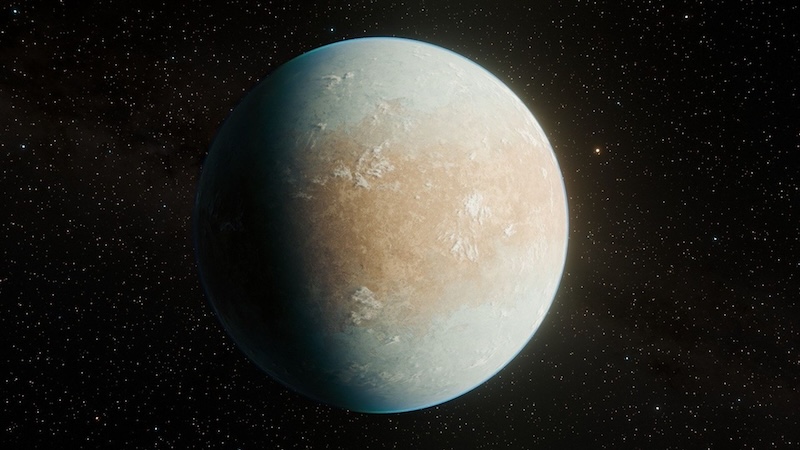
- HD 137010 b is a new candidate exoplanet, 146 light-years away. Astronomers found it in data from NASA’s Kepler Space Telescope mission.
- If real, it is rocky, just slightly larger than Earth and has an orbit similar to Earth’s.
- The planet might be a bit colder than Mars, however, because its star is a bit cooler and dimmer than our sun.
An ice-cold Earth?
Have astronomers found a colder version of Earth? An international team of researchers said on January 27, 2026, that they have discovered a new “exo-Earth” candidate 146 light-years away. The exoplanet – HD 137010 b – is rocky, only slightly larger than Earth and orbits a sunlike star. Its orbit is similar to Earth’s too. That’s exciting, although there’s one big caveat: it might be colder than Mars. But, it could also turn out to be more temperate, even watery.
The researchers found the candidate planet in data from NASA’s Kepler Space Telescope, which ended its mission in 2018. Right now, the exoplanet is still considered a candidate, because it hasn’t been fully confirmed yet.
The researchers published their intriguing peer-reviewed findings in The Astrophysical Journal Letters on January 27, 2026.
Exoplanet Candidate HD 137010 b: An Ice-Cold Earth Analog?astrobiology.com/2026/01/exop… #Astrobiology #astronomy #exoplanet
— Astrobiology (@astrobiology.bsky.social) 2026-01-30T19:43:57.821Z
Colder than Mars?
The researchers said HD 137010 b might orbit just within the outer edge of its star’s habitable zone. That’s the region around a star where temperatures on a rocky planet could support liquid water. The problem, however, is that the planet receives less than 1/3 of the heat and light from its star than Earth does from the sun. Why is that? It’s because the star is cooler and dimmer than our sun, even though it is the same spectral type (G-type star).
With this in mind, the researchers calculated that the surface temperature of HD 137010 b could be about -90 degrees Fahrenheit (-68 C). That’s a bit colder than Mars, which has an average temperature of -85 degrees Fahrenheit (-65 C).
An artist’s animation of exoplanet candidate HD 137010 b. This view also creates an effect similar to a transit, as the planet’s star disappears and then reappears from behind HD 137010 b. Video via NASA/ JPL-Caltech/ Keith Miller (Caltech/ IPAC).
From candidate to confirmation
As of now, HD 137010 b is still a candidate exoplanet. That means the data suggest it is a real planet, but it still requires full confirmation from additional observations. The paper states:
A comprehensive analysis of the K2 observations, historical low-resolution imaging and new high-resolution speckle imaging data, archival HARPS RVs, and Hipparcos–Gaia astrometry allow us to exclude the conventional false-positive hypotheses for the transit signal, leaving a transiting exoplanet as the most plausible explanation for the photometric event. However, since we only have the evidence of one transit event, we ultimately classify HD 137010 b as a candidate planet.
The research team used the transit method to detect the planet. That’s when the planet transits – passes in front of – its star, as viewed from Earth. Unfortunately, Kepler only saw one transit before its mission ended. Astronomers want to see additional transits to feel confident the planet is real. They are hoping that NASA’s TESS (Transiting Exoplanet Survey Satellite) or the European Space Agency’s CHEOPS (CHaracterising ExOPlanets Satellite) will be able to detect additional transits.

Maybe not so cold after all?
Although the astronomers say that HD 137010 b – if real – is likely very cold, there is still a possibility that it is warmer. That would require a carbon dioxide-rich atmosphere. Currently, we don’t know if it has an atmosphere or not. And whether or not the planet is actually in the habitable zone would be a factor, also.
The researchers said there is a 40% chance the planet is within the nominal “conservative” habitable zone. And a 51% chance it lies within the broader “optimistic” habitable zone. There is, however, a 50% chance the planet isn’t within the habitable zone at all. This is also why more observations are needed.
Bottom line: Astronomers have discovered a possible ice-cold Earth exoplanet 146 light-years away. It might be colder than Mars, but there’s also a chance it’s more Earth-like.
Source: A Cool Earth-sized Planet Candidate Transiting a Tenth Magnitude K-dwarf From K2
Read more: Quantum computers and exoplanets: New view of distant worlds
Read more: Colorful life on exoplanets might be lurking in clouds
The post Ice-cold Earth? Possible new exoplanet might be chillier than Mars first appeared on EarthSky.










Related Posts


Stay Informed With the Latest & Most Important News
Previous Post
Next Post




Advertisement
-
 01Two Black Holes Observed Circling Each Other for the First Time
 -
 02From Polymerization-Enabled Folding and Assembly to Chemical Evolution: Key Processes for Emergence of Functional Polymers in the Origin of Life
 -
 03Astronomy 101: From the Sun and Moon to Wormholes and Warp Drive, Key Theories, Discoveries, and Facts about the Universe (The Adams 101 Series)
 -
 04True Anomaly hires former York Space executive as chief operating officer
 -
 05Φsat-2 begins science phase for AI Earth images
 -
 06Hurricane forecasters are losing 3 key satellites ahead of peak storm season − a meteorologist explains why it matters
 -
 07Binary star systems are complex astronomical objects − a new AI approach could pin down their properties quickly